
Table of Contents
Automotive electronics have changed from simple ignition and lighting circuits into dense networks of ECUs, sensors, wireless systems, electric drives, and high-speed communications. That progress also raises the risk of EMC (electromagnetic compatibility) problems. The key lesson is controlling emissions and immunity under realistic operating conditions.
Importantly, not every famous automotive electronics recall was an EMC failure. Some were mechanical, software, thermal, or component-quality problems. This article focuses on documented cases where electrical noise, electromagnetic interference (EMI), or susceptibility played a material role, and separates those cases from incidents that are often incorrectly described as EMC failures.
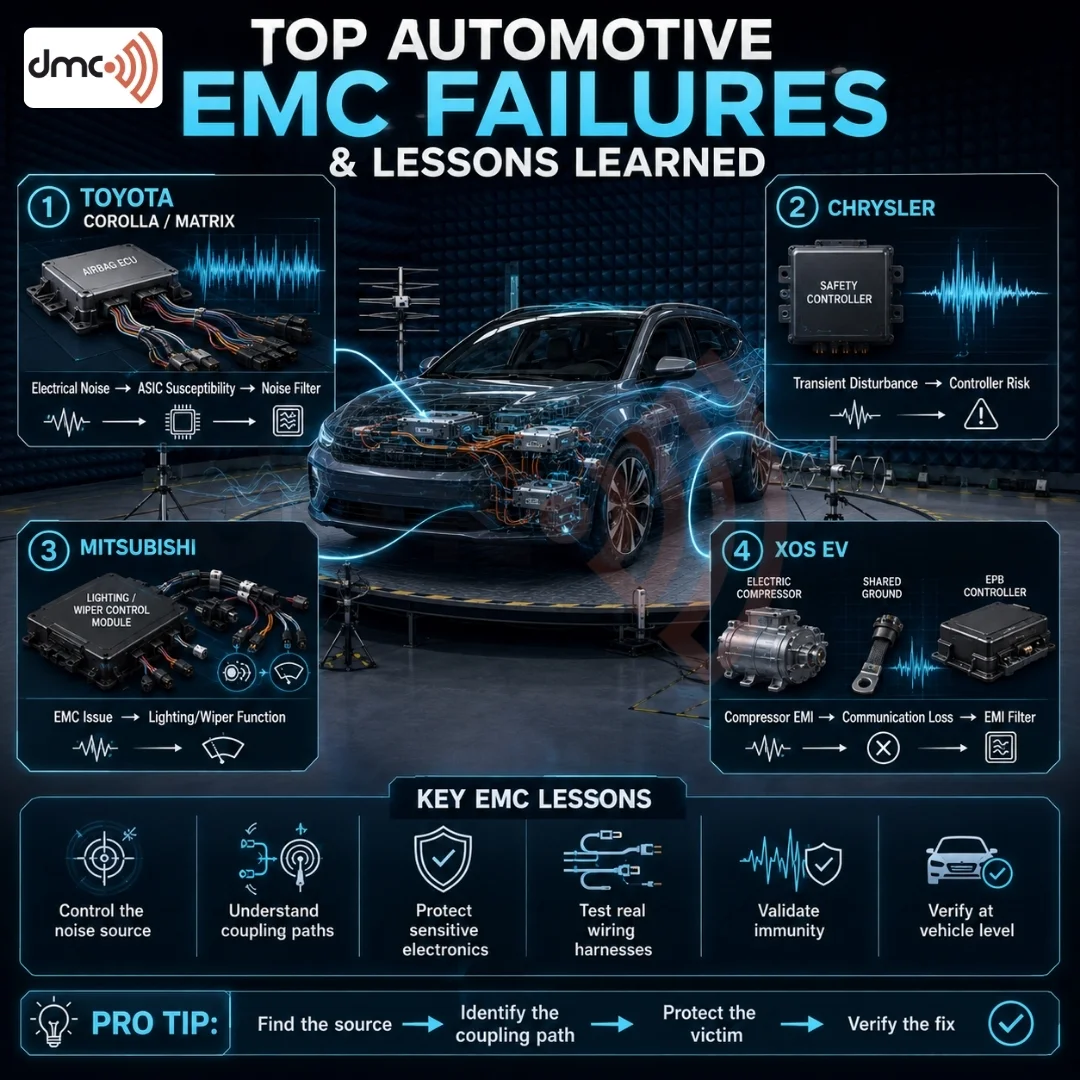
1. Toyota Corolla and Matrix Airbag Noise Issue
One of the clearest documented examples involved certain 2003–2004 Toyota Corolla and Matrix vehicles. NHTSA documents describe investigations into inadvertent airbag deployments associated with damage to an application-specific integrated circuit (ASIC) inside the airbag control module. Toyota found that electrical noise produced by vehicle electrical components could resonate and become more severe at the ASIC. Testing showed that the ASIC could be susceptible to latch-up under certain microsecond-level noise conditions.
The corrective action was practical: Toyota installed a noise filter between the airbag control module and its wiring harness. The lesson is important because the failure was not simply “too much radio energy.” It involved conducted electrical disturbances, circuit susceptibility, component characteristics, and the interaction of the vehicle wiring environment.
2. Chrysler Electrical-Transient Lessons
Automotive EMC engineering must also consider fast electrical transients. Motors, solenoids, relays, ignition systems, and switching devices can generate disturbances through shared power and ground networks. A safety-critical controller can fail even when steady-state measurements look acceptable.
Documented automotive EMC research has highlighted Chrysler airbag-related problems associated with electrical transients. The broader lesson is that immunity testing must represent realistic transient sources and system configurations rather than relying only on clean laboratory power.
Key lessons include:
- Map current paths, return paths, and shared grounds early.
- Test worst-case switching events, not only nominal operation.
- Evaluate filters under realistic load conditions.
- Check PCB protection and grounding at component level.
- Validate safety-critical modules with system-level testing.
3. Mitsubishi Lighting and Wiper Control Problems
In 2015, Mitsubishi recalled more than 53,000 vehicles for a condition involving loss of lights and/or windshield wipers. Research literature discussing automotive EMC has identified the event as an example of electromagnetic compatibility problems involving an electronic control module. NHTSA recall records confirm a campaign involving 53,396 vehicles.
The lesson is broader than the campaign: lighting and wiping may share controllers, wiring, grounds, or switching events. A disturbance that seems harmless in one subsystem can become a functional problem in another.
This is why automotive EMC validation should examine the complete electrical architecture. Engineers should consider cable routing, connector design, grounding, filtering, enclosure effects, and software behavior together.
4. Xos Electric Vehicles: A Modern EMI Example
A more recent and unusually direct example came from Xos electric vehicles. A 2023 NHTSA safety recall report states that electromagnetic interference generated by an air-conditioning compressor shared a ground with an electronic parking-brake controller. The EMI could cause communication loss between the controller and the vehicle controller. The report states that an EMI filter had not been installed with the controller.
Testing identified EMI as a contributing mechanism, and the remedy addressed hardware filtering.
This case demonstrates a modern EV challenge: high-power electrical equipment can coexist with low-level control electronics in a compact architecture. As electric vehicles add inverters, compressors, DC-DC converters, motors, chargers, and high-speed networks, controlling coupling paths becomes increasingly important.
What These Failures Teach Automotive Engineers
Across these cases, several patterns appear. EMC failures often emerge at interfaces: power and ground networks, wiring harnesses, connectors, PCB interfaces, or shared controllers. The source may be a motor, compressor, switching load, or another electronic subsystem. The victim may be an ECU, sensor interface, communication link, or safety controller.
A strong automotive EMC program should examine:
- Emissions from every major electronic subsystem.
- Immunity of safety-critical electronics.
- Conducted disturbances on power and signal wiring.
- Radiated susceptibility from internal and external RF sources.
- Transient behavior during switching, startup, shutdown, and fault conditions.
- Harness routing, shielding, bonding, grounding, and connector performance.
- Software responses when communication becomes corrupted or unavailable.
ISO 11452 covers component immunity methods for road vehicles, including absorber-lined shielded enclosures, harness excitation, magnetic-field immunity, and portable-transmitter immunity. UNECE Regulation No. 10 addresses vehicle EMC and electrical/electronic units.
EMC Failures Are Usually System Failures
The biggest mistake is treating EMC as a final compliance test. A vehicle can pass component testing and still develop problems after wiring, grounding, software, enclosure, or subsystem changes.
Engineers should build EMC controls into the design process:
- Define EMC requirements before hardware selection.
- Identify high-energy noise sources and sensitive circuits.
- Simulate or measure current return paths.
- Test representative harnesses and connectors.
- Perform component and subsystem immunity tests.
- Repeat tests after mechanical or software changes.
- Confirm fixes at vehicle level.
Anechoic and absorber-lined test environments are valuable because they provide controlled, repeatable conditions for immunity and radiated testing. Laboratory results must still reflect vehicle configurations, including harnesses, loads, grounding, and operating modes. ISO 11452-2 specifically describes absorber-lined shielded enclosure testing for automotive electronic components and wiring harnesses.
Pro Tip
Do not wait for a full vehicle EMC test to discover a coupling problem. Use staged testing: characterize the source, identify the coupling path, expose the susceptible circuit, and then verify the countermeasure. This makes troubleshooting faster and helps prevent expensive late-stage redesigns.
Final Takeaway
The history of automotive EMC failures shows that interference is rarely just a single-component problem. It is usually an interaction between source, coupling path, victim, operating condition, and system architecture. Toyota’s airbag noise investigations, Mitsubishi’s control-module example, and the Xos EMI-related parking-brake recall each demonstrate a different version of the same principle: electrical compatibility must be engineered, measured, and verified.
For manufacturers developing advanced vehicles, especially EVs and software-defined platforms, EMC testing should be treated as part of functional reliability—not as paperwork at the end of development. Diamond Microwave Chambers Ltd supports controlled RF and EMC test environments that can help engineering teams investigate emissions, immunity, shielding, and repeatability before problems reach production.
Frequently Asked Questions
Automotive EMC failures occur when electronic systems either generate excessive electromagnetic disturbances or fail to operate correctly when exposed to electromagnetic or electrical disturbances.
Common causes include poor grounding, inadequate filtering, wiring-harness coupling, switching transients, insufficient shielding, PCB design issues, connector problems, and inadequate immunity testing.
EVs contain high-power switching systems such as traction inverters, electric motors, compressors, chargers, and DC-DC converters. These systems can create electromagnetic disturbances that may affect nearby control electronics.
Automotive EMC programs commonly use standards and regulations such as the ISO 11452 series and UNECE Regulation No. 10, depending on the component, vehicle, market, and applicable requirements.
Prevention starts during design with proper grounding, shielding, filtering, PCB layout, harness routing, and source-control strategies, followed by component, subsystem, and vehicle-level EMC testing.