

Table of Contents
- What is Predictive Analytics in Chamber Maintenance
- Why Chamber Performance Monitoring Matters
- How Predictive Analytics Can Support Maintenance
- What Data Should Be Monitored
- Predictive Analytics vs Scheduled Maintenance
- Benefits for RF and EMC Laboratories
- The Future of Chamber Maintenance
Modern RF and EMC laboratories depend on predictive analytics for chamber maintenance and calibration to make maintenance decisions based on measured performance rather than relying only on fixed schedules. Anechoic chambers, RF shielded enclosures, antennas, absorbers, turntables, cables, and measurement equipment can change over time because of use, environmental conditions, component ageing, physical damage, or configuration changes.
Predictive analytics does not replace calibration or formal chamber validation. Instead, it provides another layer of information by analysing historical measurements and identifying trends that may deserve technical investigation. This approach can help laboratories plan maintenance, reduce unexpected interruptions, and maintain consistent testing practices.
What is Predictive Analytics in Chamber Maintenance?
Predictive analytics uses historical and current data to identify patterns that may indicate a developing performance issue. In an RF or EMC test environment, this could include repeated measurements of chamber performance, equipment status, environmental conditions, or maintenance records.
For example, a laboratory may track:
- Site attenuation or other chamber-performance measurements
- Antenna calibration history
- Cable and connector performance
- Absorber inspection records
- Shielding-related observations
- Turntable or positioner performance
- Measurement-system error trends
- Temperature and humidity records
- Previous maintenance activities
The purpose is not to assume that every change represents a failure. Instead, unusual trends can trigger a technical review before they become a significant operational problem.
Why Chamber Performance Monitoring Matters
A chamber is designed to provide a controlled electromagnetic environment for specific measurements. Its performance depends on the chamber structure, absorber installation, shielding, antennas, cables, positioning systems, and measurement equipment.
ETSI TS 102 321 describes chamber verification as a process for demonstrating suitability as a free-field test site. The procedure includes transmitting a known signal using a calibrated antenna and measuring the received signal with another calibrated antenna.
This illustrates an important principle: chamber performance should be demonstrated through appropriate measurements, not assumed from age or appearance alone.
Predictive analytics can support this process by organizing historical measurement results and highlighting changes that warrant investigation.
How Predictive Analytics Can Support Maintenance
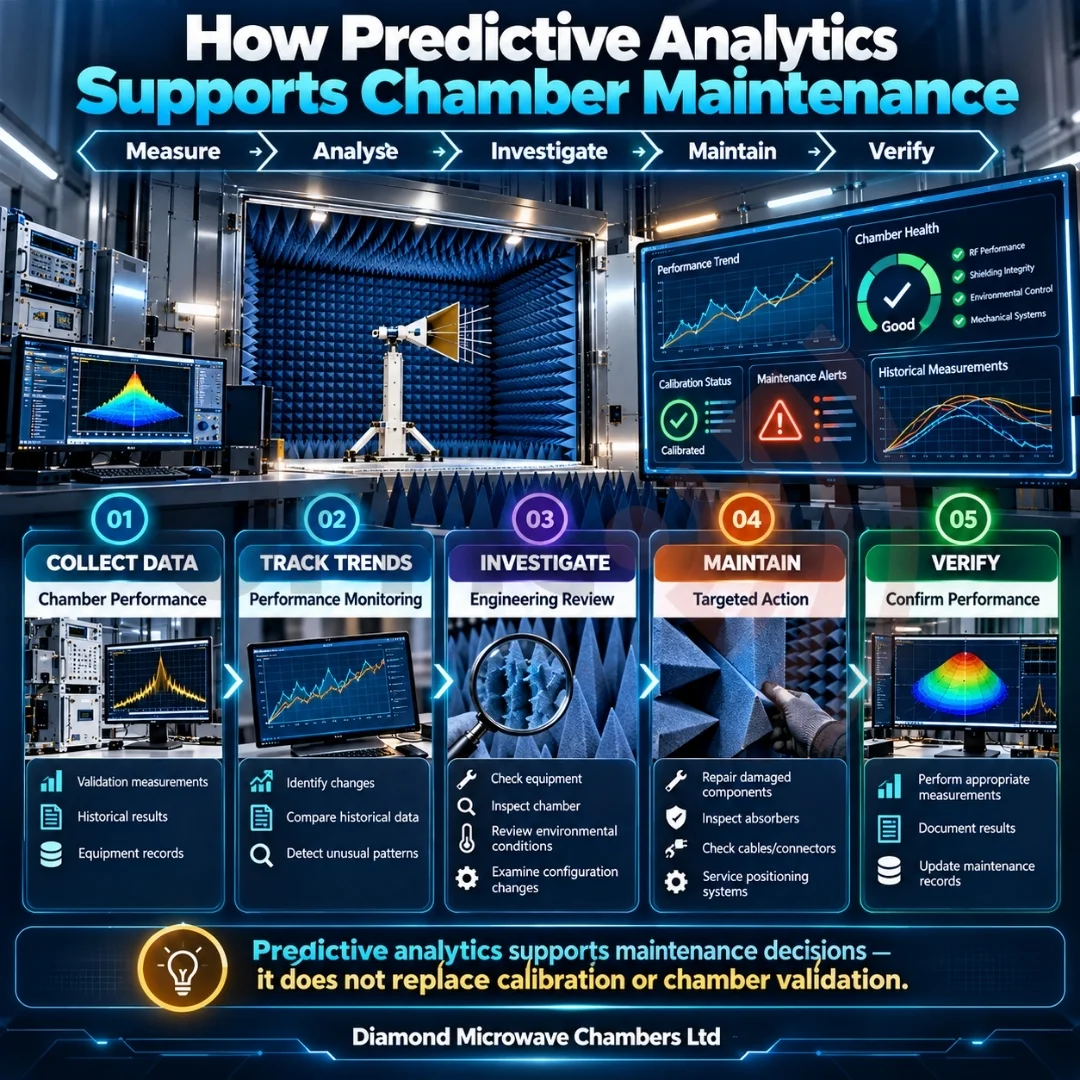
A useful predictive-maintenance program begins with reliable data. The laboratory can establish a baseline from previous measurements and compare new results against appropriate technical criteria.
A typical workflow can include:
- Collect performance dataRecord relevant chamber measurements, equipment information, environmental data, and maintenance activities.
- Establish a baselineDetermine normal performance ranges using valid historical measurements.
- Identify trendsLook for gradual changes, repeated deviations, or unusual measurement patterns.
- Investigate anomaliesEngineers review whether the change could result from equipment, chamber configuration, environmental conditions, or measurement uncertainty.
- Schedule appropriate actionIf investigation confirms a developing issue, maintenance or further verification can be planned.
- Record the outcomeAdd the inspection, corrective action, and subsequent measurement to the historical record.
This creates a feedback loop between measurement, analysis, maintenance, and verification.
What Data Should Be Monitored?
Not every laboratory needs the same predictive model. The appropriate data depends on chamber type, testing scope, equipment, applicable standards, and laboratory procedures.
| Data Category | Example Information | Maintenance Value |
|---|---|---|
| Chamber performance | Historical validation measurements | Detects performance trends |
| Antennas | Calibration records and factors | Supports measurement reliability |
| Cables | Inspection and replacement history | Identifies ageing-related concerns |
| Absorbers | Physical condition and inspection | Helps identify damaged areas |
| Shielding | Door, seams, penetrations and vents | Supports investigation of shielding issues |
| Positioning systems | Turntable/antenna position data | Identifies mechanical irregularities |
| Environment | Temperature and humidity | Provides contextual information |
| Maintenance | Repairs and component changes | Links interventions to later results |
The data should be traceable and recorded consistently. Poor-quality historical data can produce misleading patterns.
Predictive Analytics vs Scheduled Maintenance
Predictive analytics should not be treated as a replacement for scheduled maintenance or required calibration.
Scheduled maintenance provides a planned framework for inspecting equipment and facilities. Predictive analytics adds a data-driven layer that can help determine where additional attention may be useful.
For example, if a component has a predefined inspection interval, that interval should not simply be ignored because historical data appears stable. Similarly, a predictive model should not be used to declare equipment calibrated.
Calibration and validation remain technical activities that must follow the applicable procedures, standards, and laboratory quality system.
ISO/IEC 17025:2017 establishes requirements for the competence, impartiality, and consistent operation of testing and calibration laboratories and is intended to support reliable results.
Using Analytics to Improve Calibration Planning
Calibration programs generate valuable historical information. Dates, results, measurement conditions, certificates, equipment identifiers, and previous adjustments can provide a useful dataset for analysis.
A laboratory can use this information to identify:
- Instruments that frequently require adjustment
- Equipment showing gradual measurement changes
- Repeated maintenance issues
- Components with recurring failures
- Patterns associated with environmental conditions
- Differences between expected and observed performance
However, analytics should support—not replace—the laboratory’s calibration procedures and technical judgment.
A trend indicating stable performance does not automatically extend a calibration interval. Any change to calibration intervals should be justified through the laboratory’s documented procedures, applicable requirements, risk assessment, and technical evidence.
Pro Tip
Build your predictive-maintenance system around verified measurements, not assumptions.
Start with a small number of important parameters, maintain consistent measurement procedures, and document every maintenance intervention. Over time, the resulting dataset becomes more useful for identifying meaningful trends.
Avoid creating complicated AI models before establishing reliable baseline data. In many laboratories, a simple trend chart or threshold-based alert can provide useful information before advanced machine-learning techniques are introduced.
Benefits for RF and EMC Laboratories
When implemented appropriately, predictive analytics can help laboratories make maintenance planning more systematic.
Potential benefits include:
- Earlier identification of unusual performance trends
- Better visibility into equipment history
- More organized maintenance planning
- Improved documentation and traceability
- Reduced dependence on memory or manual records
- Better understanding of recurring technical issues
- More informed engineering investigations
- Potential reduction in unexpected downtime
These benefits depend heavily on data quality, measurement consistency, suitable technical criteria, and competent review.
Implementing Predictive Analytics at Diamond Microwave Chambers Ltd
For organizations working with Diamond Microwave Chambers Ltd, predictive analytics can be considered as part of a broader chamber-performance and maintenance strategy.
The practical approach should begin with understanding the chamber’s intended application and applicable test requirements. From there, relevant measurements and maintenance records can be organized into a structured historical dataset.
The process may include:
- Defining critical chamber-performance parameters
- Establishing measurement baselines
- Recording inspection and maintenance activities
- Tracking equipment calibration information
- Reviewing performance trends
- Investigating significant deviations
- Performing required maintenance
- Conducting appropriate verification after changes
A key principle is that analytics should assist qualified engineers rather than automatically determine whether a chamber is acceptable for testing.
The Future of Chamber Maintenance
As RF testing becomes increasingly data-driven, laboratories have more opportunities to combine measurement records, maintenance history, equipment information, and environmental data.
Artificial intelligence and machine-learning methods may eventually help identify complex relationships within large datasets. However, the foundation remains the same: accurate measurements, controlled procedures, traceable records, and competent technical review.
For chamber operators, the most valuable objective is not simply predicting when something will fail. It is developing a clearer understanding of how chamber performance changes over time and when additional technical investigation is justified.
Conclusion
Predictive analytics for chamber maintenance and calibration can provide laboratories with a structured way to examine historical performance and identify trends that deserve attention. It can complement scheduled maintenance, calibration, and chamber validation by providing additional evidence for maintenance planning.
The technology should be used responsibly. Predictive models cannot replace calibration certificates, required chamber validation, applicable standards, or qualified engineering decisions. Instead, they can help laboratories turn reliable historical data into useful maintenance intelligence.
For RF and EMC facilities seeking better visibility into chamber performance, combining accurate measurement practices with structured data analysis can create a more proactive approach to maintaining testing infrastructure.
Frequently Asked Questions
Predictive analytics uses historical chamber, equipment, environmental, and maintenance data to identify trends or unusual changes that may require technical investigation.
No. Predictive analytics can support maintenance planning, but it does not replace required calibration, chamber validation, or verification procedures.
Potential datasets include chamber-performance measurements, antenna calibration records, cable inspections, absorber condition, shielding observations, environmental information, positioning-system records, and maintenance history.
It can help organize historical information, identify performance trends, highlight unusual changes, and support more informed maintenance planning.
The approach can be adapted to different facilities, but the useful parameters and analysis methods depend on the chamber design, testing scope, applicable requirements, equipment, and quality procedures.