
Table of Contents
- Why Sustainability Matters in EMC Labs
- How RF Absorbers Support Efficient Testing
- Designing a Sustainable EMC Chamber
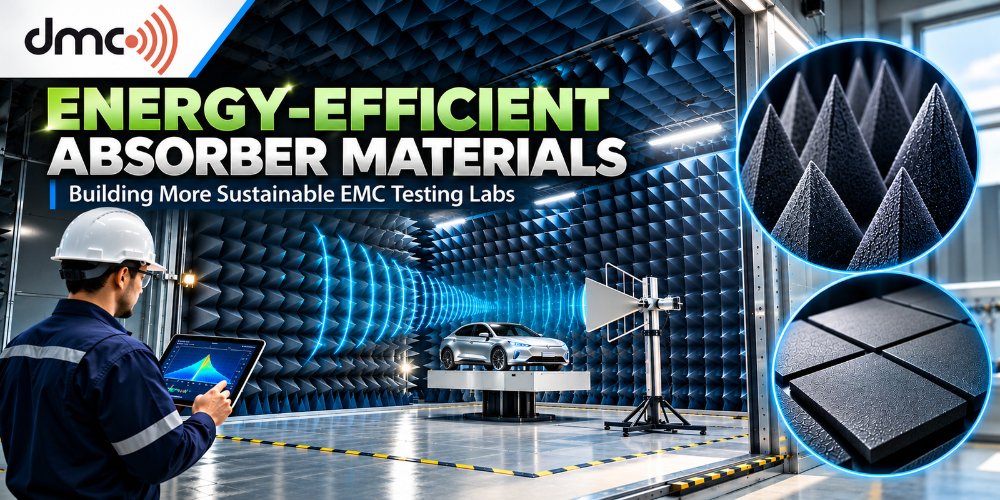
Electromagnetic compatibility (EMC) laboratories are designed to create controlled environments where unwanted reflections are minimized and equipment can be tested consistently. At the center of this environment are RF absorber materials, which reduce reflected electromagnetic energy inside anechoic and semi-anechoic chambers. As laboratories look for more sustainable operations, energy-efficient absorber materials are becoming an important part of chamber design. Diamond Microwave Chambers Ltd helps organizations evaluate absorber technologies around their actual testing requirements.
Why Sustainability Matters in EMC Labs
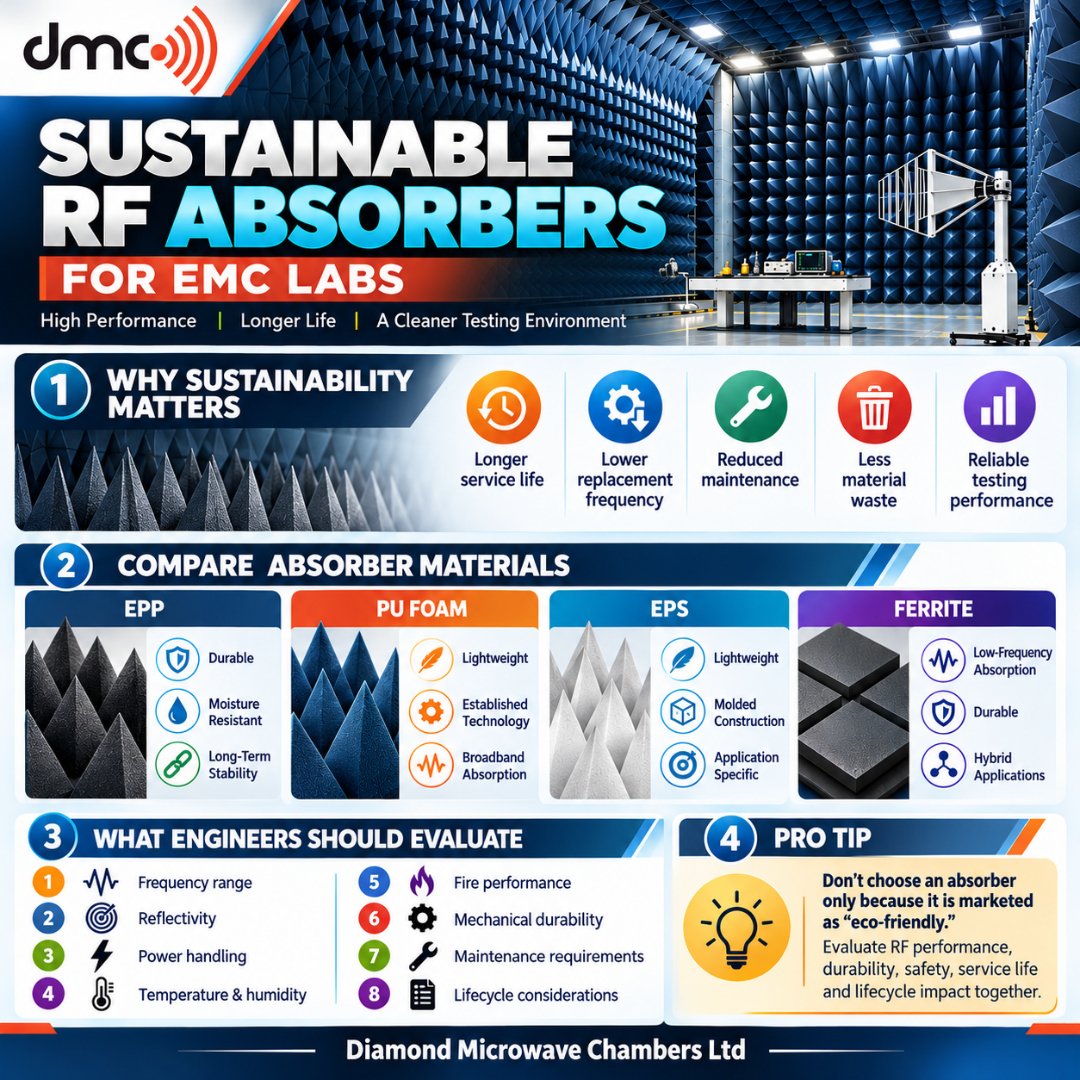
An EMC laboratory consumes resources throughout its operating life. Energy is used for HVAC, lighting, instrumentation, test equipment, and environmental control. Materials also have an environmental footprint from manufacturing, transportation, installation, maintenance, and eventual replacement. Absorbers can influence sustainability because their service life and maintenance requirements determine how often materials need to be repaired or replaced.
A sustainable chamber therefore considers lifecycle performance. An absorber that maintains its physical and electromagnetic properties for a long period may reduce replacement-related material use, downtime, installation work, and waste. However, sustainability should never be treated as a substitute for technical validation. Frequency range, reflectivity, power handling, fire performance, temperature, humidity, mechanical durability, and chamber geometry must remain central to the selection process.
How RF Absorbers Support Efficient Testing
RF absorbers work by reducing electromagnetic reflections inside the test area. Carbon-loaded foam absorbers use dielectric loss, while ferrite materials provide magnetic loss and are particularly useful toward the lower-frequency range. Hybrid chamber designs can combine ferrite and pyramidal absorbers to provide broader coverage.
Effective absorption helps create a controlled electromagnetic environment, which supports repeatable measurements. Its sustainability value is more closely connected to material efficiency, durability, maintenance, and lifecycle management.
Important benefits to evaluate include:
- Stable electromagnetic performance over the expected service period
- Reduced frequency of absorber replacement
- Lower maintenance and installation disruption
- Resistance to moisture, temperature changes, and mechanical wear
- Appropriate fire and safety performance
- Material compliance requirements such as RoHS or REACH where applicable
EPP, PU, EPS and Ferrite: What Should Labs Consider?
There is no single absorber material that is best for every EMC laboratory. Polyurethane (PU) foam is widely used for RF absorption because its porous structure and conductive loading can provide effective broadband performance. Expanded polystyrene (EPS) is another established option. Expanded polypropylene (EPP) is increasingly considered where mechanical durability, moisture resistance, cleanroom suitability, and long-term stability are priorities. Ferrite tiles are commonly used in hybrid configurations, particularly where low-frequency absorption is required.
Diamond Microwave Chambers Ltd offers EPP absorber solutions with published performance options extending across wide frequency ranges. Its high-performance EPP pyramidal absorbers include specifications such as broad frequency coverage, water resistance, fire-retardant performance, and RoHS and REACH compliance.
| Material | Characteristic | Sustainability consideration |
|---|---|---|
| EPP | Durable closed-cell polymer structure | Long service life and moisture resistance can support lower replacement needs |
| PU foam | Lightweight, established RF absorber technology | Suitable where performance, cost, and environmental conditions are well matched |
| EPS | Lightweight molded absorber option | Useful for selected applications; lifecycle and environmental requirements should be assessed |
| Ferrite | Magnetic absorption, especially at lower frequencies | Durable and long-lasting, but heavier and more structurally demanding |
| Hybrid | Combines ferrite and foam-based absorption | Can optimize broadband performance and material placement |
Pro Tip: Do not select an absorber only because it is called “eco-friendly.” Compare its verified RF performance, durability, safety certifications, maintenance needs, expected service life, and end-of-life options against the requirements of your chamber.
Designing a Sustainable EMC Chamber
Design the absorber system around the test program. Automotive EMC Chamber, antenna, wireless, aerospace, and high-power RF facilities can have different requirements.
Start by defining the frequency range and required measurement performance. Then consider absorber type, thickness, geometry, placement, power density, environmental conditions, and accessibility for maintenance. Hybrid arrangements can balance low-frequency and broadband performance.
Sustainability can also be improved through maintenance. Routine inspection can identify damaged or degraded absorber sections before they affect chamber performance. Replacing only damaged modules, where the design allows it, can reduce unnecessary material waste.
Future of Sustainable RF Absorbers
Research is moving beyond conventional absorber materials. Studies are investigating waste-derived composites, bio-based fillers, recycled materials, multilayer structures, and metamaterial approaches for electromagnetic absorption. Recent research has demonstrated waste-derived microwave absorber concepts, while other 2026 research has explored sustainable biowaste-based absorber structures for X-band applications.
These developments are promising, but practical EMC applications require repeatable manufacturing, environmental durability, safety validation, and reliable performance across the intended frequency range.
Sustainability should be achieved without compromising test accuracy or compliance. New materials may become useful as manufacturing and validation methods mature, while established materials remain important for current chamber projects.
Conclusion
Energy-efficient absorber materials can contribute to more sustainable EMC laboratories when they are selected as part of a complete lifecycle strategy. EPP, PU, EPS, ferrite, and hybrid solutions each have different technical and environmental considerations. The best choice depends on frequency, chamber configuration, environmental conditions, durability, safety, and maintenance.
Diamond Microwave Chambers Ltd can help organizations planning new chambers, upgrading existing absorbers, or evaluating long-term sustainability align absorber selection with RF and EMC testing requirements. A well-engineered absorber system should deliver electromagnetic performance while supporting long service life and responsible resource use.
Frequently Asked Questions
Energy-efficient absorber materials are RF-absorbing materials selected not only for electromagnetic performance but also for durability, maintenance requirements, service life, and lifecycle resource efficiency.
EPP can support sustainability goals where its durability, moisture resistance, and long service life reduce replacement and maintenance requirements. Sustainability should still be assessed across the complete product lifecycle.
Neither is universally better. Ferrite is particularly useful for lower-frequency absorption, while pyramidal foam absorbers provide broadband performance at higher frequencies. Hybrid systems can combine both technologies.
Regular inspections, modular installation, timely repairs, and replacing only damaged sections where possible can reduce unnecessary material replacement and chamber downtime.
Consider the operating frequency range, required reflectivity, chamber size, power density, environmental conditions, fire requirements, durability, maintenance access, and applicable compliance requirements before selecting an absorber.