
Table of Contents
- Why EMC Testing Matters for Connected Vehicles
- Key Automotive Systems Requiring EMC Evaluation
- Common Standards Used in Automotive EMC Testing
- How Automotive Bluetooth, GPS & Telematics EMC Testing Works
- Challenges in Modern Automotive Connectivity
- Choose the Right EMC Testing Environment
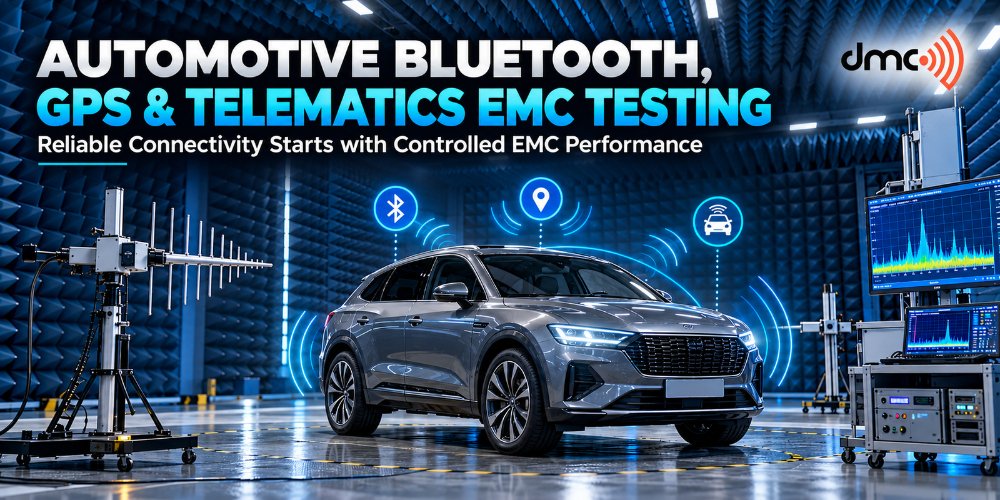
Modern vehicles rely on wireless and electronic systems for communication, navigation, safety, entertainment and connected services. Automotive Bluetooth, GPS & telematics EMC testing helps manufacturers identify electromagnetic interference (EMI) problems before they affect vehicle functions, wireless communication or customer experience.
Bluetooth modules, GPS/GNSS receivers, telematics control units, antennas, infotainment systems and connected vehicle technologies can operate close to many other electronic systems. Motors, switching electronics, processors, displays, power converters and communication networks can generate electromagnetic disturbances. Without appropriate EMC evaluation, unwanted emissions can interfere with sensitive receivers or cause wireless systems to perform unpredictably.
For automotive manufacturers and component suppliers, EMC testing is therefore an important part of developing reliable electronic systems.
Why EMC Testing Matters for Connected Vehicles
A connected vehicle contains numerous electronic systems operating simultaneously. The challenge is not simply making each system function independently; the systems must also coexist without creating unacceptable electromagnetic interference.
For example, a telematics control unit may communicate with external networks while a GPS receiver continuously processes satellite signals. Bluetooth may be active at the same time as Wi-Fi, cellular communication, digital displays and vehicle control electronics.
Automotive EMC testing helps engineers evaluate:
- Conducted electromagnetic emissions
- Radiated electromagnetic emissions
- Radiated immunity
- Conducted immunity
- Interaction between electronic modules
- Performance of wireless and navigation systems
- Potential interference affecting vehicle receivers
CISPR 25:2021 specifically addresses radio disturbance characteristics and measurement methods intended to protect on-board receivers, including GPS, Bluetooth, Wi-Fi and other receiver technologies.
Key Automotive Systems Requiring EMC Evaluation
Several connected vehicle technologies can require EMC consideration depending on the vehicle architecture, component specifications and applicable customer or regulatory requirements.
Bluetooth Systems
Bluetooth is widely used for hands-free calling, audio streaming, device connectivity and other in-vehicle functions. EMC evaluation helps determine whether nearby electronics create interference that could affect communication quality or whether the Bluetooth system contributes unwanted disturbances.
GPS and GNSS Receivers
GPS/GNSS receivers process relatively weak signals from satellites. Electromagnetic noise generated elsewhere in the vehicle can potentially reduce receiver performance.
CISPR 25 includes consideration of disturbances affecting satellite navigation receivers, including GPS-related frequency bands.
Telematics Control Units
Telematics systems can combine cellular connectivity, GNSS, Bluetooth, Wi-Fi and vehicle-network communication. Their multiple interfaces make EMC planning particularly important.
Testing can help engineers investigate whether the unit maintains expected performance when exposed to electromagnetic disturbances.
Infotainment and Connectivity Modules
Infotainment systems may incorporate several wireless technologies within one platform. EMC testing helps assess emissions and immunity while the system operates under defined test conditions.
Common Standards Used in Automotive EMC Testing
The exact test program depends on the component, vehicle manufacturer requirements and target market. Two important standards frequently encountered in automotive component EMC work are CISPR 25 and ISO 11452.
| Standard | Main Focus | Typical Application |
|---|---|---|
| CISPR 25 | Radio disturbance emissions | Vehicle and component emissions |
| ISO 11452-1 | General principles for radiated immunity testing | Automotive component immunity |
| ISO 11452-2 | Radiated immunity using absorber-lined shielded enclosure | Component-level immunity |
| Customer/OEM specifications | Additional requirements | Supplier and vehicle programs |
CISPR 25:2021 covers conducted and radiated disturbance measurements for vehicles and components, with the current edition extending measurement coverage to 5 925 MHz.
ISO 11452-1:2025 defines general principles for component testing against continuous narrowband radiated electromagnetic fields, while ISO 11452-2:2019 specifies an absorber-lined shielded enclosure method for radiated immunity testing.
Pro Tip: Do not select an EMC test solely because it is commonly used in the automotive industry. Define the test plan around the component’s function, installation location, interfaces, operating modes, applicable standards and OEM requirements.
How Automotive Bluetooth, GPS & Telematics EMC Testing Works
A typical automotive EMC evaluation begins with understanding the device under test and its intended operating conditions.
Engineers may review:
- Product architecture and operating modes
- Power supply requirements
- Communication interfaces
- Cable and harness configuration
- Antenna connections
- Mechanical installation
- Intended vehicle location
- Applicable EMC standards
- Customer-specific test limits
For emissions testing, the system is evaluated to determine the electromagnetic disturbances it produces. CISPR 25 includes both conducted and radiated emissions methods for components and modules.
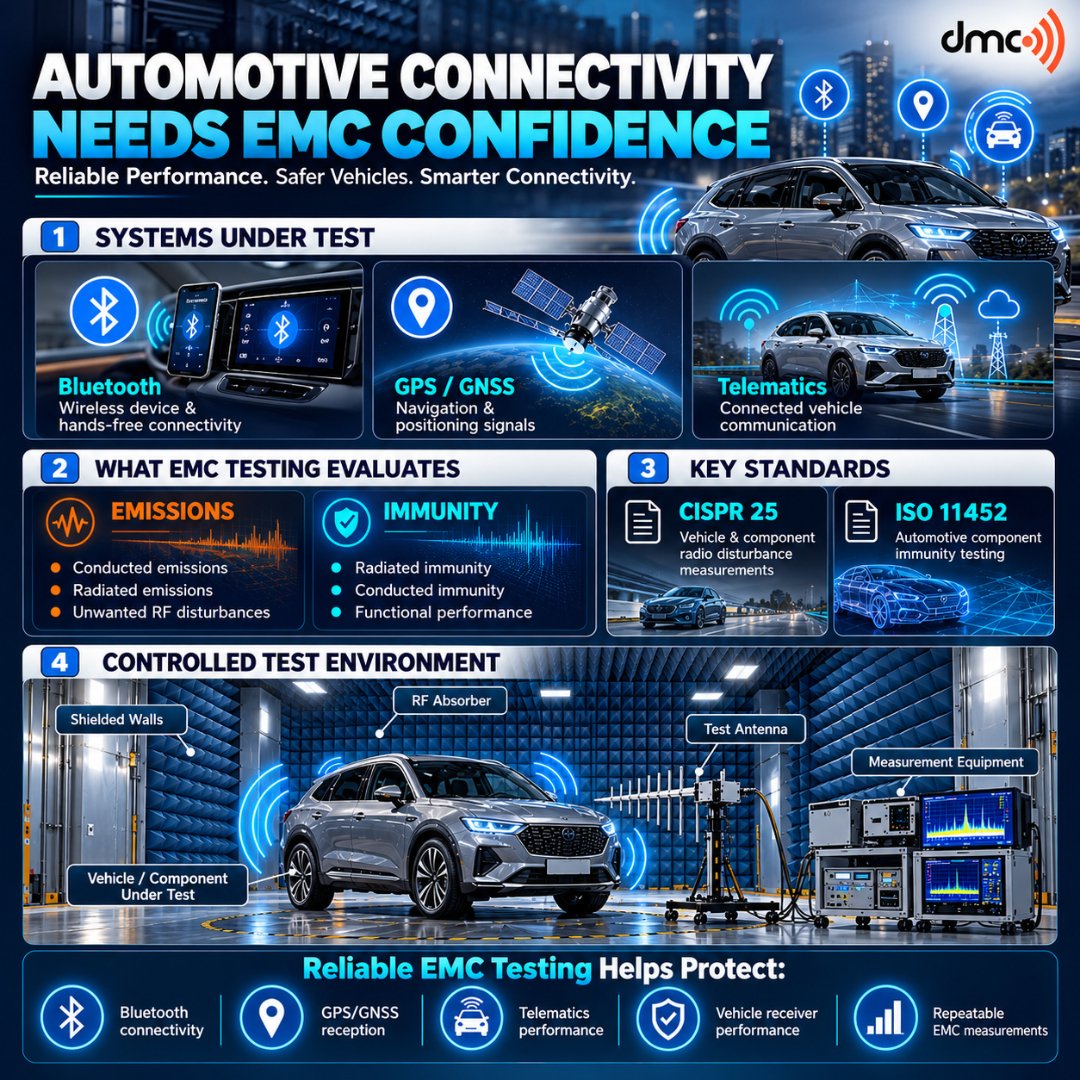
For immunity testing, controlled electromagnetic disturbances are applied to determine whether the component continues operating as intended. ISO 11452-2, for example, uses an absorber-lined shielded enclosure to expose an automotive component and associated wiring harness to an electromagnetic field.
Why the Test Environment Matters
Reliable automotive EMC measurements depend heavily on the test environment. Uncontrolled reflections, external RF signals and incorrect equipment placement can affect measurement repeatability.
An absorber-lined shielded enclosure (ALSE) provides a controlled environment for appropriate automotive EMC measurements. CISPR 25 includes requirements related to shielded enclosures and ALSE performance validation.
A properly designed test environment can help engineers achieve:
- Controlled electromagnetic conditions
- Reduced unwanted reflections
- Repeatable measurements
- Better isolation from external RF signals
- More reliable emission measurements
- Controlled immunity test conditions
This is where the expertise of Diamond Microwave Chambers Ltd can support automotive EMC test-environment requirements.
Challenges in Modern Automotive Connectivity
Connected vehicle systems are becoming increasingly integrated. A single electronic module may support multiple wireless technologies while communicating with several vehicle systems.
This creates potential EMC challenges such as:
- Multiple RF technologies operating together
Bluetooth, cellular, Wi-Fi and GNSS systems may operate within the same vehicle environment. - Sensitive navigation receivers
GNSS receivers must process weak satellite signals while operating close to numerous electronic sources. - Complex wiring harnesses
Harness routing, grounding and installation can influence electromagnetic coupling. - High-speed electronics
Digital processors and switching circuits can generate unwanted electromagnetic disturbances. - Different operating modes
EMC performance can change depending on software, communication activity, charging, engine state or other operating conditions.
CISPR 25 notes that component testing does not replace vehicle-level testing because actual vehicle performance can depend on factors such as mounting location, harness routing, grounding and antenna location.
Building EMC Confidence Before Vehicle Integration
Testing components before complete vehicle availability can help identify design issues earlier. Engineers can investigate shielding, grounding, filtering, cable routing and other design measures before the system reaches later validation stages.
A practical approach is to:
- Define EMC requirements early
- Identify critical wireless interfaces
- Establish operating modes
- Select appropriate standards and customer requirements
- Perform pre-compliance testing where useful
- Investigate failures systematically
- Validate the final design under applicable compliance conditions
- Maintain clear test documentation
For automotive suppliers, early EMC evaluation can reduce the risk of discovering interference problems late in the development cycle.
Choose the Right EMC Testing Environment
Automotive Bluetooth, GPS and telematics systems depend on reliable electromagnetic performance. EMC testing provides engineers with evidence about how components behave in controlled electromagnetic conditions and helps identify potential compatibility problems.
The right chamber, absorber configuration, instrumentation and test setup should be selected according to the required frequency range, test method, equipment under test and applicable standards.
Diamond Microwave Chambers Ltd provides RF and EMC testing environment solutions designed around specific testing requirements. From absorber-lined shielded environments to specialized RF and EMC chamber solutions, the test environment should be engineered around the application rather than treated as a one-size-fits-all installation.
For automotive electronics, the goal is simple: reliable connectivity, controlled electromagnetic performance and repeatable testing.
Frequently Asked Questions
It is the evaluation of automotive electronic systems for electromagnetic emissions and immunity to help ensure reliable operation and electromagnetic compatibility within the vehicle environment.
GPS/GNSS receivers process weak satellite signals and can be affected by electromagnetic disturbances from nearby electronics. EMC testing helps identify potential interference risks.
Yes. CISPR 25:2021 addresses protection of on-board receivers and specifically identifies receiver types including satellite navigation, Wi-Fi and Bluetooth.
The ISO 11452 series provides automotive component immunity test methods. ISO 11452-2 specifically addresses radiated immunity testing using an absorber-lined shielded enclosure.
No. Component testing can identify issues before vehicle integration, but vehicle-level performance can depend on installation, grounding, harness routing and antenna location.