
Table of Contents
- What Does an EMC Test Failure Mean?
- What Happens Immediately After an EMC Failure?
- Common Reasons Products Fail EMC Testing
- Can an EMC Failure Delay Product Launch
- How Engineers Troubleshoot EMC Test Failures
- What Happens During EMC Retesting
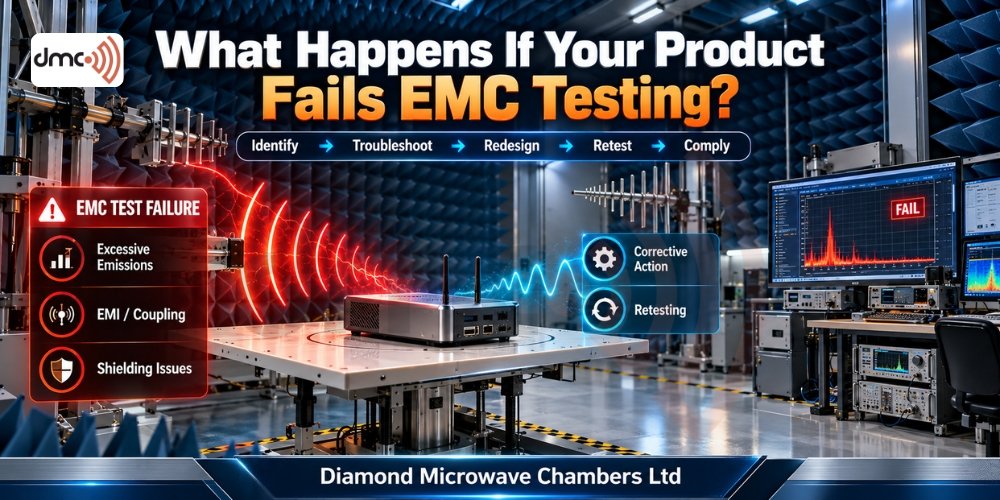
A product failing EMC testing does not necessarily mean the entire design has to be discarded. In many cases, an EMC test failure identifies a specific electromagnetic compatibility problem that engineers can investigate, correct, and verify through retesting. However, the consequences can include additional engineering work, redesign costs, testing delays, and potential compliance or market-access issues depending on the product, jurisdiction, and applicable regulations. Diamond Microwave Chambers Ltd helps manufacturers understand the controlled test environment needed to identify and address electromagnetic compatibility challenges.
EMC testing evaluates whether equipment produces excessive electromagnetic disturbances and, depending on the applicable standard, whether it can continue to operate as intended when exposed to electromagnetic disturbances. Standards such as CISPR 32 establish emission requirements for applicable multimedia equipment and emphasize reproducible and repeatable measurement procedures.
What Does an EMC Test Failure Mean?
An EMC failure generally means that the product did not meet one or more specified test limits or performance requirements during the test configuration.
The exact failure depends on the applicable standard and test program. For example, engineers may identify:
- Excessive radiated emissions
- Excessive conducted emissions
- Radiated immunity problems
- Conducted immunity problems
- Electrostatic discharge susceptibility
- Electrical fast transient or burst susceptibility
- Surge-related performance issues
- Unintended electromagnetic coupling
- Functional degradation during immunity testing
A failure should therefore be treated as engineering information, not simply as a pass-or-fail label. The test data can help identify where the design requires improvement.
What Happens Immediately After an EMC Failure?
The first step is normally to review the test results carefully rather than immediately changing components.
Engineers should examine the frequency, amplitude, operating mode, test configuration, cable arrangement, grounding, enclosure configuration, and other conditions associated with the failure.
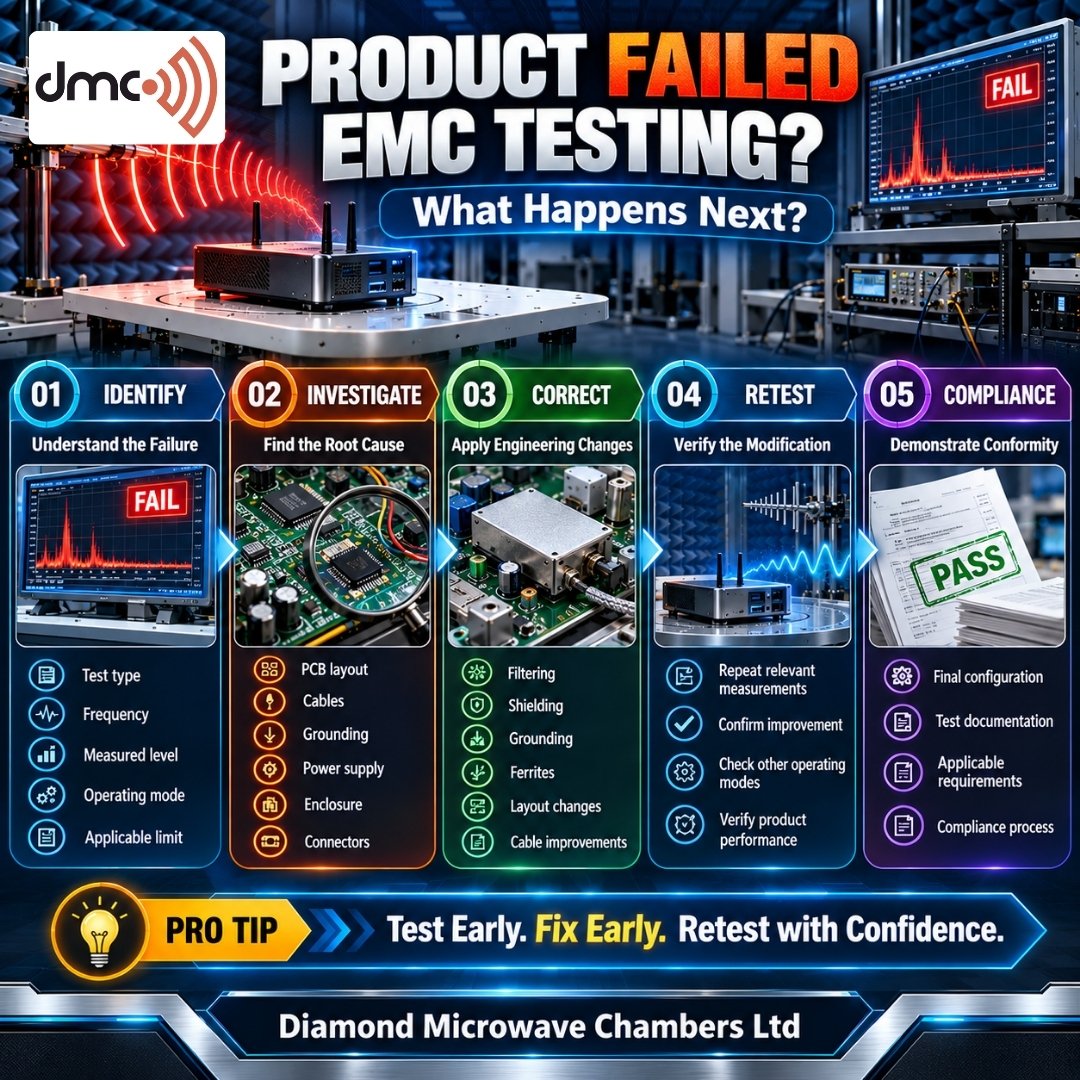
A structured investigation may include:
- Identify the exact failureDetermine which test, frequency range, limit, or performance criterion was not satisfied.
- Review the test configurationConfirm the equipment under test, cables, peripherals, software mode, loads, and operating conditions.
- Locate the noise source or susceptibility pathEngineers may investigate switching supplies, clocks, processors, motors, displays, interfaces, cables, connectors, and enclosure openings.
- Apply a controlled corrective actionPossible measures include filtering, shielding, grounding improvements, PCB layout changes, ferrites, cable modifications, or circuit changes.
- Repeat the relevant measurementsThe product should be tested again to determine whether the corrective action addressed the problem.
FCC rules also place importance on maintaining records demonstrating compliance and documenting test information for applicable equipment authorization processes.
Common Reasons Products Fail EMC Testing
EMC problems can originate from several parts of a product rather than from one obvious component.
| Common Issue | Typical Effect | Possible Engineering Response |
|---|---|---|
| Poor PCB layout | Increased emissions or coupling | Improve routing and return paths |
| Fast switching circuits | Higher-frequency noise | Review switching edges and filtering |
| Long cables | Increased radiation or susceptibility | Add filtering, shielding or ferrites |
| Enclosure gaps | RF leakage | Improve shielding and bonding |
| Inadequate filtering | Conducted emissions | Review filters and component placement |
| Poor grounding | Noise and immunity problems | Improve grounding strategy |
| Connector coupling | Noise entering or leaving product | Review interface protection |
| Insufficient pre-compliance testing | Late discovery of issues | Test earlier during development |
The correct solution depends on the measured failure and product design. A filter that reduces one emission problem, for example, may affect signal integrity, thermal performance, power consumption, or immunity characteristics.
Can an EMC Failure Delay Product Launch?
Yes. If an EMC problem requires hardware, firmware, PCB, enclosure, or cable changes, the product may require additional engineering validation before final compliance testing.
A failure can create several practical consequences:
- Additional laboratory testing
- Engineering redesign
- New PCB revisions
- Component qualification
- Mechanical modifications
- Software or operating-mode changes
- Additional verification testing
- Updated technical documentation
- Possible production schedule changes
The impact varies considerably between products. A small modification may be relatively straightforward, while a failure involving the fundamental architecture of a product can require substantial redesign.
Does an EMC Failure Mean the Product Cannot Be Sold?
Not automatically. The regulatory consequences depend on the product, market, applicable rules, conformity-assessment route, and whether the product has already been placed on the market.
For example, FCC requirements include obligations concerning applicable technical rules, records, and compliance responsibilities. The FCC has also stated that marketing noncompliant RF devices can lead to enforcement consequences.
Therefore, manufacturers should not assume that an EMC test failure has one universal legal consequence. The appropriate compliance requirements should be determined for the specific product and target market.
How Engineers Troubleshoot EMC Test Failures
Effective EMC troubleshooting is usually systematic rather than based on repeatedly changing components.
Engineers can begin by determining whether the problem is associated with:
- A particular frequency
- A particular operating mode
- A specific cable
- A switching circuit
- A clock or processor
- A power supply
- An enclosure opening
- A connector
- A grounding or bonding path
- External electromagnetic exposure
Pre-compliance EMC testing can be especially useful because problems can be identified before the final compliance stage. A controlled EMC anechoic chamber or suitable pre-compliance setup allows engineers to investigate emissions and improve the design before formal testing.
Pro Tip:
Do not wait until the final compliance test to discover EMC problems. Integrating pre-compliance testing during PCB, enclosure, and prototype development can give engineers more opportunities to identify and correct issues before the final test campaign.
What Happens During EMC Retesting?
After corrective modifications, the relevant test is repeated under the appropriate conditions. The goal is to verify that the product now satisfies the applicable requirements.
Retesting should not simply be treated as a formality. Engineers should verify that the modification did not create another EMC problem or negatively affect product performance.
For example, adding shielding may reduce radiated emissions but can affect ventilation or mechanical design. Similarly, adding filtering may reduce conducted noise while affecting power quality or signal performance.
This is why EMC compliance should be considered throughout product development rather than only at the final stage.
How to Reduce the Risk of EMC Test Failure
Manufacturers can reduce avoidable EMC problems by building electromagnetic compatibility into the design process.
Important practices include:
- Perform EMC risk reviews during product design.
- Use pre-compliance testing during prototype development.
- Review PCB grounding and return-current paths.
- Control high-speed and switching circuits carefully.
- Plan cable routing and connector filtering.
- Evaluate enclosure shielding early.
- Test representative operating modes.
- Keep detailed configuration and test records.
- Work with an experienced EMC testing partner.
Diamond Microwave Chambers Ltd provides engineering-focused solutions for controlled RF and EMC testing environments, including EMC anechoic chambers and related chamber technologies. Its experience with electromagnetic testing environments can help organisations plan facilities around their required test applications.
Conclusion
A failed EMC test is a technical warning that a product requires further investigation before compliance can be demonstrated. The failure may involve emissions, immunity, shielding, grounding, cables, PCB design, filtering, or another interaction within the system.
Instead of treating failure as the end of the development process, manufacturers can use test data to identify the underlying problem, implement controlled corrective actions, and verify the result through appropriate retesting.
Planning EMC testing, pre-compliance measurements, and design reviews early can reduce unexpected surprises near product launch. With the right testing environment and engineering approach, EMC problems can often be identified systematically and addressed before they become larger compliance and production challenges.
Frequently Asked Questions
The failure is investigated to identify the specific electromagnetic problem. Engineers may modify the PCB, filtering, grounding, shielding, cables, enclosure, or other parts of the design before retesting.
Yes. A product can be modified and retested, provided the final configuration meets the applicable requirements and the relevant compliance process is completed correctly.
Common causes include excessive radiated or conducted emissions, poor PCB layout, inadequate filtering, cable coupling, enclosure leakage, grounding problems, and immunity susceptibility.
It is not universally mandatory, but it can be a valuable engineering practice. Pre-compliance testing can identify potential problems before formal compliance testing.
Not necessarily. The regulatory consequences depend on the product, applicable regulations, conformity-assessment route, and target market. Manufacturers should determine the requirements applicable to their specific product.