
Table of Contents
- Why Is EMC Re-Testing Important
- What Changes Are Most Likely to Trigger Retesting
- Practical EMC Retesting Review
- Should EMC Testing Be Repeated Every Year
- How Diamond Microwave Chambers Ltd Can Support EMC Testing
EMC compliance is not something manufacturers should treat as a one-time checkbox. A product that passed electromagnetic compatibility testing can require additional assessment when its design, components, software, operating modes, manufacturing process, or applicable requirements change. There is no universal rule requiring every product to be fully re-tested on a fixed annual or biennial schedule. The interval depends on the product, market, standards, regulations, and changes since the previous evaluation.
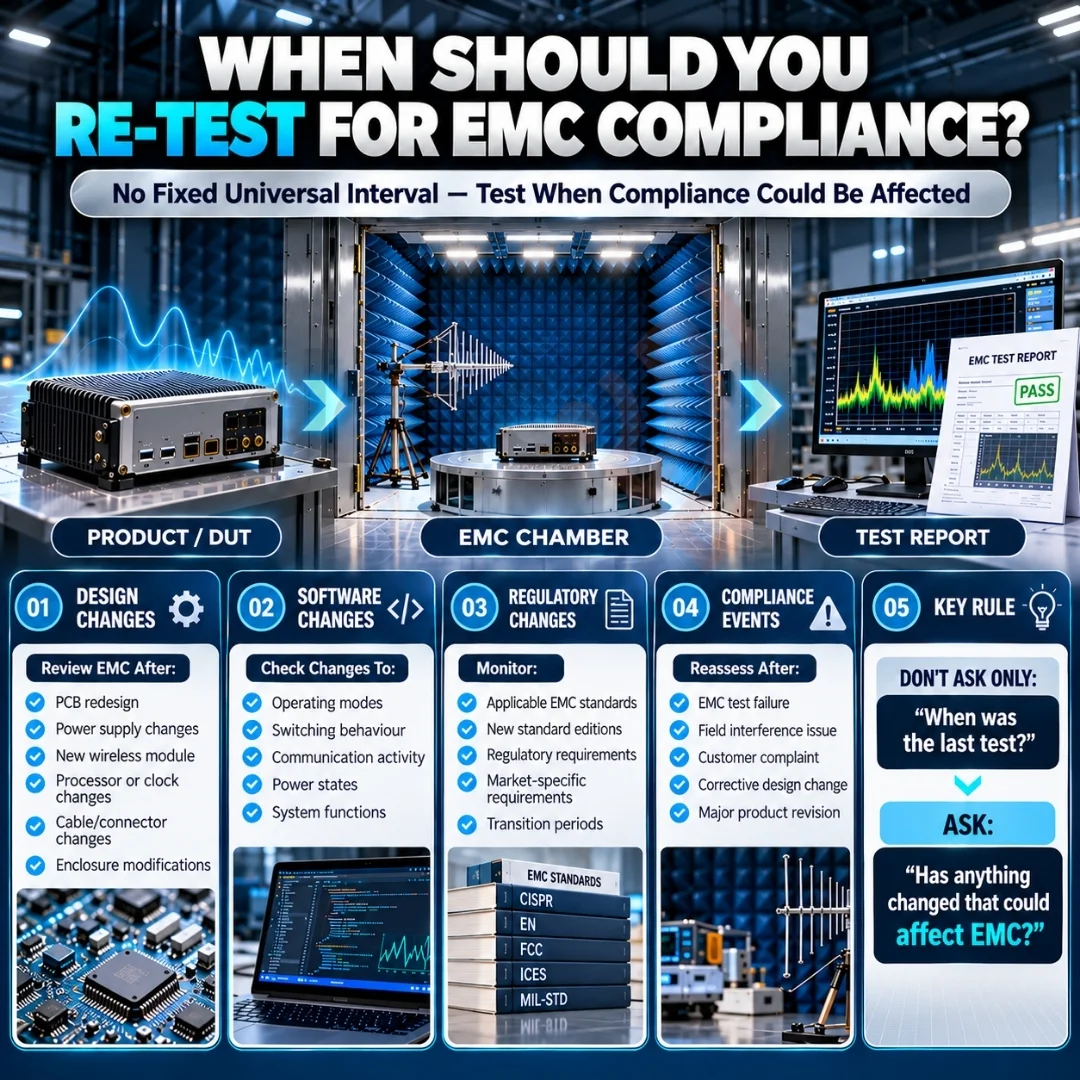
For Diamond Microwave Chambers Ltd customers, the practical question is not simply “How long ago was the last EMC test?” It is “Has anything changed that could affect emissions or immunity?” This helps avoid unnecessary testing while reducing reliance on outdated evidence.
Why Is EMC Re-Testing Important?
EMC testing evaluates whether equipment emits acceptable levels of electromagnetic disturbance and can operate as intended when exposed to electromagnetic phenomena. A previous test report represents the configuration that was actually evaluated. If the product changes materially, the old evidence may not automatically demonstrate compliance for the new configuration.
Regulatory requirements can also evolve. FCC guidance states that equipment should be re-evaluated when a modification adversely affects its emanation characteristics. Retesting decisions should therefore be linked to the effect of a change, rather than an arbitrary date.
How Often Should a Product Be Re-Tested?
There is no universal EMC retest schedule that applies to every product category worldwide. Manufacturers should establish a documented review process and trigger EMC reassessment when relevant conditions occur.
A useful approach is:
- After significant hardware changes: Reassess when the PCB, clock frequency, power supply, processor, wireless module, motor, display, cable arrangement, enclosure, or other electrically significant hardware changes.
- After major software or firmware changes: Evaluate whether new operating modes, switching behavior, communications activity, power states, or processing functions could alter emissions or immunity performance.
- After component substitutions: Check replacement power supplies, oscillators, converters, motors, relays, connectors, and communication modules.
- After enclosure or cable changes: Reassess when shielding, grounding, cable routing, connector configuration, or enclosure materials change.
- When standards or regulatory requirements change: Review the applicable edition, transition dates, and testing requirements.
- After a compliance failure or field issue: Investigate the root cause and determine the appropriate scope of corrective testing.
- Before major market expansion: Confirm that existing evidence supports the requirements of the new destination market.
- During product lifecycle reviews: Identify outdated standards, obsolete components, or undocumented modifications.
What Changes Are Most Likely to Trigger Retesting?
Not every engineering change requires a complete EMC test campaign. The scope should be determined through technical assessment.
Replacing a switching power supply, changing a high-speed processor, adding a wireless transmitter, altering cable lengths, or modifying the enclosure can affect radiated or conducted emissions.
The assessment should consider both emissions and immunity. A change that does not increase emissions could still affect susceptibility to electromagnetic disturbances. A structured engineering change review is more reliable than a simple “same product” assumption.
Practical EMC Retesting Review
| Change or Event | Possible EMC Impact | Typical Action |
|---|---|---|
| PCB redesign | High | Technical review and targeted or full testing |
| Power supply change | High | Reassess emissions and immunity as applicable |
| New wireless module | High | Review radio/EMC requirements and test scope |
| Firmware operating-mode change | Medium–High | Assess changed operating states and emissions |
| Cable or connector change | Medium–High | Review conducted and radiated effects |
| Enclosure material change | Medium | Check shielding and grounding implications |
| Cosmetic mechanical change only | Low | Document engineering assessment |
| Applicable standard updated | Variable | Review edition and transition requirements |
| Compliance failure | High | Root-cause investigation and corrective testing |
The table is a planning aid, not a substitute for the applicable standard or laboratory assessment.
Should EMC Testing Be Repeated Every Year?
Not necessarily. Annual testing can be appropriate for some organizations as part of a quality or compliance program, but it is not a universal requirement for all products.
A practical approach is to combine change-based reassessment with regulatory and standards monitoring. Manufacturers can review their EMC file periodically while triggering additional testing whenever a significant technical or regulatory change occurs.
Keep the product configuration, test report, modifications, applicable standards, test setup, and engineering decisions together. FCC rules require responsible parties to retain records supporting equipment authorization, including relevant design changes and test results.
Standards Updates Can Affect Retesting
EMC standards are periodically revised. A revised standard can introduce new test conditions, frequency ranges, equipment categories, ports, or other requirements. IEC publications show that CISPR revisions can introduce technical changes, so an old report may not automatically cover a future edition.
The effect of a standards update depends on the market and transition arrangements. Manufacturers should check current requirements rather than relying only on the previous test date.
Pro Tip
Create an EMC “change trigger” checklist inside your engineering change-control process. Whenever a component, PCB, firmware, enclosure, cable, power supply, operating mode, or applicable standard changes, route the change through an EMC review before production release. This creates an audit trail and helps determine the appropriate testing scope.
How Diamond Microwave Chambers Ltd Can Support EMC Testing
Diamond Microwave Chambers Ltd provides RF, microwave, EMC and anechoic chamber solutions for controlled electromagnetic testing environments. Its portfolio includes custom RF solutions, EMC and RF shielding solutions, absorbers, enclosures, antenna measurement systems, and related testing infrastructure.
For product redesigns, new certification, market expansion, or compliance investigations, early testing can identify issues before final compliance testing. Pre-compliance work can also help compare design revisions and investigate emissions.
The key is to define the test scope from the product configuration and applicable requirements—not simply from the age of the last test report.
Conclusion
Products should be re-tested for EMC compliance when changes, standards updates, market requirements, failures, or other circumstances could affect the validity of existing compliance evidence. There is no single worldwide calendar-based retesting interval that fits every product.
Manufacturers should document reviews, monitor standards, control engineering changes, and obtain technical assessment for significant modifications. Treating EMC compliance as an ongoing product-lifecycle activity helps companies make retesting decisions based on evidence rather than guesswork.
Frequently Asked Questions
There is no universal annual or biennial retest requirement for every product. Retesting should be considered when significant design changes, component substitutions, standards updates, regulatory changes, failures, or market requirements could affect compliance.
Not automatically. The replacement should be assessed for its potential effect on emissions and immunity. Changes involving power supplies, processors, clocks, wireless modules, converters, motors, and other electrically significant components may require additional testing.
Not generally. Whether periodic testing is required depends on the applicable product standards, regulatory framework, certification scheme, and product category.
A firmware update does not automatically require a complete EMC test. However, testing or technical assessment may be appropriate if the update changes operating modes, switching behavior, communications activity, power states, or other characteristics that could affect EMC performance.
It may provide useful supporting evidence, but it should not automatically be assumed to cover a modified product. The changes should be reviewed against the applicable standards and regulatory requirements to determine whether targeted or full re-testing is necessary.