
Table of Contents
- What Is 5G Base Station OTA Testing
- Why OTA Testing Matters for 5G Base Stations
- Key OTA Measurements Manufacturers Should Understand
- Choosing the Right OTA Test Environment
- What Manufacturers Should Prepare Before Testing
- How Diamond Microwave Chambers Ltd Supports OTA Testing
5G networks rely on advanced base stations, massive MIMO antenna arrays, beamforming, and increasingly complex radio configurations. As a result, 5G Base Station OTA Testing has become an important part of validating how a base station actually performs when its radio signals are transmitted and received through the antenna system. Unlike conducted measurements made at an RF connector, over-the-air testing evaluates the radiated performance of the complete radio and antenna system.
For manufacturers, OTA testing can help identify issues involving radiated power, modulation quality, beam direction, unwanted emissions, and antenna performance before equipment moves further through qualification or deployment. 3GPP TS 38.104 defines minimum RF characteristics and performance requirements for NR base stations, including OTA requirements for applicable base-station types.
What Is 5G Base Station OTA Testing?
5G Base Station OTA Testing measures RF performance through the air rather than relying only on conducted measurements at an antenna connector. This approach becomes particularly relevant for active antenna systems, where the radio, antenna array, and beamforming functions operate together.
During an OTA measurement, the base station under test operates in a controlled test environment. Measurement antennas, positioning equipment, signal-generation and analysis equipment, and software work together to characterize the radiated signal.
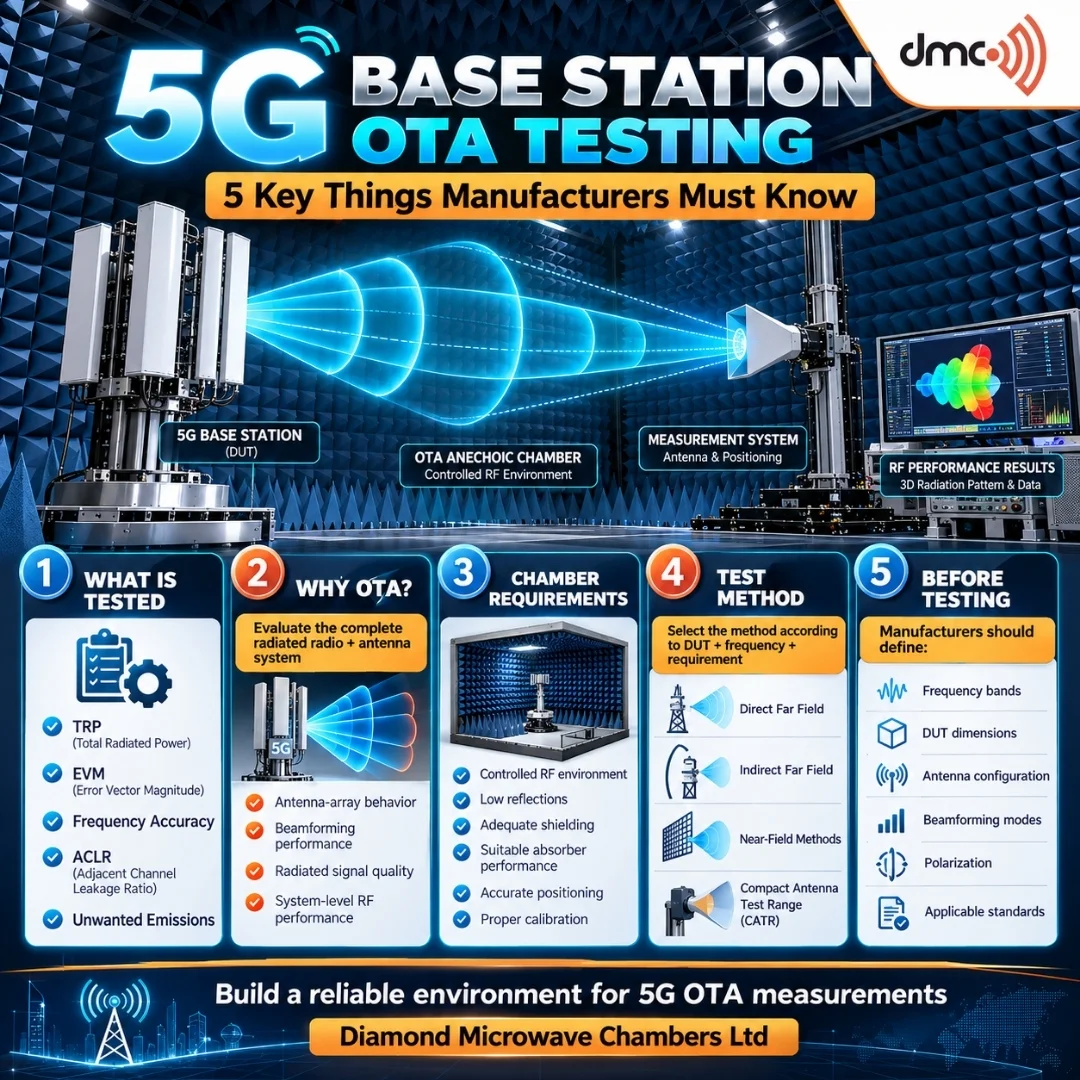
Typical measurements can include:
- Total Radiated Power (TRP)
- OTA frequency accuracy
- Error Vector Magnitude (EVM)
- Adjacent Channel Leakage Power Ratio (ACLR)
- Occupied bandwidth
- Unwanted and spurious emissions
- Beam direction and beam performance
- Radiated signal quality
- Receiver sensitivity-related measurements, where applicable
The exact measurements and limits depend on the base-station type, operating band, configuration, applicable specification, and regional requirements.
Why OTA Testing Matters for 5G Base Stations
5G base stations can use sophisticated antenna architectures that make radiated behaviour more complicated than a simple connector-based RF measurement. Beamforming can change the direction and characteristics of the transmitted signal, while multiple antenna elements can operate together.
OTA testing allows manufacturers to evaluate the complete radiated system, rather than examining individual RF paths in isolation.
This can help manufacturers:
- Verify radiated RF performance.
- Characterize beamforming behaviour.
- Detect unexpected radiated emissions.
- Evaluate modulation quality.
- Validate antenna-array integration.
- Investigate differences between conducted and radiated performance.
- Support design verification and applicable conformance activities.
For example, 3GPP TS 38.104 includes OTA requirements covering areas such as base-station output power, frequency error, modulation quality and unwanted emissions for applicable BS types.
Key OTA Measurements Manufacturers Should Understand
1. Total Radiated Power
TRP represents the total RF power radiated by the base station over the relevant measurement sphere or defined measurement procedure. It provides a system-level view of radiated output rather than simply measuring power at one RF connector.
For active antenna systems, this distinction is particularly important because beamforming settings can influence where energy is radiated.
2. EVM and Modulation Quality
Error Vector Magnitude, or EVM, is commonly used to evaluate modulation quality. A transmitter with excessive modulation error may indicate problems involving RF impairments, signal generation, amplification, synchronization, or other parts of the transmission chain.
3GPP specifications define OTA modulation-quality requirements for applicable base-station configurations.
3. Unwanted Emissions and ACLR
OTA measurements can also evaluate emissions outside the intended transmission characteristics. These measurements help determine whether the base station meets applicable limits for unwanted radiation.
3GPP TS 38.104 includes OTA requirements for occupied bandwidth, ACLR and unwanted emissions.
4. Beamforming Performance
Beamforming is central to many 5G antenna systems. Manufacturers therefore need to understand how the base station behaves across different beam directions and configurations.
Testing may involve:
- Beam peak direction
- Beam coverage
- Radiated power by direction
- Polarization
- Beam-to-beam repeatability
- Beamforming configuration changes
The measurement procedure must be selected according to the applicable specification and product architecture.
Choosing the Right OTA Test Environment
A suitable 5G OTA test chamber should provide a controlled RF environment with sufficiently low reflections and external interference. Anechoic chambers are commonly used to create the required measurement conditions.
The chamber design depends on several engineering parameters:
| Parameter | Why It Matters |
|---|---|
| Frequency range | Determines absorber and antenna requirements |
| DUT size | Influences chamber dimensions and measurement distance |
| Far-field distance | Supports valid radiated measurements |
| Dynamic range | Helps distinguish wanted signals from unwanted emissions |
| Shielding effectiveness | Limits external RF interference |
| Absorber performance | Reduces reflections inside the chamber |
| Positioning accuracy | Supports repeatable angular measurements |
| Calibration | Establishes measurement-system accuracy |
For far-field measurements, distance is related to the physical size of the radiating system and wavelength. 3GPP OTA test-method documentation discusses direct far-field approaches and far-field criteria for OTA measurements.
Direct Far Field, Near Field and Other Approaches
There is no single OTA setup that fits every 5G base station.
Depending on the DUT, frequency range, physical dimensions, and measurement objectives, manufacturers may consider approaches such as:
- Direct Far Field (DFF)
- Indirect Far Field (IFF)
- Near-field-to-far-field transformation
- Compact antenna test range approaches
- Other validated measurement configurations
The appropriate method should be selected based on the applicable test specification and the characteristics of the device.
3GPP documentation describes multiple OTA methodologies and their applicability to different measurement requirements.
What Manufacturers Should Prepare Before Testing
Good preparation can significantly improve test efficiency. Before placing a base station in an OTA chamber, manufacturers should clearly define the DUT configuration and measurement requirements.
Preparation checklist
- Confirm operating frequency bands.
- Identify supported channel bandwidths.
- Document antenna and radio configuration.
- Define beamforming modes to be tested.
- Confirm polarization requirements.
- Establish required measurement parameters.
- Verify calibration status of test equipment.
- Confirm chamber frequency coverage.
- Define DUT positioning and orientation.
- Review applicable 3GPP and regional requirements.
Pro Tip: Do not design the OTA chamber around frequency range alone. Consider the largest DUT dimension, antenna-array characteristics, measurement distance, dynamic range, beamforming requirements, and future product bands before finalizing the chamber design.
How Diamond Microwave Chambers Ltd Supports OTA Testing
For manufacturers developing advanced wireless equipment, the test environment is an important part of obtaining repeatable RF measurements. Diamond Microwave Chambers Ltd provides RF and microwave chamber solutions designed for controlled electromagnetic testing environments.
A properly engineered chamber can help manufacturers establish the controlled conditions required for antenna and OTA measurements while supporting different test configurations and future technology requirements.
When planning a 5G Base Station OTA Testing facility, manufacturers should consider both today’s measurement requirements and the evolution of antenna architectures, frequency bands, and beamforming technologies.
Final Takeaway
5G base station performance cannot always be understood through conducted RF measurements alone. 5G Base Station OTA Testing provides a way to evaluate the radiated behaviour of the complete radio and antenna system under controlled conditions.
For reliable results, the OTA methodology and chamber should be matched to the specific base-station architecture, frequency range, physical size, and testing objectives rather than using a one-size-fits-all approach.
Frequently Asked Questions
5G Base Station OTA Testing evaluates the RF performance of a base station through its radiated signals rather than relying only on conducted measurements.
Common parameters include TRP, EVM, frequency accuracy, ACLR, occupied bandwidth, unwanted emissions, and beam-related performance, depending on the applicable test requirements.
An anechoic chamber provides a controlled electromagnetic environment that reduces unwanted reflections and external RF interference, helping improve measurement repeatability.
3GPP TS 38.104 specifies NR base-station RF requirements, while related 3GPP test specifications and regional regulations determine applicable test methods and limits.
No. The appropriate setup depends on factors such as frequency range, DUT dimensions, antenna architecture, beamforming capabilities, measurement objectives, and applicable requirements.