
Table of Contents
- Why EMC Matters in EV Fast-Charging Systems
- Where Can EMI Come From
- Emissions and Immunity: Two Sides of EMC
- The Role of EMC Testing Chambers
- Why Fast Charging Creates New EMC Design Challenges
- How Diamond Microwave Chambers Ltd Can Support EMC Testing
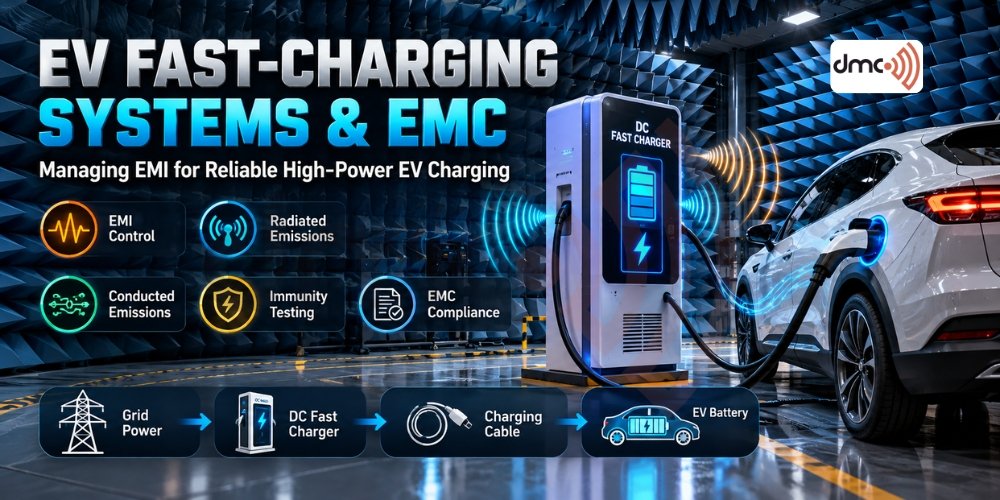
EV fast-charging systems and electromagnetic compatibility(EMC)are becoming increasingly important as electric vehicles move toward higher charging power, faster energy transfer, and more sophisticated electronic control. A DC fast charger is not simply a high-power electrical source. It contains switching power electronics, control circuits, communication interfaces, cooling systems, sensors, cables, and protection components that must operate reliably without creating unacceptable electromagnetic interference (EMI).
For manufacturers, validating EV charging EMC performance is therefore an important part of product development. IEC 61851-21-2 defines EMC requirements for off-board EV charging equipment used for conductive charging, including applicable charging modes and defined test setups.
Why EMC Matters in EV Fast-Charging Systems
Fast chargers operate with significant electrical power and rapidly controlled switching devices. These characteristics can create conducted and radiated electromagnetic disturbances. At the same time, the charger must remain sufficiently immune to electromagnetic disturbances from its environment.
Poor EMC performance can potentially affect:
- Charger control electronics
- Vehicle-to-charger communication
- Sensors and monitoring circuits
- Display and user-interface systems
- Protection and fault-detection functions
- Nearby electronic equipment
- Charging stability and system reliability
The objective is not simply to reduce EMI. A successful design must balance emissions and immunity while maintaining the required charging performance.
Where Can EMI Come From?
An EV fast charger contains several possible sources of electromagnetic disturbance. Power-conversion stages are particularly important because semiconductor switching can produce high-frequency components.
Common areas requiring EMC attention include:
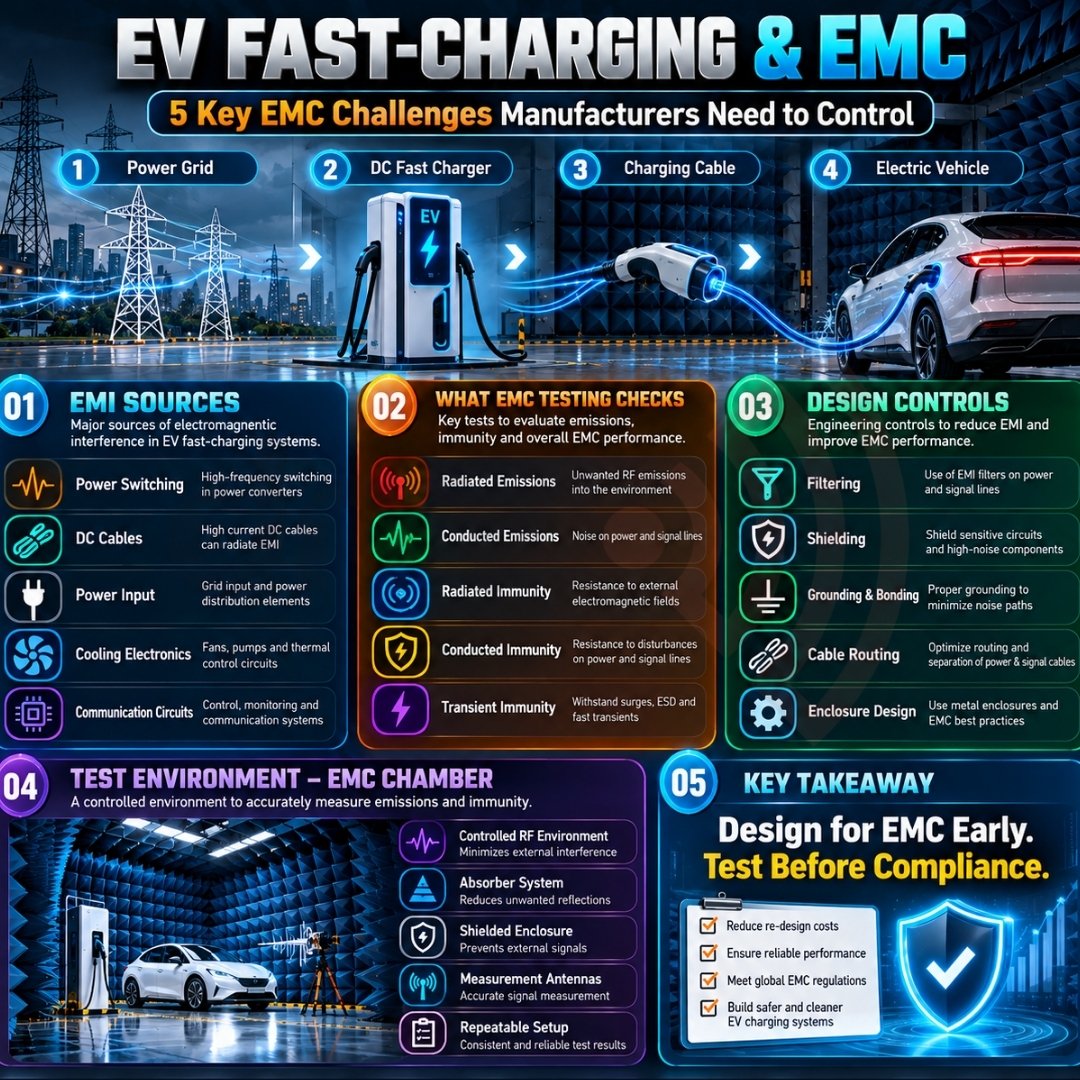
- Power switching circuits – High-speed switching can generate unwanted electrical noise.
- DC output cables – Long conductors can provide paths for common-mode or differential-mode disturbances.
- Input power connections – Conducted disturbances can travel toward the electrical supply.
- Cooling and auxiliary electronics – Fans, pumps and their control circuits can introduce additional electrical noise.
- Communication interfaces – Charging-control communication must operate reliably in the presence of electrical disturbances.
- Enclosures and cable penetrations – Poor shielding continuity can allow unwanted electromagnetic energy to escape or enter.
Not every charger will experience the same EMC problem. Actual behaviour depends on circuit architecture, switching technology, mechanical construction, filtering, grounding, cable routing and operating conditions.
Emissions and Immunity: Two Sides of EMC
EMC testing generally considers two complementary questions: What electromagnetic disturbance does the charger generate? and can the charger continue to operate correctly when exposed to electromagnetic disturbance?
| EMC Area | What Is Evaluated | Why It Matters |
|---|---|---|
| Radiated emissions | Electromagnetic energy emitted into the environment | Helps control interference with nearby equipment |
| Conducted emissions | Disturbances travelling through connected conductors | Helps prevent interference through power connections |
| Radiated immunity | Response to external electromagnetic fields | Tests operational robustness |
| Conducted immunity | Response to disturbances entering through cables | Helps validate connected interfaces |
| Transient immunity | Response to fast electrical disturbances | Supports reliable operation during disturbance events |
The exact tests, limits, ports and operating conditions depend on the applicable standards and the equipment configuration. Manufacturers should therefore establish the applicable compliance requirements before defining the complete test plan.
The Role of EMC Testing Chambers
The exact tests, limits, ports and operating conditions depend on the applicable standards and the equipment configuration. Manufacturers should therefore establish the applicable compliance requirements before defining the complete test plan.
A controlled test environment is essential when measuring radiated emissions or evaluating radiated immunity. EMC testing chambers help reduce the influence of external electromagnetic signals and provide a controlled environment for repeatable measurements.
For EV charging equipment, chamber planning may need to consider:
- Equipment dimensions and weight
- Charging cable arrangement
- Vehicle simulator or artificial load requirements
- Power supply connections
- Auxiliary equipment
- Measurement antennas
- Cable routing
- Absorber configuration
- Ground-plane requirements
- Required frequency range
The physical test setup can influence measurement results. A charger that passes one configuration may require investigation if its operating mode, cable arrangement, load condition or auxiliary equipment changes significantly.
Why Fast Charging Creates New EMC Design Challenges
Higher charging capability does not automatically mean higher EMI, but fast-charging architectures can introduce additional EMC design challenges.
Modern chargers may use advanced power semiconductors, high-frequency switching and compact power-density designs. These technologies can improve efficiency and reduce system size, but they also require careful control of switching paths, parasitic coupling and filtering.
Engineers should pay particular attention to:
- Short, controlled high-current paths
- Appropriate input and output filtering
- Shield termination
- Grounding and bonding
- Separation of noisy and sensitive circuits
- Cable routing
- Enclosure continuity
- Common-mode current paths
- Communication-line protection
EMC should be considered during the design stage rather than treated only as a final compliance test.
Standards and Compliance Considerations
IEC 61851 provides an important framework for conductive EV charging systems. IEC 61851-21-2 addresses EMC requirements for off-board EV charging equipment, while IEC 61851-21-1 addresses EMC requirements for on-board charging units connected to AC/DC supplies.
For DC charging infrastructure, IEC 61851-23:2023 covers DC EV supply equipment, including systems with supply-side ratings up to 1,000 V AC or 1,500 V DC and EV-side output up to 1,500 V DC.
The standards landscape is also evolving. For example, IEC 61851-23-3:2026 addresses megawatt charging systems and specifies DC EV supply equipment for MCS applications.
This makes it important for manufacturers to identify the standards applicable to their specific product, market and installation before testing.
How Diamond Microwave Chambers Ltd Can Support EMC Testing
Diamond Microwave Chambers Ltd provides RF and EMC chamber solutions designed around controlled electromagnetic testing environments. For EV charging equipment manufacturers, the chamber must be considered as part of the complete measurement system rather than as an isolated enclosure.
A suitable chamber solution can help provide:
- Controlled RF test conditions
- Reduced external interference
- Appropriate absorber performance
- Shielding against unwanted electromagnetic signals
- Repeatable test configurations
- Space for large equipment and charging-system setups
Chamber design should be based on the intended frequency range, equipment size, test methodology, antenna configuration, cable requirements and applicable standards.
Pro Tip
Do not wait until the final compliance test to investigate EMC problems. Perform EMC-oriented design reviews and pre-compliance testing during product development. Early identification of noisy switching loops, cable coupling, enclosure leakage and filtering problems can reduce expensive redesign work later.
Building a Reliable EMC Strategy for EV Charging
A successful EV charging EMC testing strategy combines good electrical design, appropriate filtering, mechanical shielding, controlled cable routing and properly planned laboratory testing.
The goal is not merely to obtain a test result. The goal is to develop an EV fast-charging system that can deliver high-power charging while maintaining electromagnetic compatibility with its own electronics and surrounding equipment.
As EV charging technology moves toward higher power levels and new architectures, EMC considerations will remain an important part of charger development. Working with an experienced chamber manufacturer such as Diamond Microwave Chambers Ltd can help manufacturers plan a controlled environment suitable for their intended EMC and RF testing requirements.
Frequently Asked Questions
EMC helps ensure that the charging system does not create unacceptable electromagnetic interference and can continue operating correctly when exposed to relevant electromagnetic disturbances.
Depending on the equipment and applicable requirements, testing can include radiated and conducted emissions as well as immunity tests and other applicable EMC phenomena.
IEC 61851-21-2 defines EMC requirements for off-board electric vehicle charging systems used for conductive power transfer.
Radiated EMC testing generally requires a controlled electromagnetic environment. The appropriate facility depends on the applicable test method, equipment configuration and required frequency range.
EMC should be considered throughout product development, with pre-compliance evaluation used where appropriate before formal compliance testing.