
Table of Contents
- What Is an Open Area Test Site (OATS)?
- What Is an Indoor Anechoic Chamber?
- OATS vs Indoor Anechoic Chambers: Key Differences
- Which Provides Better Measurement Repeatability?
- When Should You Choose an Indoor Anechoic Chamber?
- How Diamond Microwave Chambers Ltd Can Help
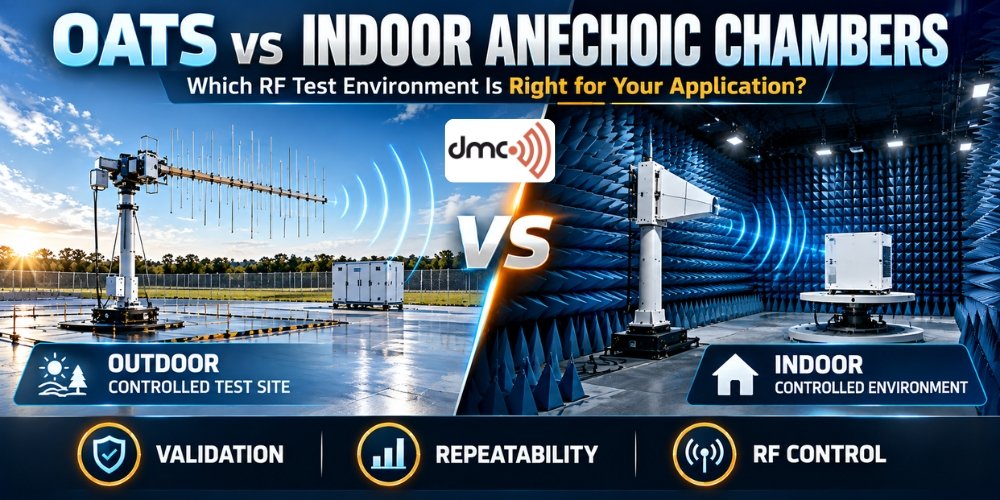
Radiated RF and EMC measurements need a controlled environment so engineers can separate device emissions from reflections, background signals, and uncertainty. Two established approaches are an Open Area Test Site (OATS) and an Indoor Anechoic Chambers. Both can support radiated measurements when properly designed and independently validated, but they create the test environment in very different ways. The choice depends on the product, frequency range, method, standard, facility constraints, and repeatability.
What Is an Open Area Test Site (OATS)?
An OATS is an outdoor test area designed to provide a low-reflection measurement environment. It typically uses a conductive ground plane and a defined test distance between the equipment under test and the measurement antenna. The area must be free from objects and interference that could disturb the measurement.
OATS has traditionally supported radiated-emissions measurements because the site can approximate reference conditions used by EMC methods. However, an OATS is not simply an empty field. Its performance must be demonstrated through the applicable site-validation method, and the surrounding terrain, structures, cables, weather exposure, and ambient RF environment all matter.
Typical OATS characteristics include:
- Outdoor controlled measurement area
- Conductive ground plane
- Antenna mast and positioning system
- Defined measurement distance
- Site validation and performance checks
- Protection from nearby structures and RF sources
What Is an Indoor Anechoic Chamber?
An indoor anechoic chamber creates a controlled electromagnetic environment inside a shielded enclosure. Absorbing materials are used to reduce reflections from walls, ceiling, and other surfaces, while the shielded structure helps reduce external RF interference. An indoor facility may be a semi-anechoic chamber (SAC), fully anechoic room (FAR), or another specialized RF environment.
A chamber can provide a stable environment independent of weather and many outdoor background conditions. It can support controlled antenna positioning, turntable rotation, cable routing, and automation.
Common chamber features include:
- RF-shielded enclosure
- RF absorbers for the required frequency range
- Antenna mast and turntable
- Filtered power and controlled cable penetrations
- Controlled access and test configuration
- Site validation for the applicable method
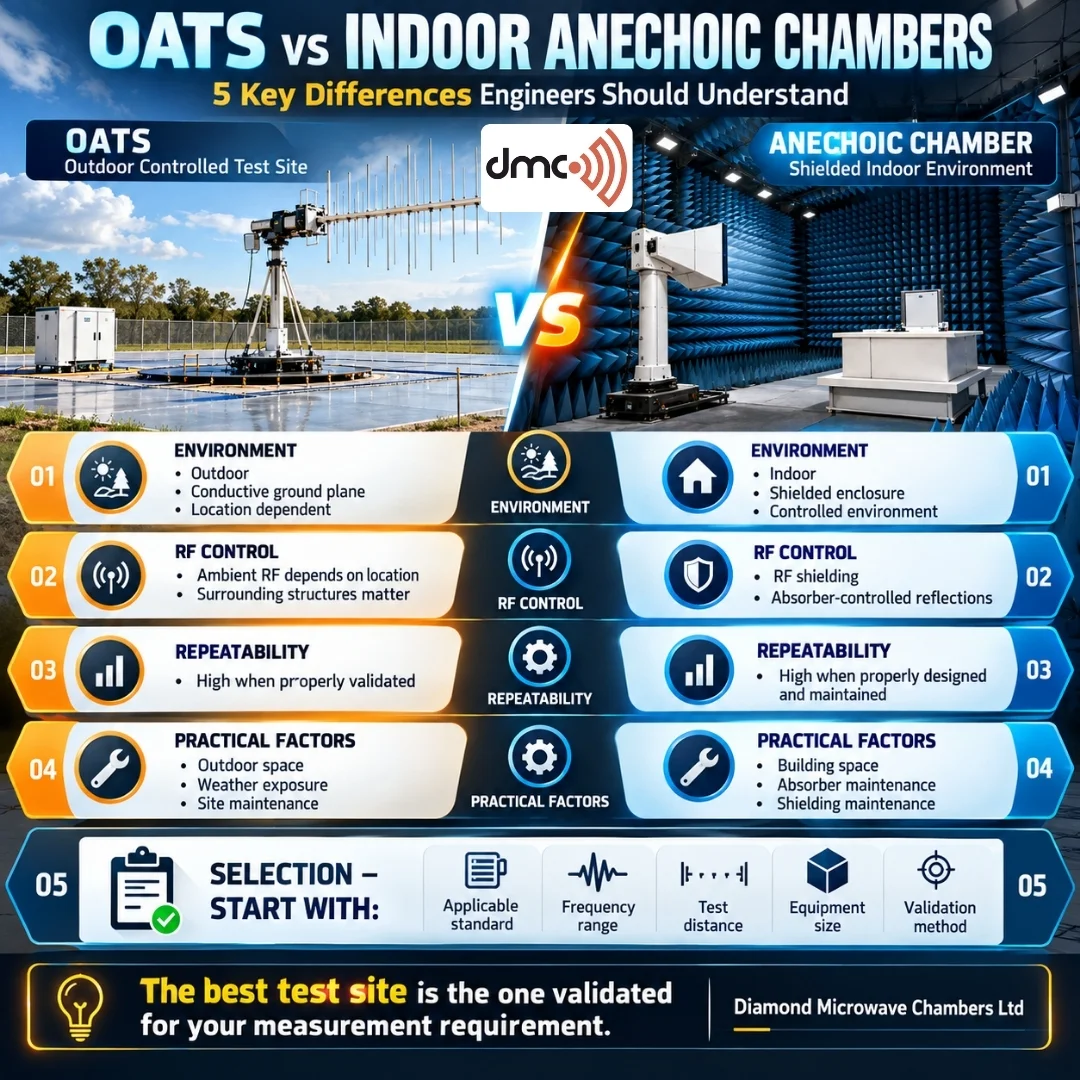
OATS vs Indoor Anechoic Chambers: Key Differences
| Factor | OATS | Indoor Anechoic Chamber |
|---|---|---|
| Environment | Outdoor | Indoor, controlled |
| Reflections | Managed through geometry and ground plane | Reduced using absorbers and chamber design |
| External RF interference | Depends strongly on location | Shielding provides stronger environmental isolation |
| Weather | Can affect practical operation | Generally unaffected |
| Repeatability | Can be high when properly validated | High when properly designed and maintained |
| Space requirement | Requires suitable outdoor land | Requires building/facility space |
| Maintenance | Ground plane, site, vegetation and environment | Absorbers, shielding, doors, vents and systems |
| Privacy/security | More exposed | Controlled indoor access |
| Automation | Possible | Often easier to integrate |
| Upfront infrastructure | Site-dependent | Typically substantial chamber construction |
Which Provides Better Measurement Repeatability?
Neither option automatically wins. Repeatability comes from the complete measurement system: validated site performance, calibrated equipment, controlled geometry, antenna positioning, cable configuration, ambient conditions, and consistent test procedures.
An OATS can deliver reliable results when the site meets validation criteria and the environment remains controlled. An indoor chamber can provide excellent repeatability because shielding, absorbers, and equipment positions can be engineered as a controlled system.
For compliance testing, engineers should not choose a facility because it is called an “anechoic chamber” or an “OATS.” Confirm that the facility is validated for the intended frequency range, distance, polarization, equipment size, and standard.
When Should You Choose an OATS?
An OATS can suit organisations with sufficient outdoor space and a conventional radiated test requirement. It may suit applications where the standard permits or references an open-area configuration.
Consider an OATS when:
- Outdoor space is available and suitably controlled
- The measurement method calls for an OATS-type environment
- The site can achieve the required validation performance
- Weather and ambient RF conditions can be managed
- Large equipment or test setups benefit from open access
When Should You Choose an Indoor Anechoic Chamber?
An indoor chamber is practical when a company needs year-round testing, controlled conditions, strong RF isolation, or automated measurement systems.
Consider an indoor chamber when:
- Testing must continue regardless of outdoor weather
- External RF interference is difficult to control
- Repeatable product-development measurements are important
- Security and restricted access matter
- The facility needs integrated turntables, antenna masts, automation, or other test hardware
- Future testing may involve different RF or EMC applications
Pro Tip
Do not compare OATS and chambers by construction type alone. Start with the required test standard, frequency range, test distance, equipment dimensions, measurement uncertainty, and validation method. Then design or select the facility around those requirements. A correctly validated OATS can outperform a poorly designed chamber, while a well-engineered chamber can offer a more controlled environment for demanding development and compliance programs.
How Diamond Microwave Chambers Ltd Can Help
Diamond Microwave Chambers Ltd supports RF and EMC test environments with an emphasis on controlled electromagnetic performance. For organisations evaluating an indoor anechoic chamber, the key is to define the measurement objective before selecting chamber size, absorbers, shielding, antenna systems, and other components.
A chamber should be engineered around the actual application rather than treated as a standard room. Frequency range, quiet-zone requirements, equipment size, test distance, access, cable penetrations, absorber performance, and validation requirements should be considered during planning.
Conclusion
OATS and indoor anechoic chambers are both established approaches for radiated RF and EMC measurements. An OATS uses an outdoor controlled site and ground plane, while an indoor chamber combines shielding and RF absorption to create a controlled test environment. The better option depends overall on the applicable standard, test method, product, frequency range, facility constraints, and required measurement performance.
Before investing, define the compliance and engineering requirements. Proper validation—not the facility label—determines whether the environment suits the test.
Frequently Asked Questions
An OATS is an outdoor controlled test site that commonly uses a conductive ground plane, while an indoor anechoic chamber uses RF shielding and absorbers to create a controlled electromagnetic environment.
Neither is universally better. The appropriate choice depends on the applicable standard, measurement method, frequency range, equipment size, site conditions, and required measurement performance.
In some measurement applications, a properly designed and validated indoor chamber can provide equivalent or appropriate measurement conditions. However, the applicable standard and validation requirements must be checked before treating the facilities as interchangeable.
Both can provide reliable repeatability when properly designed and validated. Indoor chambers can offer stronger control over external RF interference and environmental conditions, while a well-designed OATS can also provide accurate and repeatable measurements.
Engineers should review the applicable standard, frequency range, test distance, equipment dimensions, antenna configuration, measurement uncertainty, shielding requirements, site-validation method, and future testing needs.