
Table of Contents
- Why Shielding Matters in Military Communication Equipment
- Key Military Communication Equipment Shielding Standards
- Understanding RF Shielding Effectiveness
- Best Practices for Reliable Military EMC Performance
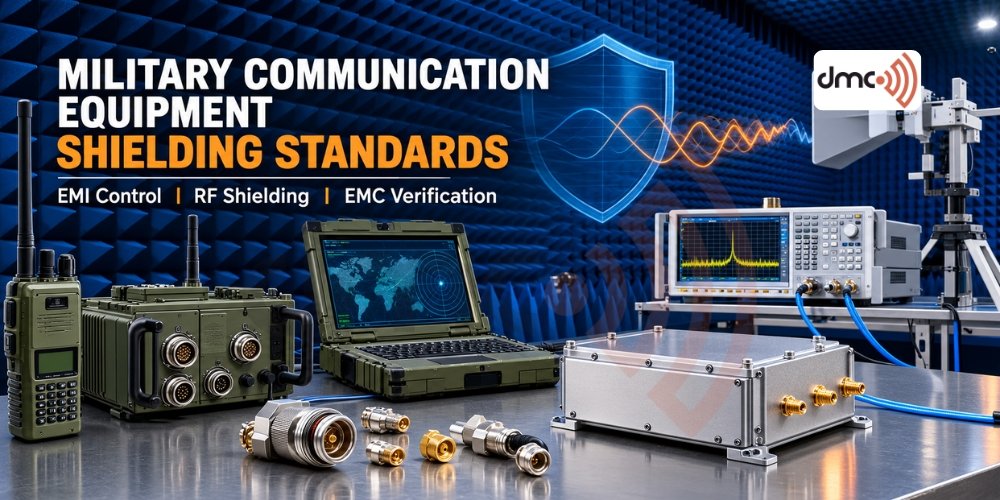
Military communication equipment shielding standards help protect radios, communication terminals, antennas, and electronic subsystems from electromagnetic interference (EMI). In defence environments, reliable communication is essential for coordinating operations, sharing information, and maintaining dependable links between land, air, naval, and space-based systems. Understanding military EMI shielding standards, EMC testing, and RF shielding requirements helps engineers design equipment that performs reliably under specified operating conditions.
Why Shielding Matters in Military Communication Equipment
Military communication systems often operate alongside radar, navigation equipment, power electronics, data links, and other radio-frequency sources. These systems can create electromagnetic interference that affects sensitive receivers, control circuits, and communication signals.
Effective shielding helps limit unwanted electromagnetic coupling between equipment and its surroundings. However, shielding alone cannot guarantee reliable communication. Proper grounding, cable routing, connector design, filtering, enclosure construction, and system-level testing are equally important.
Key reasons for implementing shielding include:
- Reducing interference: Limits unwanted electromagnetic energy entering or leaving sensitive equipment.
- Protecting signal integrity: Helps receivers and electronic circuits operate within their specified performance limits.
- Improving operational reliability: Reduces the risk of electromagnetic interactions affecting mission-critical functions.
- Supporting compliance: Helps equipment meet applicable contractual EMI and EMC requirements.
- Managing electromagnetic risks: Supports the assessment of interactions between communication systems and nearby electronic equipment.
Key Military Communication Equipment Shielding Standards
Military shielding requirements depend on the equipment, platform, intended environment, and procurement contract. Several standards may apply, but they address different aspects of electromagnetic and environmental performance.
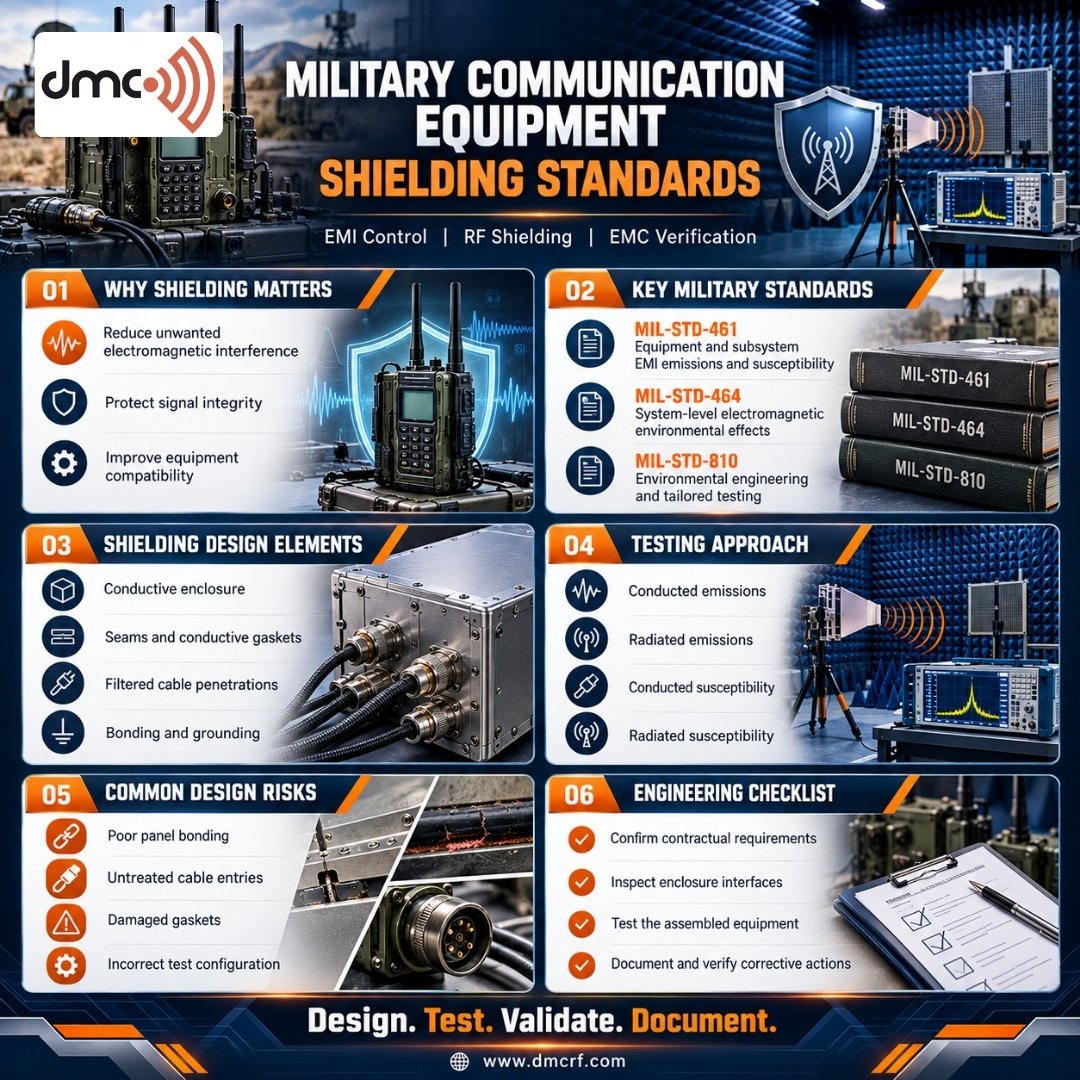
1. MIL-STD-461: Electromagnetic Interference Control
MIL-STD-461 establishes requirements and verification methods for controlling electromagnetic emissions and susceptibility in applicable electronic, electrical, and electromechanical equipment and subsystems. It covers conducted and radiated interference characteristics, subject to the requirements selected for the equipment.
Engineers use the applicable test methods to evaluate whether equipment generates excessive electromagnetic emissions or responds improperly to external electromagnetic disturbances.
Examples of relevant activities include:
- Measuring conducted emissions through power or signal connections.
- Evaluating radiated emissions from equipment.
- Testing susceptibility to conducted or radiated disturbances.
- Assessing whether filtering, bonding, grounding, or enclosure improvements are needed.
The exact test methods and limits must be selected from the governing revision and contract requirements. MIL-STD-461 is not a universal pass/fail specification with one limit for every military device.
2. MIL-STD-464: Electromagnetic Environmental Effects
MIL-STD-464 addresses electromagnetic environmental effects (E3) at the system level. It establishes applicable interface requirements and verification criteria for airborne, sea, space, and ground systems.
For military communication equipment, this broader perspective matters because a radio that performs correctly in isolation may interact with antennas, transmitters, radar, aircraft electronics, or other systems after installation.
System-level evaluation may consider electromagnetic compatibility, external electromagnetic environments, and interactions between installed equipment. The applicable requirements should be tailored to the platform and acquisition programme.
3. MIL-STD-810: Environmental Engineering Considerations
MIL-STD-810 addresses environmental engineering considerations and laboratory test methods. It helps programmes assess environmental stresses that equipment may experience during its service life.
Depending on the equipment and tailored test plan, relevant stresses may include temperature, vibration, shock, humidity, and dust exposure.
MIL-STD-810 is not an RF shielding standard. However, environmental testing can reveal enclosure damage, degraded seals, loose connectors, or other physical changes that may compromise shielding performance.
Understanding RF Shielding Effectiveness
RF shielding effectiveness describes how effectively a material, enclosure, or assembled structure reduces electromagnetic transmission between two regions. It is commonly expressed in decibels (dB), with the measurement method and test configuration affecting the result.
A higher measured shielding effectiveness indicates greater attenuation under the conditions of that measurement. However, a material’s laboratory result does not automatically represent the performance of a complete enclosure.
Real-world performance depends on frequency, enclosure geometry, apertures, seams, doors, cable penetrations, ventilation panels, connector interfaces, and bonding quality.
Common shielding approaches include:
- Conductive metal enclosures: Provide a conductive barrier when properly designed and assembled.
- Conductive gaskets: Help maintain electrical continuity at removable panels and doors.
- Filtered feedthroughs: Control unwanted conducted interference entering through power and signal lines.
- Bonding and grounding: Help manage electrical continuity and current paths according to the system design.
- RF absorber materials: Reduce reflections within suitable test environments; they do not replace conductive shielding.
Comparison of Key Standards
| Standard | Main focus | Relevance to communication equipment |
|---|---|---|
| MIL-STD-461 | Equipment and subsystem EMI emissions and susceptibility | Evaluates applicable conducted and radiated interference requirements |
| MIL-STD-464 | System-level electromagnetic environmental effects | Assesses electromagnetic interactions across a platform or system |
| MIL-STD-810 | Environmental engineering and tailored laboratory tests | Evaluates specified environmental stresses that may affect equipment integrity |
These standards are complementary rather than interchangeable. The applicable revision, test methods, limits, and acceptance criteria must be confirmed from the contract and official standard documents.
Testing Environments and Shielding Validation
Testing helps determine whether a shielding design performs as intended. The appropriate facility depends on the test objective, frequency range, equipment dimensions, measurement uncertainty, and required procedure.
A shielded enclosure can help isolate measurements from external electromagnetic signals. An RF anechoic chamber uses absorbers to reduce reflections within its intended operating range, supporting suitable radiated measurements. A chamber’s absorber performance and a room’s shielding effectiveness are different characteristics and should be verified separately.
A practical validation programme may include:
- Reviewing applicable contractual requirements and equipment configurations.
- Inspecting enclosure seams, doors, connectors, cable entries, and conductive bonds.
- Performing the specified conducted and radiated emissions tests.
- Conducting applicable susceptibility tests using calibrated equipment.
- Recording test conditions, instrumentation, results, and deviations.
- Correcting identified issues and repeating affected tests.
Diamond Microwave Chambers Ltd (DMC) works in the RF chamber and shielding environment, where appropriate facility design and measurement conditions are important considerations for electromagnetic testing. Chamber selection should be based on the actual verification requirements rather than appearance or enclosure size alone.
Common Shielding Challenges
Even a carefully designed enclosure can experience unexpected EMI or EMC problems. Frequent challenges include poorly bonded panels, untreated cable penetrations, damaged conductive gaskets, unsuitable filter installation, and unintended coupling through connected cables.
Other issues can arise when equipment is modified after qualification or installed on a different platform. A design that meets equipment-level requirements may still need additional system-level assessment.
Engineers should address these risks through early design reviews, documented configuration control, appropriate testing, and corrective-action tracking. Shielding improvements must also preserve thermal management, ventilation, maintainability, connector access, and mechanical durability.
Best Practices for Reliable Military EMC Performance
A structured engineering process helps reduce late-stage redesign and testing delays.
- Define requirements early: Identify the governing standard revisions, applicable test methods, limits, and contractual acceptance criteria.
- Design the complete enclosure: Consider seams, apertures, access panels, cable entries, and connectors from the beginning.
- Validate the assembled equipment: Test the final configuration, including relevant cables, accessories, and operating modes.
- Assess environmental durability: Evaluate whether expected service conditions could damage seals, bonds, or shielding interfaces.
- Document every test: Maintain traceable results, calibration details, configuration records, and corrective actions.
- Review changes carefully: Reassess the need for retesting when components, layouts, or installation conditions change.
Pro Tip: Do not select an enclosure based only on a quoted shielding-effectiveness value. Confirm the required frequency range, measurement method, door and penetration performance, installed cable configuration, and contractual acceptance criteria before approving the design.
Conclusion
Military communication equipment shielding standards provide a framework for evaluating electromagnetic interference, system-level compatibility, and environmental durability. MIL-STD-461, MIL-STD-464, and MIL-STD-810 serve different purposes, so selecting the correct requirements is essential.
Combining sound RF shielding design with appropriate chamber selection, controlled testing, and thorough documentation helps engineers identify risks before deployment. For organisations planning defence electronics verification, Diamond Microwave Chambers Ltd (DMC) can be considered when evaluating RF chamber and shielding-related requirements. Final compliance must always be demonstrated against the applicable contract and approved test criteria.
Frequently Asked Questions
They are standards and contractual requirements used to evaluate electromagnetic interference, compatibility, and related performance of military electronic equipment and systems.
MIL-STD-461 specifies applicable requirements and verification methods for controlling conducted and radiated EMI emissions and susceptibility in covered equipment and subsystems.
MIL-STD-461 focuses on applicable equipment and subsystem EMI characteristics, while MIL-STD-464 addresses electromagnetic environmental effects at the system level.
No. MIL-STD-810 addresses environmental engineering and tailored test methods. RF shielding effectiveness requires a suitable measurement method and defined test configuration.
They can optimise conductive enclosure design, panel bonding, gaskets, cable penetrations, filtering, and grounding, then validate the assembled equipment using the applicable test procedures.