
Table of Contents
- Why RF Test Cycle Time Matters
- Use Efficient Measurement Strategies
- RF Test Cycle Time Optimization: Practical Comparison
- Reduce Environmental and Setup Variations
Reducing RF test cycle time without compromising RF measurement accuracy is an important objective for engineering teams involved in antenna testing, EMC validation, wireless product development, and over-the-air (OTA) measurements. As modern electronic devices operate across increasingly complex frequency bands, testing laboratories must manage higher workloads while maintaining reliable and repeatable results.
The key is to optimize the testing process rather than eliminate essential measurement steps. Diamond Microwave Chambers Ltd supports RF testing environments through engineered anechoic chambers and RF measurement solutions designed for controlled testing applications.
Why RF Test Cycle Time Matters
RF testing involves several stages, including equipment configuration, calibration, device positioning, measurement execution, data processing, and reporting. Delays in any of these stages can increase the total testing duration.
Long test cycles can create challenges such as:
- Reduced laboratory throughput.
- Increased equipment utilization time.
- Delays in product validation.
- Higher testing and operational costs.
- Difficulty meeting project deadlines.
Improving efficiency requires identifying bottlenecks while preserving measurement integrity.
Automate Repetitive RF Testing Tasks
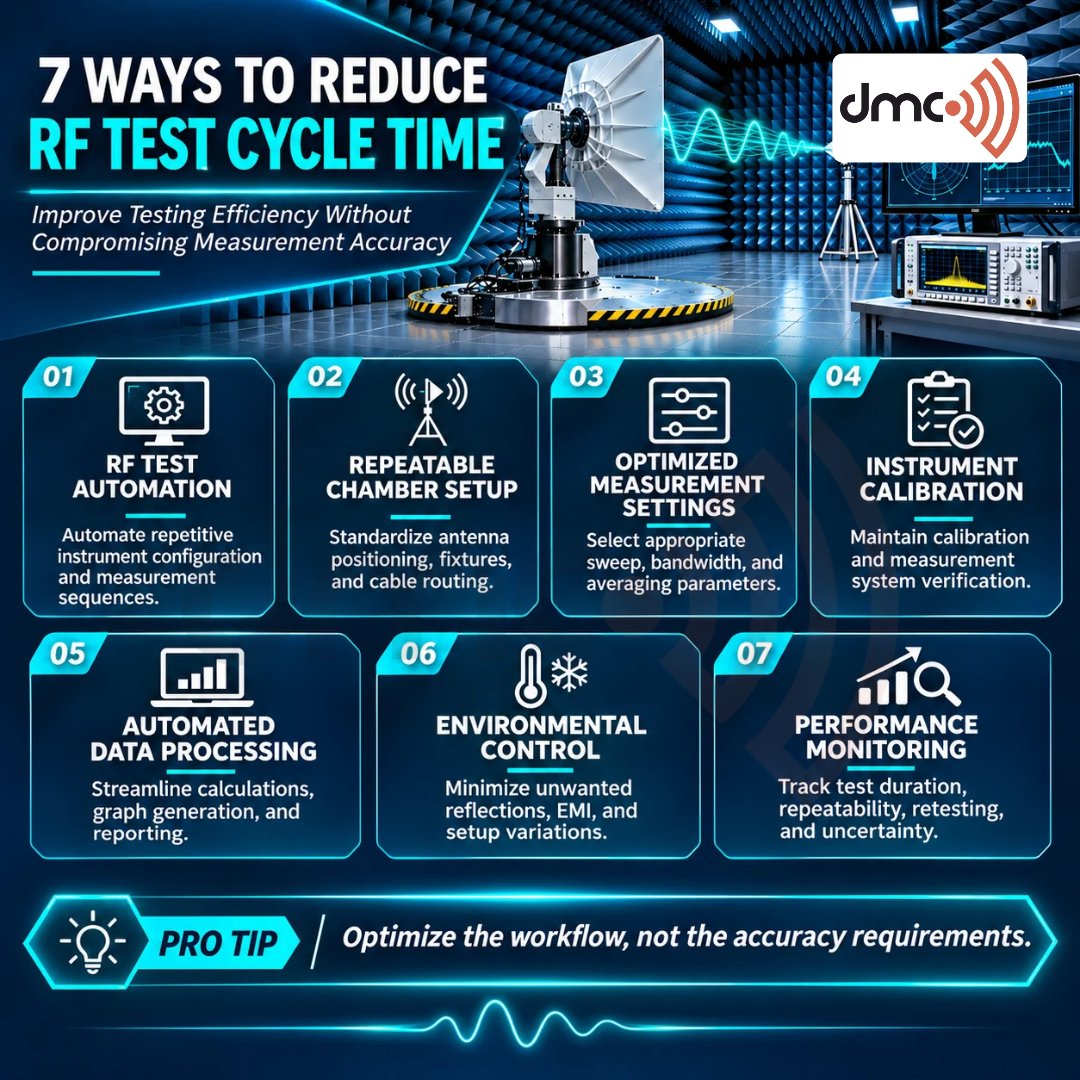
RF test automation is one of the practical ways to reduce manual effort and improve consistency. Automated test systems can control instruments, execute predefined measurement sequences, collect data, and generate reports.
Automation is particularly useful for repeated antenna measurements, OTA testing, and multi-frequency characterization.
Key benefits include:
- Reduced manual instrument configuration.
- Consistent execution of test sequences.
- Lower risk of operator-related errors.
- Faster data collection and processing.
- Improved repeatability across test runs.
However, automation must be validated. Incorrect scripts, instrument settings, or synchronization can produce systematic errors. Automated workflows should include verification checks and appropriate calibration procedures.
Optimize RF Chamber Setup and Device Positioning
An optimized RF chamber setup can reduce unnecessary preparation time and improve measurement consistency.
In antenna measurement environments, device positioning, cable routing, absorber condition, and antenna alignment can influence the measurement results.
Practical improvements include:
- Use repeatable fixtures for device positioning.
- Establish predefined chamber configurations.
- Maintain consistent antenna alignment.
- Minimize unnecessary cable movement.
- Verify the condition of RF absorbers.
- Document setup parameters for recurring tests.
Anechoic chambers supplied by DMC provide controlled testing environments for RF and antenna measurement applications. Proper chamber configuration and maintenance remain essential for reliable results.
Use Efficient Measurement Strategies
Measurement efficiency can often be improved by selecting an appropriate test strategy based on the device under test (DUT), measurement objectives, and applicable standards.
For example, a preliminary engineering assessment may use a reduced frequency sweep to identify areas requiring closer investigation. A final compliance or characterization test must still follow the required frequency coverage and measurement procedures.
Useful strategies include:
- Use suitable frequency step sizes.
- Optimize receiver bandwidth where technically justified.
- Apply appropriate averaging settings.
- Use targeted measurements during troubleshooting.
- Avoid unnecessary duplicate test runs.
- Use adaptive measurement techniques when validated.
Averaging, narrower receiver bandwidths, and reduced frequency sampling can change noise levels, test duration, and measurement uncertainty. These parameters should be selected based on the required accuracy rather than speed alone.
Maintain Proper Calibration and Instrument Readiness
Calibration and instrument verification are fundamental to RF measurement accuracy. Skipping calibration to save time can lead to inaccurate measurements and unreliable conclusions.
A structured instrument readiness process helps reduce avoidable delays.
Recommended practices:
- Maintain an instrument calibration schedule.
- Verify cables, connectors, and adapters.
- Perform appropriate system checks before testing.
- Confirm instrument settings and frequency ranges.
- Allow equipment to warm up according to manufacturer recommendations.
- Record calibration and verification information.
A prepared test station reduces setup interruptions while preserving confidence in the collected data.
Improve Test Data Processing and Reporting
Data processing and reporting can consume considerable time, particularly when measurements are repeated across multiple devices or frequency bands.
Automated data handling helps engineers focus on technical analysis rather than repetitive administrative work.
Consider implementing:
- Standardized reporting templates.
- Automated file naming conventions.
- Centralized measurement data storage.
- Automatic graph generation.
- Predefined result comparison formats.
- Integrated pass/fail evaluation where applicable.
Automated reporting should retain raw measurement data, configuration details, calibration information, and relevant uncertainty records. This supports traceability and facilitates future comparison.
RF Test Cycle Time Optimization: Practical Comparison
| Testing Area | Traditional Approach | Optimized Approach | Accuracy Consideration |
|---|---|---|---|
| Instrument configuration | Manual setup | Validated automation | Verify settings |
| DUT positioning | Manual placement | Repeatable fixtures | Maintain alignment |
| Frequency sweep | Fixed, unreviewed settings | Application-based optimization | Preserve required coverage |
| Calibration | Reactive preparation | Scheduled readiness | Follow calibration requirements |
| Data processing | Manual calculations | Automated processing | Validate algorithms |
| Reporting | Manual documentation | Standardized templates | Maintain traceability |
| Chamber setup | Repeated configuration | Documented setup procedures | Verify chamber conditions |
Reduce Environmental and Setup Variations
Environmental factors can influence RF measurements. Temperature changes, unwanted reflections, electromagnetic interference, cable movement, and inconsistent device positioning may affect measurement repeatability.
RF anechoic chambers help reduce unwanted reflections through specialized absorber materials and controlled configurations. Nevertheless, chamber performance depends on its design, operating frequency range, installation, maintenance, and measurement setup.
To improve repeatability:
- Maintain stable environmental conditions.
- Inspect RF absorbers periodically.
- Keep the chamber configuration consistent.
- Control electromagnetic interference.
- Use suitable cable management.
- Record relevant environmental parameters.
These measures help reduce unexpected measurement variations and unnecessary retesting.
Monitor Test Performance Using Key Metrics
RF laboratories can identify improvement opportunities by monitoring test cycle performance.
Useful metrics include:
- Total test duration per DUT.
- Instrument setup time.
- Calibration and verification time.
- Measurement repeatability.
- Retest frequency.
- Data processing duration.
- Equipment utilization.
For example, if instrument setup accounts for a significant portion of the testing duration, automation may provide a greater improvement than changing measurement parameters.
The objective should be to reduce avoidable delays while maintaining acceptable measurement uncertainty and required test coverage.
Pro Tip
Optimize the workflow before reducing measurement quality. Start by identifying time-consuming manual tasks, standardizing chamber configurations, and automating repeatable instrument operations. Always validate optimized settings against the required measurement accuracy, uncertainty limits, and applicable test standards before using them for formal testing.
Conclusion
Reducing RF test cycle time without compromising measurement accuracy requires a combination of automation, efficient chamber configuration, instrument readiness, optimized measurement strategies, and reliable data processing.
The most effective improvements come from eliminating unnecessary delays while preserving calibration, test coverage, repeatability, and measurement traceability.
Diamond Microwave Chambers Ltd provides RF and microwave chamber solutions that support controlled testing environments for antenna measurement and related RF applications. With an optimized testing workflow and a properly configured chamber, engineering teams can improve laboratory efficiency while maintaining confidence in their measurement results.
Frequently Asked Questions
RF test cycle time can be reduced through validated automation, repeatable device positioning, optimized measurement settings, efficient data processing, and proper instrument readiness. Calibration and required test coverage must remain intact.
RF test automation improves consistency by reducing manual configuration errors and standardizing test sequences. However, automation does not automatically guarantee accuracy. The system and its procedures must be validated.
Anechoic chambers reduce unwanted electromagnetic reflections, supporting controlled antenna and RF measurement environments. Their performance depends on chamber design, absorber characteristics, frequency range, installation, and validation.
Important factors include instrument calibration, cable losses, antenna alignment, positioning errors, environmental variations, unwanted reflections, receiver settings, and measurement uncertainty.
Diamond Microwave Chambers Ltd provides RF and microwave chamber solutions for antenna measurement and RF testing applications. A properly designed and configured chamber can support repeatable measurements and an efficient laboratory workflow.