
Table of Contents
- What Does Renting Chamber Mean?
- Renting vs Buying: Cost Comparison
- When Renting Can Be More Cost-Effective
- How Diamond Microwave Chambers Ltd Can Help
When companies need reliable chambers for testing, one practical question often comes up: should you rent chamber from a testing facility or invest in your own test chamber? The answer depends on how frequently you test, the type of products you develop, your testing requirements, and the long-term value of having controlled testing capabilities in-house.
For businesses working with EMC testing, RF testing, antenna measurements, OTA testing, or microwave testing, both options can make sense. Renting reduces the initial investment, while owning a chamber can provide greater control and availability. Understanding the real costs behind both approaches can help engineering and management teams make a more informed decision.
What Does Renting Chamber Mean?
Renting chamber means using an existing anechoic chamber, EMC chamber, RF chamber, or antenna test facility for a defined period. Instead of purchasing and maintaining the complete facility, you pay for access to the testing environment and, depending on the provider, additional services such as equipment, technical support, setup assistance, and measurement resources.
This model is particularly useful for companies that only require chamber access occasionally. For example, a startup developing a new wireless device may need several testing sessions during product development but may not have enough testing volume to justify building a dedicated facility.
Typical rental-related expenses can include:
- Chamber usage fees
- Engineering or technician support
- Measurement equipment
- Test setup and configuration
- Calibration or verification services
- Travel and transportation
- Additional testing time caused by troubleshooting or redesign
The important point is that the quoted chamber rate is not always the complete project cost.
What Does Buying a Test Chamber Involve?
Buying means investing in a dedicated testing facility designed around your requirements. Depending on the application, this could include an EMC anechoic chamber, RF shielded enclosure, antenna measurement chamber, OTA test system, or specialized microwave test environment.
The initial investment can be substantial because the chamber is only one part of the overall system. Costs may also include:
- Chamber structure and shielding
- RF absorbers
- Doors and access systems
- Filters and penetrations
- Antennas and positioning equipment
- Turntables or antenna positioners
- Measurement instrumentation
- Installation and site preparation
- Calibration and validation
- Maintenance and periodic upgrades
For this reason, buying should be evaluated as a long-term infrastructure investment rather than simply comparing the chamber purchase price with an hourly rental rate.
Renting vs Buying: Cost Comparison
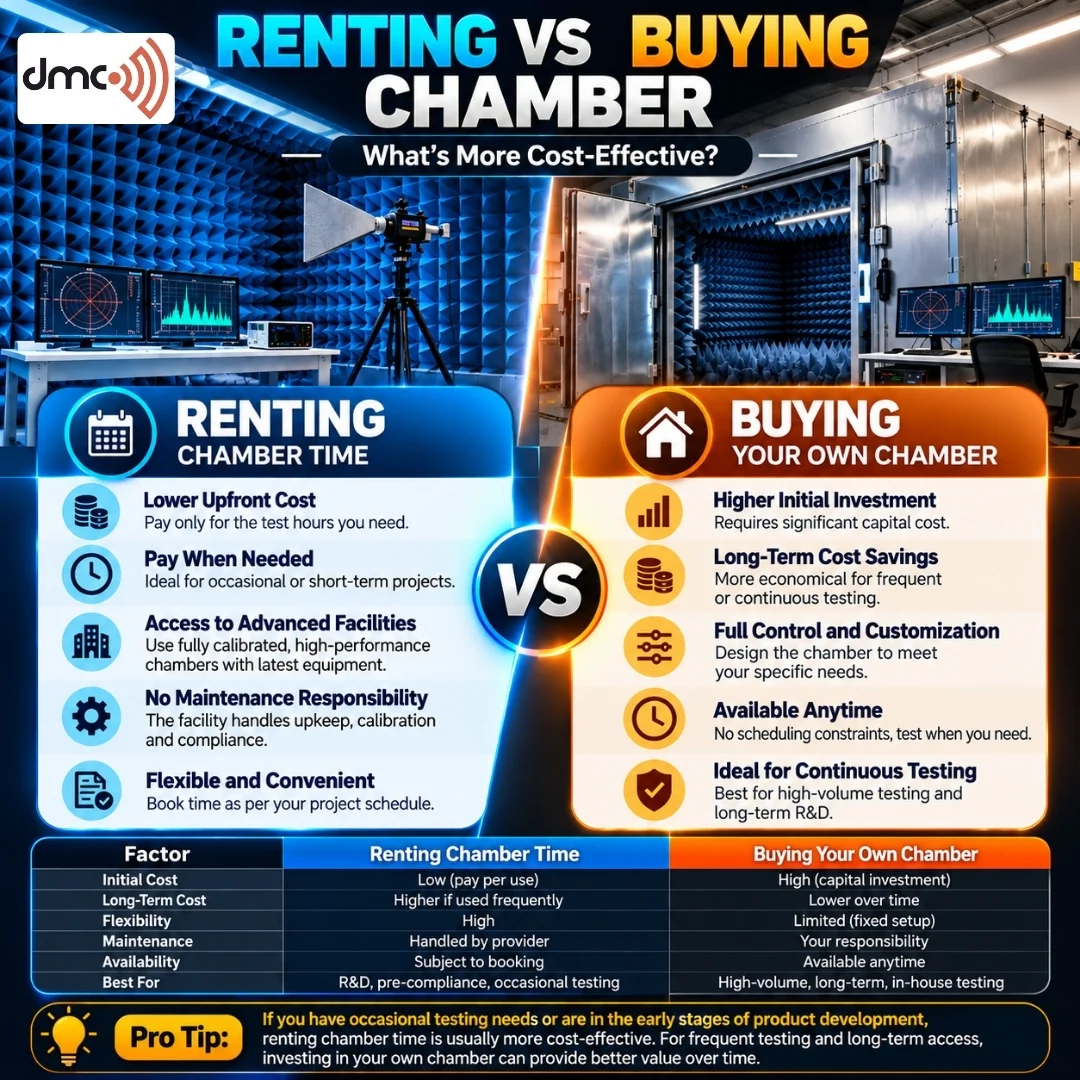
| Factor | Renting Chamber | Buying a Chamber |
|---|---|---|
| Initial investment | Low | High |
| Regular testing | Cost increases with usage | More predictable after installation |
| Facility ownership | No | Yes |
| Maintenance | Usually handled by facility | Owner responsibility |
| Testing availability | Depends on facility schedule | Greater internal control |
| Customization | Limited to available facility | Designed around requirements |
| Scalability | Easy for occasional needs | Requires planning |
| Long-term utilization | Can become expensive with frequent use | Can become economical with high utilization |
| Installation responsibility | Usually none | Significant |
| Capital expenditure | Low | High |
There is no universal break-even point. A company should compare its expected testing frequency, rental rates, engineering requirements, facility costs, and expected chamber lifetime before making a decision.
When Renting Can Be More Cost-Effective
Renting is often practical when testing demand is limited or unpredictable. A company developing a small number of products may not use a chamber frequently enough to justify owning one.
Rental testing can also make sense during early product development. Instead of committing capital before the product portfolio is established, engineering teams can use external facilities to identify emissions, immunity, antenna, or RF performance issues.
It may be particularly suitable when:
- Testing is required only a few times per year.
- The company is still developing its product portfolio.
- Specialized equipment is needed only occasionally.
- Capital expenditure needs to remain low.
- External technical expertise is valuable.
- The organization does not have suitable space for a chamber.
However, scheduling availability should be considered. If a project requires repeated testing and the external facility has limited availability, delays can affect development timelines.
When Buying Can Make More Sense
Owning a chamber becomes more attractive when testing is frequent, predictable, and strategically important to product development.
For manufacturers developing multiple generations of products, internal testing can reduce dependence on external schedules. Engineers can run development tests when needed, investigate problems immediately, and repeat measurements during design iterations.
Potential advantages include:
- Immediate access to the test environment
- Greater control over test scheduling
- Faster engineering iterations
- Ability to customize the chamber
- Reduced dependence on external facilities
- Better integration with internal development processes
However, ownership also creates ongoing responsibilities. A chamber must be properly maintained, operated, and periodically verified. Its performance should remain suitable for the intended measurement method and applicable standards.
Don’t Compare Price Alone
One of the most common mistakes is comparing an hourly rental price directly with the purchase price of a chamber.
A better calculation considers the total cost of ownership.
For a purchased chamber, consider:
Total Ownership Cost = Purchase + Installation + Equipment + Maintenance + Validation + Upgrades + Facility Costs
For rented chamber, consider:
Total Rental Cost = Chamber Fees + Equipment/Service Fees + Travel + Setup + Repeated Test Sessions + Scheduling Impact
This comparison can reveal that a seemingly inexpensive rental becomes costly when testing occurs frequently. Conversely, a purchased chamber may take many years to justify if utilization is low.
Pro Tip
Pro Tip: Before deciding, estimate your expected chamber usage for the next three to five years. Include planned products, development iterations, compliance testing, troubleshooting sessions, and engineering research. Then compare that usage with the complete cost of ownership rather than using only the chamber purchase price.
How Diamond Microwave Chambers Ltd Can Help
Diamond Microwave Chambers Ltd supports organizations that require specialized RF and EMC testing environments. Its chamber solutions can be considered for applications involving RF testing, EMC testing, antenna measurements, OTA testing, microwave testing, and controlled electromagnetic environments.
The right chamber should be selected according to the intended frequency range, equipment requirements, test distance, device size, measurement objectives, shielding performance, absorber configuration, and applicable testing standards.
For radiated disturbance measurements, IEC’s CISPR 16-1-4 addresses antennas and test sites. The 2025 edition covers the characteristics and performance of equipment used for radiated-disturbance measurements and includes requirements related to antennas and test sites.
This highlights why chamber selection should be based on technical requirements rather than price alone.
Final Thoughts
There is no single answer to whether renting or buying chamber is cheaper. Renting can provide flexibility and lower upfront costs for companies with occasional or uncertain testing requirements. Buying can provide greater control and potentially better long-term economics for organizations with consistent, high-volume testing needs.
The most reliable approach is to calculate your expected testing demand, identify the complete cost of each option, and consider operational factors such as scheduling, technical support, maintenance, validation, and future product development.
For organizations planning a dedicated facility, working with an experienced chamber manufacturer such as Diamond Microwave Chambers Ltd can help translate testing objectives into an appropriate chamber configuration.
Frequently Asked Questions
Renting usually requires less upfront capital and can be more economical for occasional testing. For frequent, long-term testing, ownership may become more financially attractive.
Companies with frequent testing requirements, multiple products, repeated development cycles, or a need for immediate internal testing may consider investing in their own EMC chamber.
The evaluation should include the chamber, absorbers, shielding, installation, site preparation, measurement equipment, calibration, validation, maintenance, and future upgrades.
Renting can reduce capital expenditure, provide access to specialized equipment, and allow companies to use professional testing facilities without owning and maintaining the infrastructure.
Estimate your expected testing hours and sessions over three to five years, then compare total rental expenses with the complete cost of ownership and the operational value of having internal access.