
Table of Contents
- What Is ADAS Sensor Fusion Testing?
- How Sensor Fusion Testing Works
- Key Parameters to Evaluate
- Important Testing Challenges
- Role of Diamond Microwave Chambers Ltd
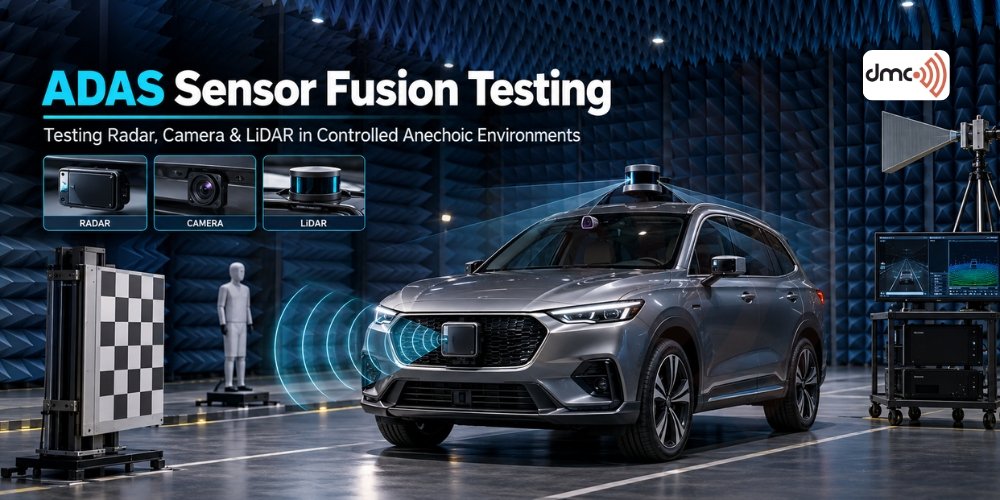
Advanced Driver Assistance Systems (ADAS) increasingly depend on multiple sensors working together to understand the vehicle’s surroundings. Radar, cameras and LiDAR can provide different types of information, but combining those inputs reliably requires careful validation. ADAS Sensor Fusion Testing in Anechoic Chambers provides a controlled environment where engineers can evaluate sensor behavior, electromagnetic conditions and repeatability without many of the variables found in open-road testing.
Sensor fusion is particularly important for functions such as adaptive cruise control, automatic emergency braking, lane-related assistance, blind-spot detection and other automated driving features. ISO 21448:2022 addresses Safety of the Intended Functionality (SOTIF) for functions where safety depends on situational awareness derived from complex sensors and processing algorithms.
What Is ADAS Sensor Fusion Testing?
ADAS sensor fusion testing evaluates how information from different vehicle sensors is combined and interpreted by the electronic control and perception system.
A typical sensor suite may include:
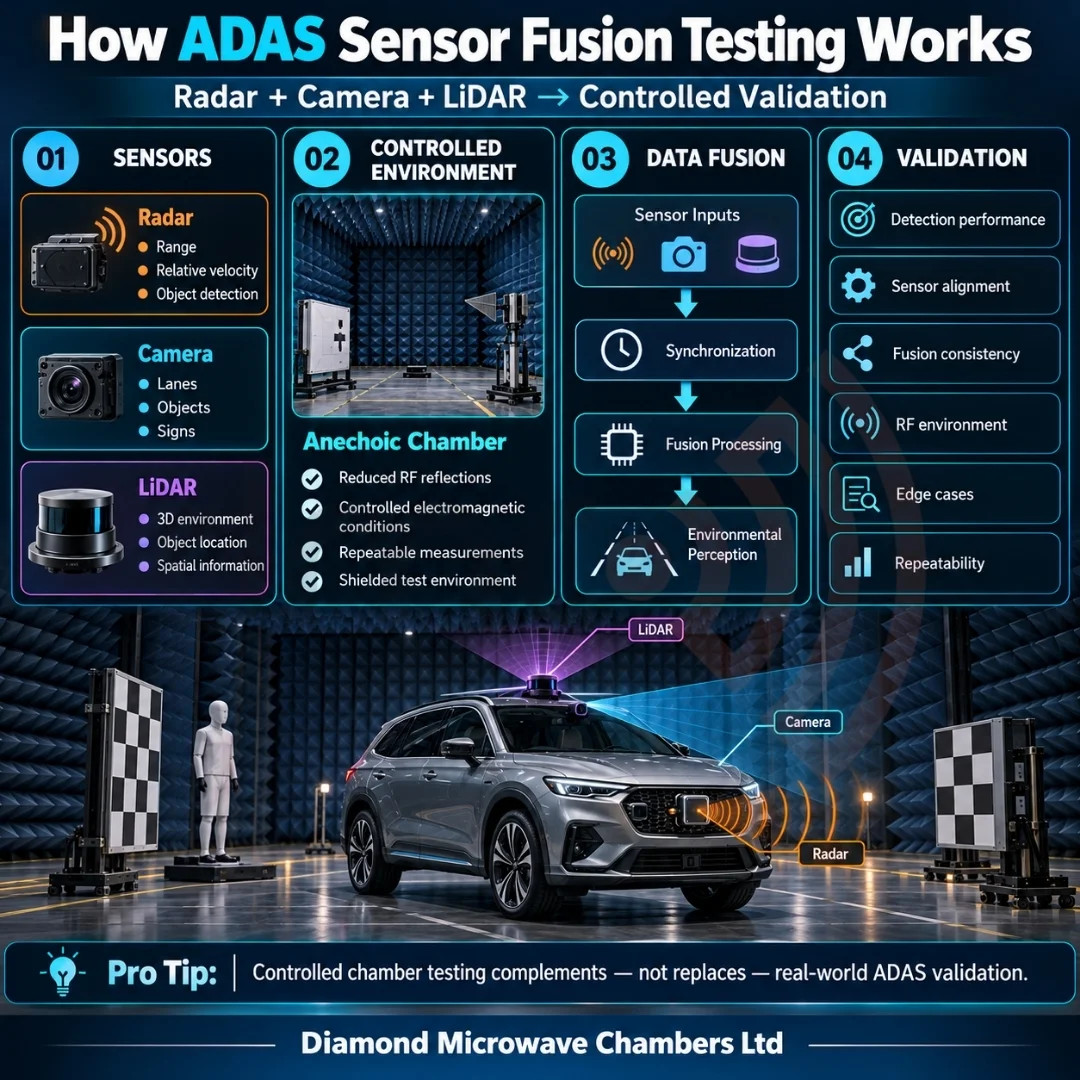
- Radar: Provides information such as range, relative velocity and object detection.
- Camera: Supplies visual information including lanes, signs, vehicles and pedestrians.
- LiDAR: Can provide detailed three-dimensional environmental information where used.
- GNSS/IMU: May provide vehicle position, motion and orientation information.
- Fusion processor: Combines sensor outputs to create a more complete representation of the surrounding environment.
The objective is not simply to determine whether an individual sensor works. Engineers also need to understand whether the combined system produces consistent results when sensor inputs differ, overlap or become degraded.
Why Use an Anechoic Chambers for ADAS Testing?
An anechoic chambers provides a controlled electromagnetic environment designed to reduce unwanted reflections and external RF interference. ETSI measurement guidance describes anechoic chambers as preferred test sites for certain radiated automotive-radar measurements above 1 GHz and explains how absorbing materials help suppress reflections.
For ADAS development, controlled conditions can help engineers:
- Reduce unwanted electromagnetic interference.
- Control radar test signals and measurement conditions.
- Improve test repeatability.
- Evaluate sensor performance under defined RF conditions.
- Investigate interactions between wireless and sensing systems.
- Separate specific test variables rather than relying only on road testing.
An anechoic chamber does not replace real-world validation. Instead, it can complement proving-ground and road testing by providing a repeatable environment for controlled measurements.
How Sensor Fusion Testing Works
A sensor-fusion test normally begins by defining the scenario, sensor configuration and performance criteria. Engineers then configure the vehicle, test equipment, targets and data-acquisition systems.
The process can include:
1. Sensor Configuration
Radar, cameras, LiDAR and supporting vehicle systems are installed and configured according to the test plan.
2. Target or Scenario Setup
Controlled targets, simulated objects or appropriate signal-generation equipment are positioned according to the required test case.
3. RF Environment Control
The chamber helps establish controlled electromagnetic conditions and minimize unwanted reflections.
4. Data Collection
Sensor outputs and fusion-system responses are recorded for analysis.
5. Correlation
Engineers compare expected and measured behavior across repeated test cases.
6. Fault and Edge-Case Evaluation
The system can be evaluated when individual sensor inputs are degraded, inconsistent or unavailable, depending on the test objective.
Key Parameters to Evaluate
The exact measurements depend on the ADAS function and sensor technology, but important areas can include:
| Test Area | What Engineers Evaluate |
|---|---|
| Radar performance | Range, velocity and target detection behavior |
| Camera perception | Object, lane and sign recognition |
| LiDAR performance | Object location and 3D perception |
| Sensor alignment | Spatial relationship between sensor outputs |
| Fusion behavior | Consistency of combined sensor information |
| RF environment | Interference, reflections and controlled signal conditions |
| Repeatability | Consistency across repeated measurements |
| Edge cases | Performance when sensor information is incomplete or degraded |
The test plan should be based on the actual system architecture rather than assuming that every ADAS platform requires the same measurements.
Important Testing Challenges
Sensor fusion introduces challenges that are different from testing a single sensor.
1. Timing and Synchronization
Sensors may operate with different sampling rates, processing delays and data formats. Time synchronization is therefore important when comparing observations from multiple sensors.
2. Different Sensor Characteristics
Radar, camera and LiDAR do not observe the environment in identical ways. Differences in resolution, range, field of view and environmental sensitivity can affect the fusion result.
3. Electromagnetic Interference
Modern vehicles contain numerous electronic systems and wireless technologies. Controlled RF testing can help engineers investigate whether electromagnetic conditions affect sensor or electronic-system behavior.
4. Repeatability
A controlled chamber can reduce environmental variables and make repeated measurements easier to compare. This is especially useful during development and troubleshooting.
5. Edge Cases
Sensor fusion algorithms must account for situations where one sensor provides incomplete, uncertain or conflicting information. These cases can be important in the broader SOTIF verification and validation process. ISO 21448:2022 specifically considers functional insufficiencies and reasonably foreseeable misuse within its SOTIF framework.
Role of Diamond Microwave Chambers Ltd
We support the development of controlled RF and microwave testing environments for applications involving demanding electromagnetic measurement requirements.
For ADAS-related development, an appropriately designed automotive anechoic chambers can support controlled testing of radar systems and related electronic equipment. Chamber design must consider factors such as operating frequency, test distance, absorber performance, shielding, equipment placement, antenna configuration and the required measurement environment.
The correct chamber should therefore be specified from the intended test methodology and equipment requirements rather than selected solely by chamber size.
Pro Tip
Do not treat an anechoic chamber as a complete substitute for road or proving-ground validation. Use controlled chamber testing to isolate specific sensor, RF and system variables, then correlate those results with appropriate real-world scenarios. This combination can provide a stronger verification and validation workflow.
Designing an Effective ADAS Test Environment
A successful test environment begins with clear requirements. Before specifying an anechoic chamber, engineering teams should define:
- Sensor technologies and operating frequencies.
- Required test distances.
- Vehicle or subsystem dimensions.
- Target and positioning requirements.
- RF signal-generation requirements.
- Data-acquisition and synchronization needs.
- Desired shielding and absorber performance.
- Required measurement repeatability.
- Applicable internal and industry test procedures.
This information helps determine the chamber geometry, absorber configuration, shielding approach and supporting test equipment.
Conclusion
ADAS Sensor Fusion Testing in Anechoic Chambers provides engineers with a controlled approach for investigating how multiple sensing technologies and electronic systems behave under defined conditions. Radar, cameras and LiDAR each contribute different information, making synchronization, correlation and controlled testing important parts of sensor-fusion development.
An anechoic chamber can reduce unwanted RF reflections and external electromagnetic variables, helping engineers perform repeatable measurements. However, chamber testing should be considered one component of a broader ADAS verification and validation strategy.
As automotive sensing systems become more complex, combining controlled laboratory testing with simulation, proving-ground testing and real-world evaluation can help development teams identify performance limitations and investigate challenging sensor-fusion scenarios more systematically.
Diamond Microwave Chambers Ltd can support organizations evaluating RF and microwave chamber requirements for automotive sensor and electronic-system testing.
Frequently Asked Questions
ADAS sensor fusion testing evaluates how information from multiple sensors, such as radar, cameras and LiDAR, is combined and interpreted by an ADAS system.
Anechoic chambers provide a controlled electromagnetic environment with reduced RF reflections and external interference, supporting repeatable radiated measurements.
Yes. Anechoic chambers are used for controlled radiated testing of automotive radar and other RF systems, subject to the applicable test method and chamber characteristics.
No. Chamber testing provides controlled laboratory conditions and should complement appropriate simulation, proving-ground and real-world validation.
ISO 21448:2022 addresses SOTIF for intended functions where safety depends on situational awareness derived from complex sensors and processing algorithms.