
Table of Contents
- What Is Full-Vehicle EMC Testing?
- What Is Component-Level EMC Testing?
- Why Automotive Manufacturers Often Need Both
Satellite Communication Equipment EMC Validation is an important part of developing reliable satellite communication products for demanding environments. Satellite terminals, modems, transceivers, amplifiers, receivers, gateways, GNSS equipment, and associated electronics can both generate electromagnetic disturbances and be affected by external interference. Proper EMC validation helps manufacturers identify these risks before equipment reaches deployment, certification, or operational service. Diamond Microwave Chambers Ltd supports the controlled RF and EMC testing environments needed to evaluate equipment performance under defined electromagnetic conditions.
Why EMC Validation Matters for Satellite Communication Equipment
Satellite communication equipment must often operate continuously while handling sensitive RF signals, digital processing, power conversion, networking, and control functions. A product may perform correctly during normal laboratory operation but experience degradation when exposed to electromagnetic disturbances.
EMC validation evaluates two fundamental areas:
- Emissions: unwanted electromagnetic energy generated by the equipment.
- Immunity: the ability of equipment to continue operating when exposed to electromagnetic disturbances.
The exact tests depend on the equipment type, intended environment, applicable market requirements, radio technology, and product-specific standards. There is no single EMC test standard that automatically applies to every satellite communication product.
For example, IEC 61000-6-2:2016 provides generic immunity requirements for equipment intended for industrial environments when no relevant dedicated product or product-family immunity standard exists. IEC 61000-6-4:2018 addresses generic emission requirements for industrial environments.
What Equipment May Require EMC Validation?
Satellite communication systems can contain multiple electronic subsystems, each with different EMC characteristics.
Typical equipment includes:
- Satellite modems and network terminals
- RF transceivers and receivers
- Block upconverters and low-noise block converters
- Satellite amplifiers
- VSAT equipment
- GNSS receivers
- Mobile and fixed earth-station equipment
- Satellite gateway electronics
- Antenna control and tracking systems
- Power supplies and converters
- Digital processing and networking units
- Communication control units
The complete system configuration should be considered because cables, power supplies, enclosures, interfaces, and connected peripherals can influence EMC performance.
Key EMC Tests
A practical validation programme may include several categories of testing.
| EMC Test Area | What It Evaluates | Typical Concern |
|---|---|---|
| Radiated emissions | Electromagnetic energy radiated by equipment | Interference with nearby receivers |
| Conducted emissions | Noise conducted through power or signal connections | Interference through cables |
| Radiated immunity | Response to external RF fields | Loss of communication or malfunction |
| Conducted immunity | Response to disturbances entering through cables | Reset, data errors or degraded operation |
| Electrostatic discharge | Response to ESD events | Temporary or permanent malfunction |
| Electrical fast transients | Response to fast electrical disturbances | Communication interruption |
| Surge | Response to higher-energy transients | Power or interface damage |
| Power-frequency magnetic fields | Immunity to magnetic-field exposure where applicable | Functional degradation |
Not every test above is applicable to every satellite product. The test plan should be based on the product’s intended environment and applicable standard.
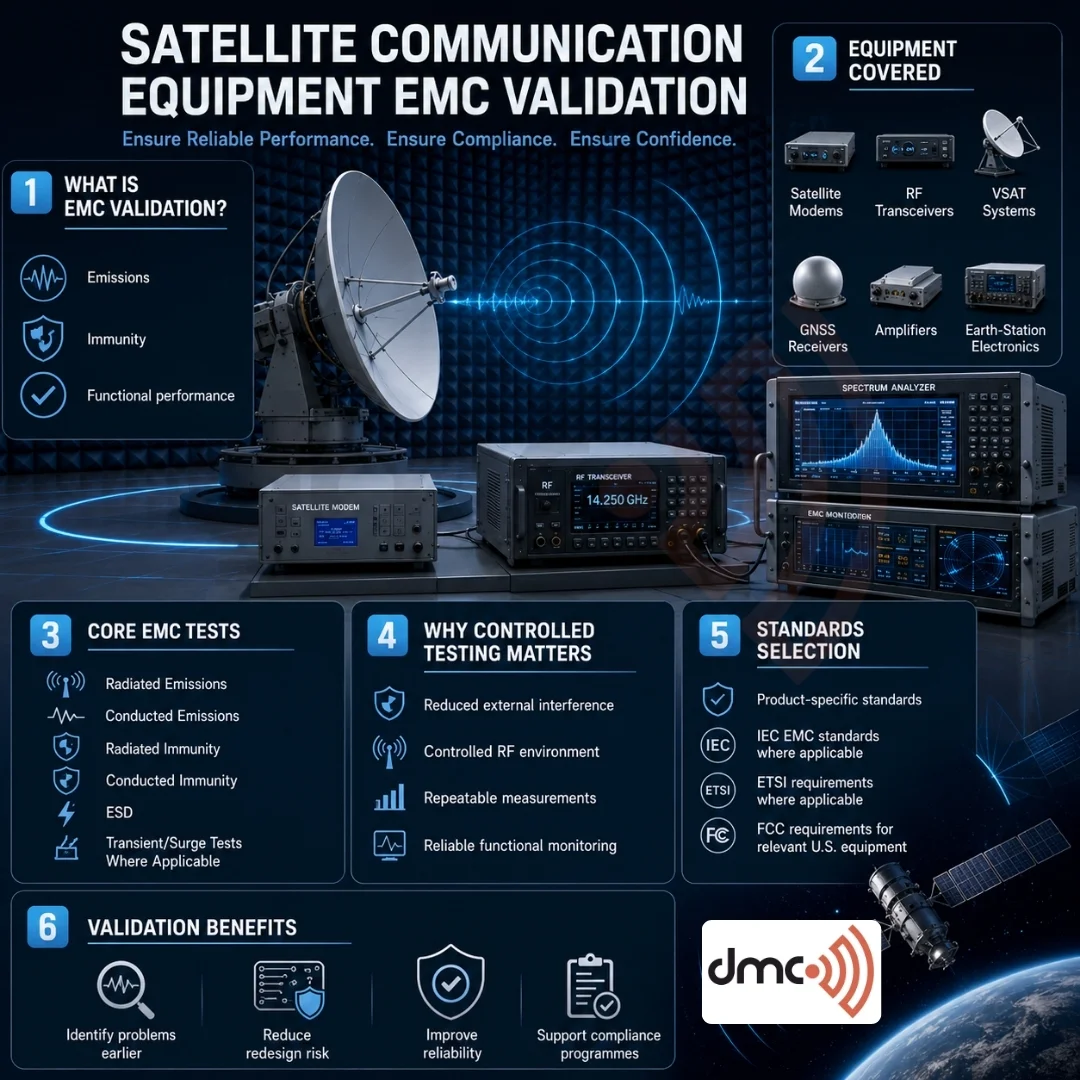
EMC Validation in a Controlled Test Environment
Reliable measurements require a suitable test environment. Uncontrolled electromagnetic reflections, external RF signals, poor grounding, cable configuration, or inadequate chamber performance can affect test results.
A properly designed EMC chamber can help provide controlled electromagnetic conditions and reduce unwanted external interference. Absorber systems, shielding, filtering, appropriate antenna arrangements, turntables, monitoring equipment, and calibrated measurement instrumentation all contribute to a repeatable test setup.
Diamond Microwave Chambers Ltd provides RF and EMC chamber solutions designed around specific testing requirements. The chamber specification should be matched to the frequency range, equipment dimensions, required field strengths, measurement configuration, and applicable standards.
Satellite RF Performance and EMC Must Be Considered Together
One of the challenges in satellite communication testing is that EMC performance cannot always be separated from RF functionality.
A satellite receiver may experience:
- Reduced receiver sensitivity
- Increased noise floor
- Loss of synchronization
- Packet errors
- Temporary communication loss
- Control-system interruptions
A transmitter or power amplifier can also generate unwanted emissions that potentially affect other electronic systems.
This makes functional monitoring important during immunity testing. Instead of checking only whether the equipment remains powered, engineers should define meaningful performance criteria such as communication continuity, data integrity, alarm status, synchronization, receiver lock, or specified degradation limits.
Pro Tip
Do not select EMC tests simply because they were used for another satellite product. Start with the product architecture, operating environment, frequency range, ports, power configuration, radio technology, destination market, and applicable product or regulatory standards. This reduces unnecessary testing while helping prevent important EMC requirements from being overlooked.
Benefits of Early EMC Validation
Performing EMC validation early in product development can reveal design weaknesses before formal compliance testing.
Potential benefits include:
- Earlier identification of emission problems
- Better immunity performance
- Reduced redesign risk
- Improved system reliability
- More predictable compliance testing
- Better understanding of cable and enclosure effects
- Reduced risk of late-stage certification failures
EMC testing should therefore be viewed as part of engineering verification rather than only as a final certification exercise.
Conclusion
Satellite Communication Equipment EMC Validation helps manufacturers evaluate whether communication equipment can control unwanted emissions and maintain reliable operation in the presence of electromagnetic disturbances. Because satellite products vary considerably, EMC validation must be based on the equipment’s function, environment, operating frequencies, interfaces, destination market, and applicable standards.
A carefully planned validation programme, supported by a controlled RF test environment, can identify problems earlier and provide stronger evidence of product robustness. For manufacturers developing satellite communication, earth-station, RF, and related electronic systems, Diamond Microwave Chambers Ltd can support the chamber infrastructure required for controlled EMC and RF testing.
Frequently Asked Questions
Full-vehicle testing evaluates the electromagnetic behaviour of the complete vehicle, while component-level testing evaluates individual electronic modules or subsystems.
It allows engineers to identify and correct emissions or immunity problems before a component is integrated into the complete vehicle.
Not necessarily. Vehicle testing evaluates system-level behaviour, but component testing can make it easier to isolate and correct problems at the module level.
CISPR 25 is used for automotive radio-disturbance measurements, while ISO 11451 and ISO 11452 cover vehicle and component immunity test methods. The exact requirements depend on the test programme and applicable edition.
The chamber should be specified according to the required test methods, frequency range, DUT size, antenna and instrumentation requirements, applicable standards, validation requirements and expected future testing.