
Table of Contents
- What Is Full-Vehicle EMC Testing?
- What Is Component-Level EMC Testing?
- Why Automotive Manufacturers Often Need Both
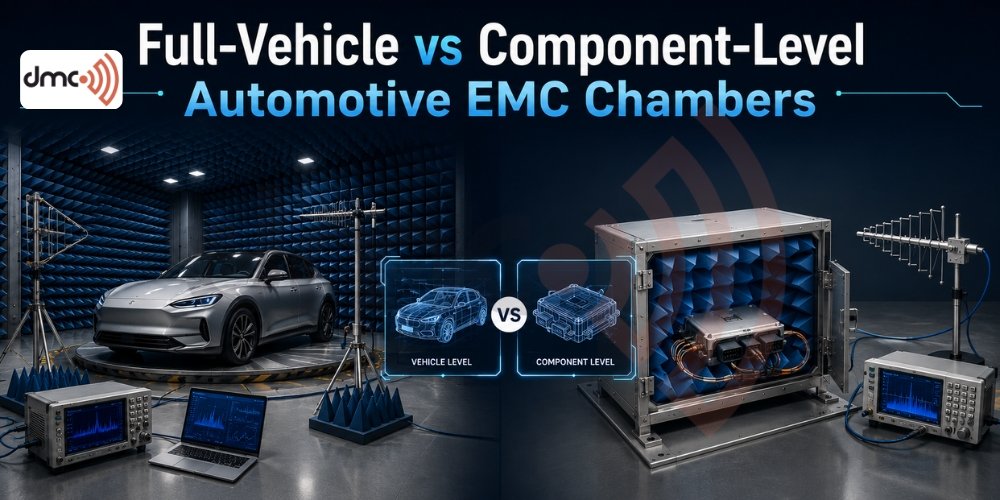
Automotive electronics are becoming more complex, with electric powertrains, advanced driver assistance systems, connected infotainment, battery-management systems, sensors, radar and wireless communication technologies operating within the same vehicle. This makes electromagnetic compatibility (EMC) an important part of automotive development. Full-Vehicle vs Component-Level Automotive EMC Chambers is therefore an important consideration for manufacturers deciding how and where to evaluate electromagnetic emissions and immunity. While both approaches support EMC development, they test different parts of the system and answer different engineering questions.
What Is Full-Vehicle EMC Testing?
Full-vehicle EMC testing evaluates the complete vehicle in a controlled electromagnetic environment. The vehicle is positioned inside a sufficiently large test facility, with the necessary antennas, measurement equipment, monitoring systems and supporting infrastructure.
The purpose is to understand how the vehicle behaves as an integrated system. Wiring harnesses, electronic control units, motors, inverters, sensors, body structures and communication systems can interact in ways that may not be visible during individual component testing.
Vehicle-level testing can be particularly important because the physical installation of components and harnesses can influence electromagnetic coupling. CISPR 25:2021 distinguishes vehicle and component/module test methods, while ISO 11451-2:2025 specifies a vehicle immunity method using external radiation sources.
Full-Vehicle EMC Testing Typically Helps Evaluate:
- Radiated emissions from the complete vehicle
- Vehicle immunity to external electromagnetic fields
- Interactions between electronic systems
- Effects of actual vehicle wiring and grounding
- Performance of installed antennas and communication systems
- Electromagnetic behaviour of EV and hybrid powertrain systems
- System-level EMC issues that may not appear during component testing
The major advantage is realism. Engineers can evaluate the electromagnetic behaviour of the vehicle in an arrangement much closer to its intended operating configuration.
What Is Component-Level EMC Testing?
Component-level EMC testing focuses on an individual electronic module or subsystem rather than the complete vehicle. Examples include electronic control units, battery-management electronics, sensors, lighting modules, infotainment equipment, power converters and other automotive electronic assemblies.
Component testing can be performed earlier in the development cycle and allows engineers to isolate problems before they become system-level issues.
For example, ISO 11452-2:2019 defines an absorber-lined shielded enclosure method for testing component immunity to continuous narrowband electromagnetic fields. The device under test and its wiring harness are exposed to the required electromagnetic disturbance inside the enclosure.
CISPR 25:2021 also includes methods for components and modules, alongside complete-vehicle methods.
Component-Level Testing Is Useful For:
- Identifying emissions from individual electronic modules
- Evaluating immunity before vehicle integration
- Troubleshooting specific EMC problems
- Comparing design revisions
- Supporting supplier validation
- Reducing development-stage testing time
- Investigating PCB, enclosure, cable and grounding issues
Component testing is often more practical during product development because the equipment under test is smaller and easier to modify or replace.
Full-Vehicle vs Component-Level Automotive EMC Chambers: Key Differences
| Factor | Full-Vehicle EMC Chamber | Component-Level EMC Chamber |
|---|---|---|
| Test object | Complete vehicle | ECU, module or subsystem |
| Facility size | Large | Smaller |
| Main objective | System-level EMC performance | Component-level performance |
| Vehicle installation | Required | Not required |
| Troubleshooting | More complex | Easier to isolate |
| Development stage | Later/system validation | Early and intermediate development |
| Testing flexibility | Lower for rapid design changes | Higher |
| Infrastructure | Extensive | Comparatively compact |
| Typical concern | System interactions | Individual component behaviour |
| Cost and space | Generally higher | Generally lower |
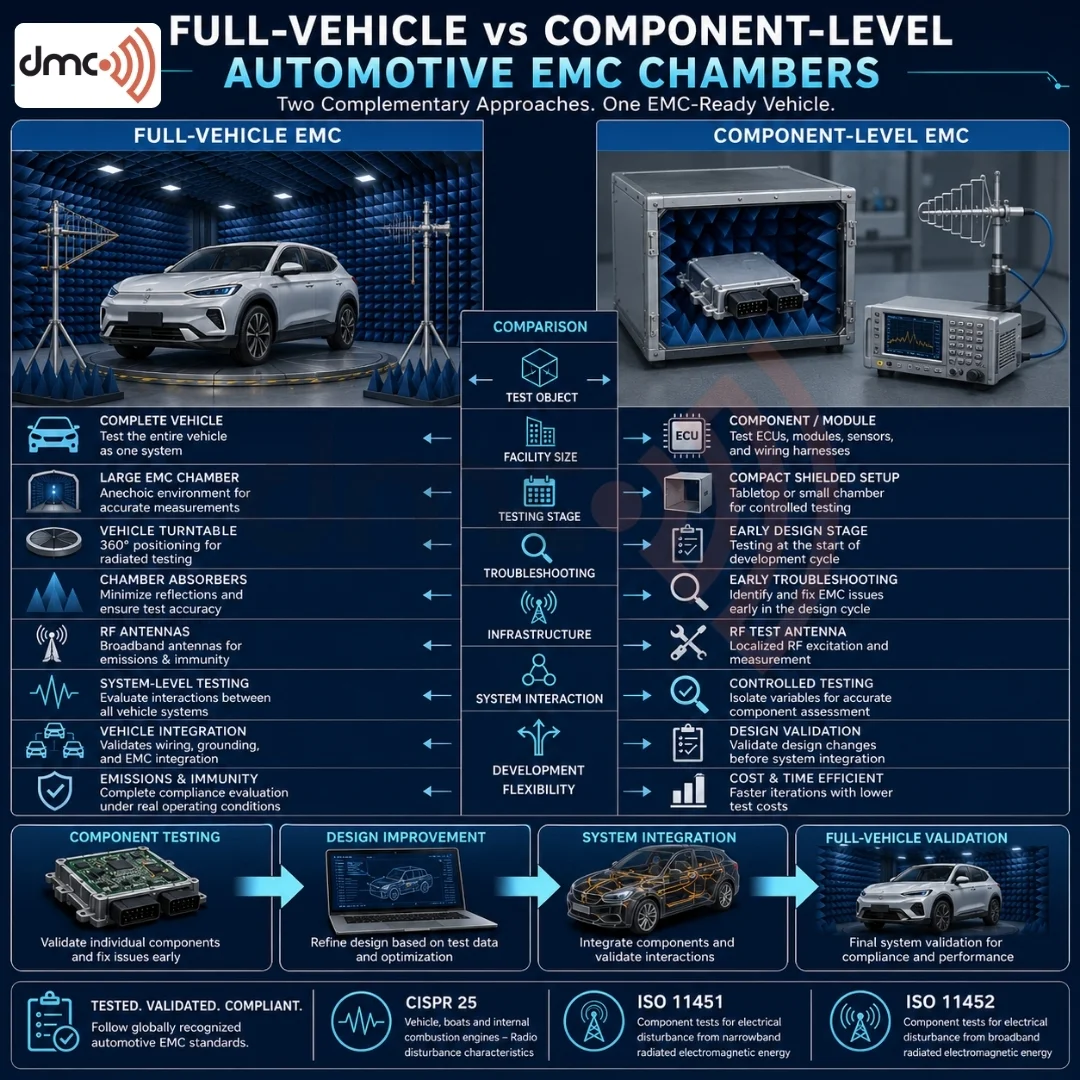
The table highlights why these facilities should not be treated as interchangeable. A component chamber can support efficient engineering development, while a full-vehicle chamber provides information about the integrated vehicle.
Why Automotive Manufacturers Often Need Both
The comparison between Full-Vehicle vs Component-Level Automotive EMC Chambers is not necessarily about choosing one facility over the other. In many development programmes, both levels complement each other.
A component may pass its individual EMC requirements but behave differently after installation because of cable routing, grounding, vehicle body geometry, proximity to other electronics or interaction with other systems.
Similarly, discovering an EMC problem during full-vehicle testing does not always identify its root cause immediately. Engineers may need to remove the suspected module and return to component-level testing to isolate the source.
A practical development sequence can therefore be:
- Design and simulation
- Component-level EMC testing
- Design modification
- Subsystem validation
- Vehicle integration
- Full-vehicle EMC testing
- Final corrective actions and validation
This staged approach can help identify problems earlier rather than waiting until the complete vehicle is assembled.
Chamber Design Considerations
Automotive EMC chambers need to be designed around the intended test methods rather than simply the physical size of the equipment.
For full-vehicle facilities, engineers need to consider vehicle dimensions, antenna positioning, turntables or positioning systems, absorber coverage, access doors, cable routing and measurement instrumentation.
Component chambers have different priorities. Test fixtures, harness layouts, grounding arrangements, RF generation systems and monitoring equipment can become more important than vehicle access.
The absorber system is also significant. Proper electromagnetic absorption helps control reflections and create a suitable test environment. Chamber shielding must also provide adequate isolation from external electromagnetic interference.
For either facility, the chamber should be validated according to the applicable test methodology rather than judged only by its construction materials or appearance.
Choosing the Right Automotive EMC Chamber
When evaluating Full-Vehicle vs Component-Level Automotive EMC Chambers, manufacturers should first identify the testing requirements.
Consider:
- Vehicle or component test requirements
- Applicable customer specifications
- Required frequency range
- Emission and immunity tests
- Vehicle dimensions
- EV or hybrid high-voltage systems
- Antenna and RF equipment requirements
- Expected testing volume
- Future vehicle platforms
- Available facility space
- Calibration and validation requirements
There is no universal chamber specification that fits every automotive programme. The correct solution depends on the test plan, vehicle architecture, applicable standards and future development requirements.
Pro Tip
Design the chamber around the test programme, not simply around the vehicle or component size. Define the required standards, frequency range, test configurations, instrumentation and future testing needs before finalising the chamber architecture.
Conclusion
Understanding Full-Vehicle vs Component-Level Automotive EMC Chambers helps automotive manufacturers create a more effective EMC development strategy. Component-level testing provides controlled conditions for individual modules and supports early troubleshooting, while full-vehicle testing evaluates electromagnetic behaviour after systems have been integrated.
Neither approach completely replaces the other. Component testing can identify problems early, whereas vehicle-level testing reveals interactions that may only appear after integration. For this reason, a coordinated testing strategy can provide stronger technical confidence throughout automotive development.
Diamond Microwave Chambers Ltd develops engineered RF and EMC chamber solutions for demanding measurement environments. By defining the intended test methods, standards, equipment and future requirements at the beginning of a project, manufacturers can select a chamber configuration that supports both reliable testing and long-term development needs.
Frequently Asked Questions
Full-vehicle testing evaluates the electromagnetic behaviour of the complete vehicle, while component-level testing evaluates individual electronic modules or subsystems.
It allows engineers to identify and correct emissions or immunity problems before a component is integrated into the complete vehicle.
Not necessarily. Vehicle testing evaluates system-level behaviour, but component testing can make it easier to isolate and correct problems at the module level.
CISPR 25 is used for automotive radio-disturbance measurements, while ISO 11451 and ISO 11452 cover vehicle and component immunity test methods. The exact requirements depend on the test programme and applicable edition.
The chamber should be specified according to the required test methods, frequency range, DUT size, antenna and instrumentation requirements, applicable standards, validation requirements and expected future testing.