
Table of Contents
- Estimated EMC Anechoic Chamber Costs in 2026
- What Determines the Cost of an EMC Anechoic Chamber?
- Is a Custom EMC Anechoic Chamber More Expensive?
An EMC anechoic chamber is a major investment for organizations involved in electromagnetic compatibility testing, RF testing, product development, automotive validation, aerospace, defense, and wireless technology. However, there is no single fixed price because every chamber is designed around specific testing requirements.
In 2026, a basic EMC or RF test chamber may cost significantly less than a large, fully integrated compliance facility. Factors such as chamber size, frequency range, absorber technology, shielding performance, automation, and installation requirements can all affect the final investment.
Based on publicly available starting prices from Diamond Microwave Chambers Ltd, standard semi-anechoic and fully anechoic EMC chamber configurations can start from approximately $295,000 for a 3 m semi-anechoic chamber, while larger and more advanced systems can cost substantially more. These prices should be treated as starting points rather than universal final prices because project-specific requirements can change the total cost.
Estimated EMC Anechoic Chamber Costs in 2026
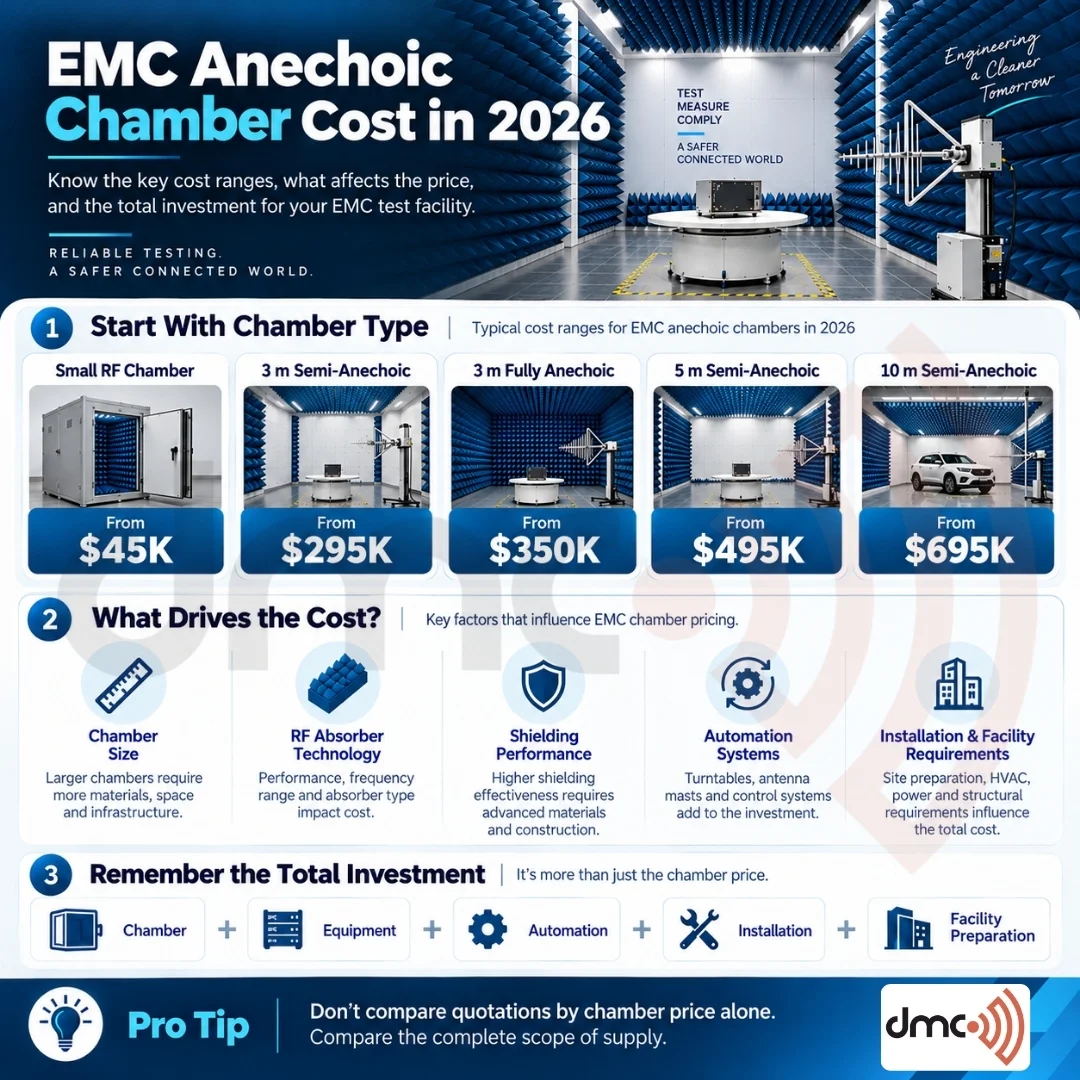
The following table provides a general comparison of common EMC chamber configurations and their publicly listed starting prices or typical project ranges. Actual quotations may vary based on technical specifications.
| Chamber Type | Typical Application | Estimated Starting Cost |
|---|---|---|
| Small RF/Antenna Chamber | Research and basic RF testing | From $45,000 |
| 3 m Semi-Anechoic EMC Chamber | Pre-compliance and EMC testing | From $295,000 |
| 3 m Fully Anechoic EMC Chamber | Advanced EMC and RF measurements | From $350,000 |
| 5 m Semi-Anechoic EMC Chamber | Larger products and expanded testing | From $495,000 |
| 10 m Semi-Anechoic EMC Chamber | Automotive and full-compliance testing | From $695,000 |
These figures represent useful budgeting references rather than guaranteed project prices. The final EMC anechoic chamber cost depends on the complete technical scope, equipment package, site conditions, and performance requirements.
What Determines the Cost of an EMC Anechoic Chamber?
1. Chamber Size
Chamber size is one of the biggest cost drivers. A larger chamber requires more structural material, RF shielding, absorbers, electrical infrastructure, HVAC integration, and installation work.
For example, a 3 m chamber generally requires less internal space and absorber coverage than a 10 m chamber. However, choosing a smaller chamber simply to reduce the initial investment can create operational limitations if the organization later needs to test larger products.
Before selecting a chamber size, consider:
- Maximum dimensions of the equipment under test
- Required antenna separation distance
- Future product development plans
- Applicable EMC standards
- Space available inside the facility
A properly sized chamber may cost more initially but can provide better long-term value than a facility that quickly becomes inadequate.
2. RF Absorber Technology
RF absorbers are essential for reducing unwanted electromagnetic reflections inside an anechoic chamber. The type, thickness, geometry, and frequency performance of the absorber system directly affect the overall cost.
Common options may include:
- Ferrite absorbers
- Pyramidal foam absorbers
- Hybrid ferrite and foam systems
- Broadband absorbers designed for specific frequency ranges
Lower-frequency performance often requires more specialized absorber solutions. Therefore, a chamber designed for a broad frequency range can cost considerably more than a system intended for a narrower application.
3. Shielding Performance and Construction
An EMC chamber requires effective shielding to isolate the test environment from external electromagnetic interference. The shielded enclosure itself can represent a substantial portion of the project investment.
The final cost may depend on:
- Shielding effectiveness requirements
- Steel or modular construction
- Number and type of RF doors
- Filtered electrical penetrations
- Data and communication interfaces
- Ventilation and HVAC waveguides
High-performance shielding is particularly important when accurate and repeatable measurements are required. An anechoic chamber is not simply an absorber-lined room; the shielding system and RF absorber treatment must work together to create a controlled test environment.
4. Test Equipment and Automation
The chamber itself is only one part of a complete EMC testing facility. Additional equipment can significantly increase the overall project cost.
A complete system may include:
- Antenna masts
- Turntables
- Positioning systems
- Control software
- Test antennas
- EMI receivers
- Signal generators
- Amplifiers
- Monitoring and safety systems
Organizations should clearly separate the cost of the chamber infrastructure from the cost of test instrumentation when preparing a budget. A chamber quotation may not automatically include every instrument required for a specific compliance program.
5. Installation and Facility Requirements
Installation costs can vary depending on the project location and building conditions. Some facilities may already have sufficient floor space, structural clearance, electrical capacity, and HVAC infrastructure. Others may require major modifications before installation can begin.
Potential additional costs include:
- Building preparation
- Foundation and floor work
- Electrical upgrades
- HVAC integration
- Fire and safety systems
- Shipping and logistics
- Installation and commissioning
- Site validation
These expenses are sometimes underestimated during early budgeting. For this reason, buyers should evaluate the total project cost instead of focusing only on the listed chamber price.
Is a Custom EMC Anechoic Chamber More Expensive?
In many cases, a custom-designed chamber costs more than a standard configuration because it requires specialized engineering and manufacturing. However, customization can be financially beneficial when standard chamber dimensions or features do not match the intended application.
Custom requirements may include:
- Large automotive components
- Electric vehicle powertrain systems
- Military and defense equipment
- High-frequency antenna testing
- Specialized doors and access systems
- Automated positioning systems
- Unique frequency requirements
At Diamond Microwave Chambers Ltd, EMC and RF chamber solutions can be designed around specific testing applications and facility requirements. A custom solution should be evaluated based on the complete testing objective rather than the chamber purchase price alone.
How Can You Budget for an EMC Chamber in 2026?
A practical approach is to divide the project budget into separate categories:
- Chamber infrastructure – shielding, absorbers, doors, and structural components.
- Testing equipment – antennas, receivers, amplifiers, and related instruments.
- Automation – turntables, masts, positioners, and software.
- Facility preparation – power, HVAC, space, and building modifications.
- Installation and validation – commissioning and performance verification.
- Long-term ownership – maintenance, calibration, training, and upgrades.
This approach provides a more realistic picture of the total investment. It also helps organizations identify which features are essential at the beginning and which can potentially be added later.
Is Buying an EMC Anechoic Chamber Worth the Investment?
The answer depends on testing volume and business requirements. Organizations that frequently use external EMC laboratories may benefit from faster development cycles and greater testing flexibility by establishing an in-house facility.
Potential benefits include:
- Faster pre-compliance testing
- Reduced dependence on external laboratories
- Improved product development cycles
- Better control over confidential projects
- Easier troubleshooting and debugging
- Long-term testing capability
However, smaller organizations with limited testing requirements may find external laboratory services more economical. A financial decision should therefore consider the expected test volume, cost of outsourced testing, product development schedule, and future growth.
Pro Tip: Ask for a detailed scope of supply before comparing EMC chamber quotations. The lowest initial price may exclude critical items such as installation, automation, calibration support, facility modifications, or test equipment.
Final Thoughts
So, how much does an EMC anechoic chamber cost in 2026? The answer can range from tens of thousands of dollars for smaller specialized RF chambers to several hundred thousand dollars or more for advanced EMC testing systems.
For a realistic budget, buyers should evaluate chamber size, frequency range, absorber technology, shielding performance, automation, test equipment, and installation requirements. Publicly listed starting prices from Diamond Microwave Chambers Ltd provide a useful initial reference, but a detailed project quotation is necessary for an accurate final investment.
The best approach is not simply to search for the cheapest anechoic chamber price. Instead, choose a system that meets current testing requirements while providing sufficient flexibility for future technologies, products, and compliance needs.
Frequently Asked Questions
A 3 m EMC chamber can vary significantly depending on its design and included equipment. Publicly listed starting prices for a 3 m semi-anechoic chamber from Diamond Microwave Chambers Ltd begin at approximately $295,000, while project-specific configurations may cost more.
EMC chambers require specialized RF shielding, high-performance absorber materials, filtered services, mechanical systems, installation, and validation. Automation and test instrumentation can further increase the total project cost.
Not always. The chamber infrastructure and EMC test equipment may be quoted separately. Buyers should confirm whether antennas, receivers, amplifiers, turntables, software, and other equipment are included.
A 10 m chamber is generally more expensive because it requires a larger shielded enclosure, more RF absorber material, greater facility space, and additional infrastructure.
The most accurate way is to request a project-specific quotation based on your testing standards, product dimensions, frequency range, chamber size, automation requirements, and installation location.