
Table of Contents
- Why Bigger Is Not Always Better
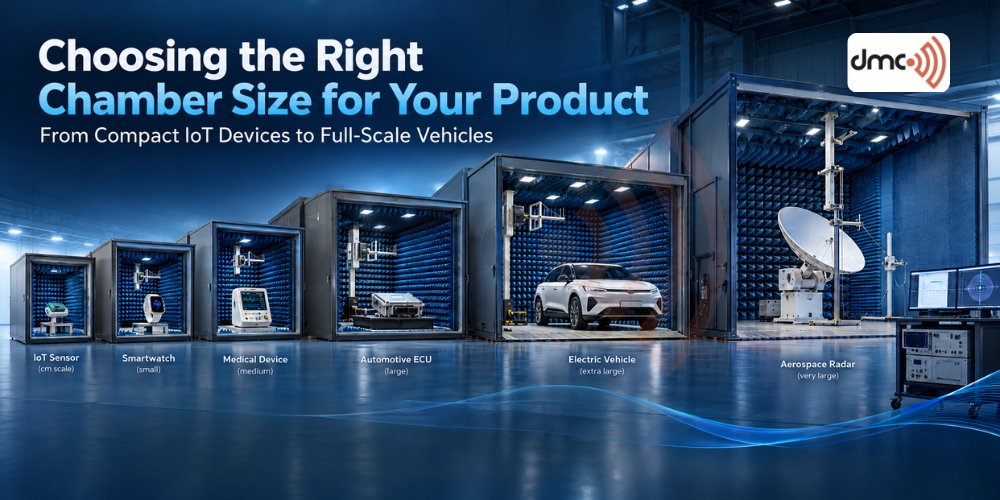
- Chamber Size by Product Category
- Near-Field and Far-Field Chamber Considerations
- Choosing the Right Chamber from the Start
Selecting the right chamber size is one of the most important decisions in any EMC or RF testing project. However, many businesses focus on the equipment they want to test before considering whether the chamber itself is appropriately designed for that application.
At Diamond Microwave Chambers Ltd, we have seen situations where a testing facility selected an oversized chamber for a compact IoT device or, conversely, attempted to test large automotive equipment inside a chamber that simply did not provide sufficient measurement distance. Both situations can lead to unnecessary costs, inefficient use of space, and unreliable test results.
Why Bigger Is Not Always Better
A common misconception is that selecting the largest possible EMC chamber size automatically provides better testing performance. While an undersized chamber can certainly create measurement problems, an unnecessarily large chamber may also increase construction and operating costs without providing meaningful benefits.
An oversized chamber may require:
- More RF absorber material
- Additional construction space
- Higher installation and maintenance costs
- Larger HVAC and ventilation requirements
- More floor space than the testing application actually needs
The right RF chamber dimensions should therefore be based on a combination of technical and practical requirements.
Key factors that influence chamber size include:
- The physical size of the device under test (DUT)
- Test fixtures, antennas, positioners, and support equipment
- The required frequency range
- Applicable EMC or RF testing standards
- Required measurement distance
- Near-field or far-field testing requirements
- Future testing requirements and product expansion plans
This approach provides a more effective chamber selection guide than simply choosing the biggest available chamber.
Chamber Size by Product Category
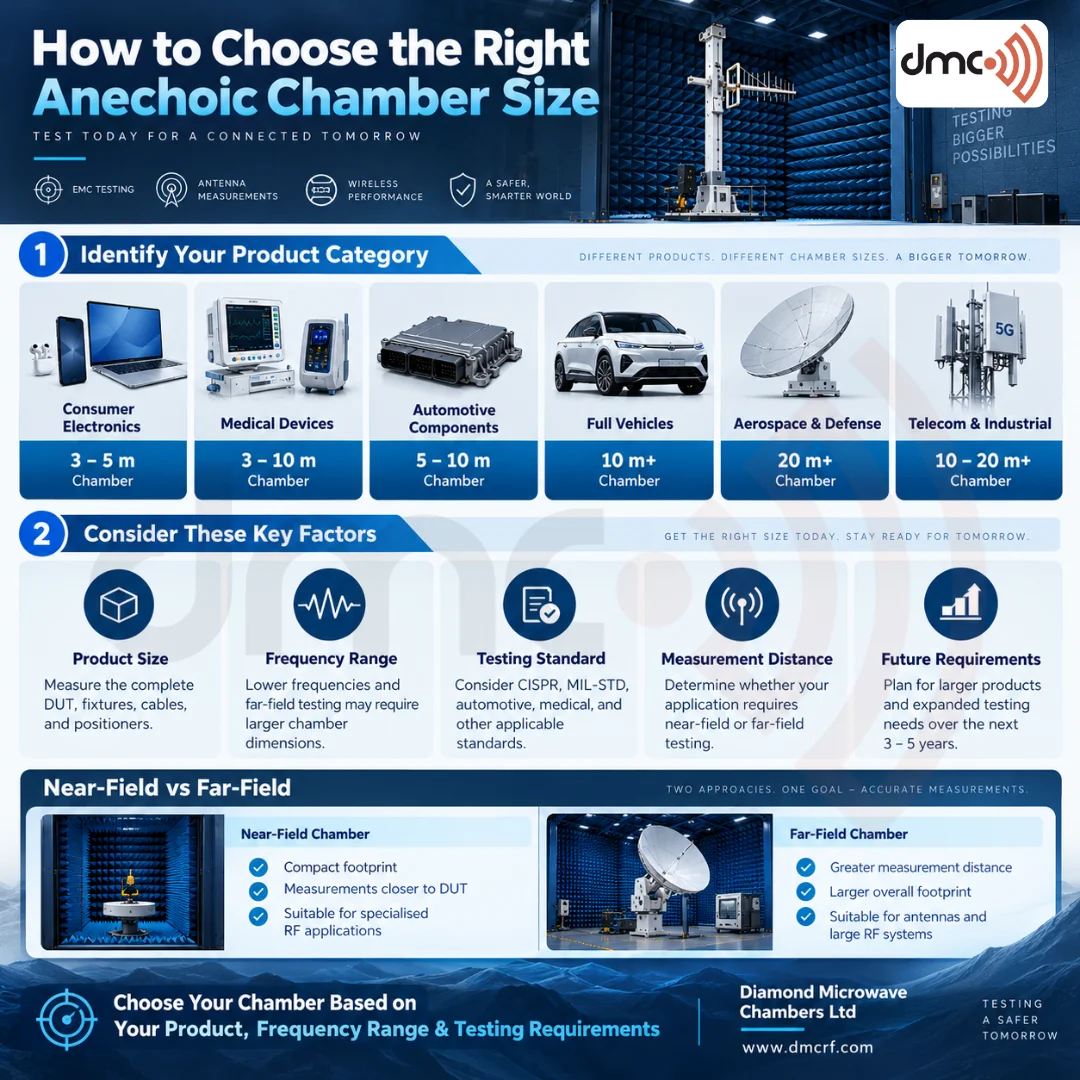
Different product categories often require different testing environments. Although every project should be individually engineered, grouping products by category can provide a useful starting point when determining the appropriate chamber size by product.
Consumer Electronics and Wearables
Consumer electronics such as smartphones, smartwatches, wireless earbuds, tablets, and compact IoT devices typically require smaller testing environments compared with industrial or automotive equipment.
For many applications, a 3-metre or 5-metre semi-anechoic chamber may be suitable, depending on the required standard and measurement method.
These products may be physically small, but they often operate across multiple high-frequency wireless bands. As a result, chamber design must focus not only on physical space but also on effective RF absorber performance at the frequencies being tested.
Typical applications include:
- Smartphones and tablets
- Smartwatches and wearable devices
- Wireless sensors
- IoT modules
- Bluetooth devices
- Consumer communication equipment
A compact EMC chamber size can often provide an efficient solution when the DUT and required testing distance are relatively small.
Medical Devices
Medical equipment presents a more diverse set of chamber requirements. The physical size of the product alone may not determine the required chamber dimensions.
For example, a portable diagnostic device and a larger medical monitoring system may both fall within the medical category, but their electromagnetic compatibility requirements can be significantly different.
Depending on the applicable regulations and testing standards, medical devices may require chambers ranging from compact 3-metre facilities to larger 10-metre testing environments.
Important considerations include:
- Device classification
- Applicable EMC standards
- Operating environment
- Required immunity and emissions testing
- Product dimensions and cable configurations
For this reason, medical device chamber selection should be based primarily on the testing standard and intended application rather than the product category alone.
Automotive Components
Automotive components such as ECUs, radar sensors, infotainment systems, battery management systems, and electronic control modules often require mid-sized EMC and RF testing chambers.
A chamber in the 5-metre to 10-metre range may be suitable for many component-level applications, depending on the specific automotive standard.
However, full-vehicle testing is a completely different requirement.
Testing an entire vehicle requires sufficient internal space for the vehicle itself, antennas, test equipment, positioning systems, and the required measurement distance. These projects often require a 10-metre or larger chamber with specialised infrastructure.
Typical chamber requirements may include:
- Vehicle turntables
- High-performance RF absorbers
- Large RF shielded doors
- Integrated antenna positioning systems
- Automotive-specific EMC testing infrastructure
When determining chamber size by product, it is important to distinguish between individual automotive components and complete vehicles.
Aerospace and Defense Systems
Aerospace and defense applications can require some of the largest and most technically complex chambers.
Aircraft components, radar systems, communication equipment, military vehicles, and large electronic assemblies may require extensive testing across very wide frequency ranges.
These applications can demand chambers of 20 metres or more, particularly when large equipment or significant measurement distances are involved.
The required anechoic chamber size may be influenced by:
- Large DUT dimensions
- Wide frequency coverage
- Antenna testing requirements
- Radar and communication systems
- Susceptibility and immunity testing
- Military or aerospace testing standards
In many cases, a full anechoic environment is required to minimise unwanted reflections and provide a controlled electromagnetic testing environment.
Industrial and Telecom Infrastructure
Industrial machinery, telecommunications equipment, base station antennas, radar modules, and large RF systems often require specialised testing environments.
Depending on the equipment and measurement requirements, these systems may require a far field chamber rather than a compact near-field configuration.
A far-field measurement setup requires sufficient distance between the antenna and the DUT for the electromagnetic field to form under the required measurement conditions. This can significantly influence overall RF chamber dimensions.
Typical applications include:
- Base station antennas
- Telecommunications infrastructure
- Radar systems
- Industrial RF equipment
- Large communication modules
- High-frequency antenna systems
For these applications, chamber length and measurement distance can be just as important as chamber width and height.
Near-Field and Far-Field Chamber Considerations
One of the most important factors in chamber planning is determining whether the application requires near-field or far-field measurements.
A near field chamber can often be more compact because measurements are performed closer to the device or antenna under test. These configurations may be suitable for applications where full far-field distance is unnecessary.
A far field chamber, however, requires additional measurement distance. The required separation between the transmitting antenna and DUT depends on factors such as frequency, antenna characteristics, and the physical dimensions of the test object.
Choosing between a near-field and far-field configuration should therefore be part of the initial chamber design process.
Quick Chamber Size Comparison
| Product Category | Typical Chamber Size | Frequency Focus | Common Chamber Type |
|---|---|---|---|
| Consumer electronics and wearables | 3–5 m | Up to several GHz | Semi-anechoic |
| Medical devices | 3–10 m | Standard-dependent | Semi or full anechoic |
| Automotive components | 5–10 m | RF and broadband EMC | Semi-anechoic |
| Full vehicles | 10 m+ | Broadband EMC | Full anechoic with turntable |
| Aerospace and defense | 20 m+ | Very wide frequency range | Full anechoic |
| Telecom and industrial infrastructure | 10–20 m+ | High-frequency and far-field testing | Far-field anechoic |
These figures should be treated as starting points rather than fixed design rules. The final EMC chamber size must always be determined according to the actual DUT, test method, applicable standard, and measurement requirements.
Questions to Ask Before Selecting a Chamber Size
Before finalising your chamber design, consider the following questions:
- What is the largest product you expect to test?
- Which testing standards apply?
- Will the chamber support multiple product categories?
- Do you require near-field or far-field testing?
- Does your facility have sufficient installation space?
Choosing the Right Chamber from the Start
Selecting the correct anechoic chamber size is essential for obtaining reliable measurements and maximising the value of your testing facility.
A chamber that is too small may restrict testing capabilities and compromise measurement conditions. A chamber that is unnecessarily large can increase construction costs and consume valuable facility space.
At Diamond Microwave Chambers Ltd, every chamber project begins with a detailed assessment of the product category, DUT dimensions, frequency range, testing standards, and future requirements.
This engineering-first approach helps ensure that the final chamber design supports both current testing requirements and long-term operational needs.
If your product fits between multiple categories or has specialised RF and EMC testing requirements, it is best to evaluate those factors before finalising the chamber layout. Adjusting chamber dimensions during the design stage is significantly easier and more cost-effective than modifying an installed facility later.
Frequently Asked Questions
Your chamber may be undersized if the required measurement distance cannot be achieved or if reflections and environmental effects interfere with measurement accuracy. The applicable testing standard and frequency range should always be reviewed when evaluating chamber suitability.
Yes. A properly designed chamber can support multiple product categories. However, the chamber should be planned around the largest DUT, the widest frequency range, and the most demanding testing standard among the intended applications.
Yes. The RF chamber dimensions can affect measurement distance, quiet-zone performance, and the chamber’s ability to support specific frequencies and testing configurations. Proper sizing is therefore essential for reliable results.
A near field chamber allows measurements closer to the DUT and can often require less physical space. A far field chamber requires greater separation between the measurement antenna and DUT, which typically results in a larger overall chamber footprint.
It is generally advisable to consider anticipated testing needs for the next three to five years. Future product sizes, frequency ranges, and additional testing requirements should be considered before the final chamber design is approved.