
Table of Contents
- What Is an Acoustic Anechoic Chamber?
- Acoustic vs EMC Anechoic Chambers: Key Differences
- Why Shielding Matters in EMC Chambers
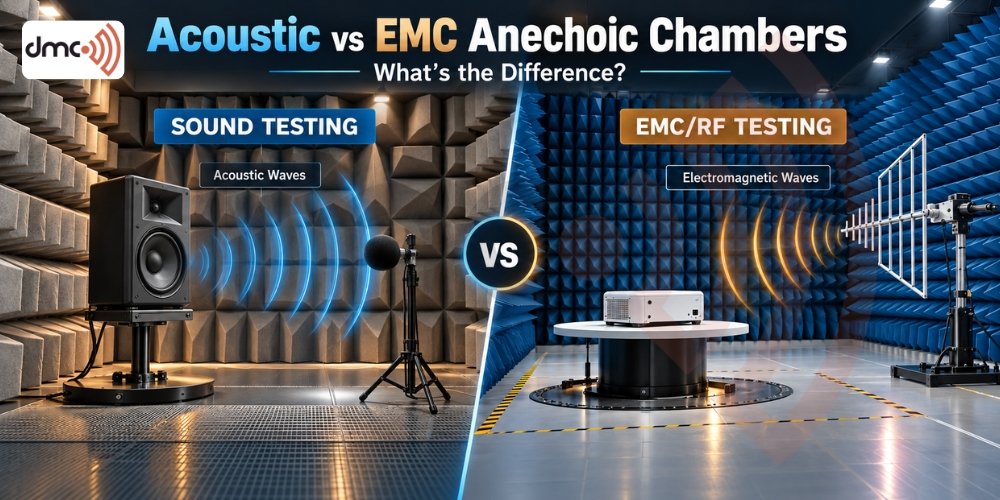
Anechoic chambers are controlled testing environments designed to minimize unwanted reflections and outside interference. Although acoustic and EMC anechoic chambers may look similar from the outside, they are engineered for very different types of measurements. An Acoustic Anechoic Chamber controls sound waves, while an EMC Anechoic Chamber controls electromagnetic energy and radio-frequency reflections.
Understanding this difference is important when selecting a chamber for product development, compliance testing, research, or quality validation. Choosing the wrong chamber can result in inaccurate measurements, unsuitable test conditions, and unnecessary project costs.
Diamond Microwave Chambers Ltd provides custom chamber solutions for RF, EMC, antenna, microwave, millimeter-wave, and acoustic applications, allowing chamber designs to be matched to specific testing requirements.
What Is an Acoustic Anechoic Chamber?
An acoustic anechoic chamber is designed to create a highly controlled sound environment. Its primary purpose is to reduce sound reflections from walls, ceilings, and other surfaces so engineers can measure sound produced by a product more accurately.
Acoustic chambers are commonly used for evaluating products such as speakers, microphones, appliances, motors, automotive components, and other equipment where noise performance matters.
The chamber uses specialized sound-absorbing materials to reduce reflections. Depending on the application, manufacturers may choose between fully anechoic and hemi-anechoic chamber configurations.
Typical acoustic chamber applications include:
- Product noise measurements
- Sound power testing
- Loudspeaker testing
- Microphone characterization
- Automotive noise evaluation
- Appliance noise testing
- Acoustic research and development
- Noise-source analysis
A Fully Anechoic Acoustic Chamber is designed to absorb sound reflections from multiple surfaces, whereas a Hemi Anechoic Chamber generally incorporates a reflective floor for applications where floor-mounted testing is required. Diamond Microwave Chambers Ltd offers both acoustic chamber configurations.
What Is an EMC Anechoic Chamber?
An EMC anechoic chamber is designed for electromagnetic compatibility testing. Instead of controlling audible sound, the chamber controls electromagnetic fields and reflections.
Electronic products can both generate electromagnetic energy and be affected by electromagnetic interference from other equipment. EMC testing helps determine whether equipment operates correctly in its intended electromagnetic environment and whether its emissions remain within applicable limits.
An EMC chamber typically combines a shielded enclosure with RF-absorbing materials. The shielding helps isolate the test area from external electromagnetic interference, while absorbers reduce unwanted RF reflections inside the chamber.
EMC chambers can support testing such as:
- Radiated emissions testing
- Radiated immunity testing
- Electromagnetic compatibility evaluation
- Product pre-compliance testing
- RF measurements
- Electronic equipment validation
- Automotive and EV testing
- Aerospace and defence applications
Diamond Microwave Chambers Ltd designs EMC and RF chamber solutions for applications requiring controlled electromagnetic environments and repeatable measurements.
Acoustic vs EMC Anechoic Chambers: Key Differences
Although both chamber types aim to create controlled environments, their engineering requirements are different.
| Feature | Acoustic Anechoic Chamber | EMC Anechoic Chamber |
|---|---|---|
| Primary purpose | Sound measurement | Electromagnetic testing |
| Waves controlled | Acoustic waves | Electromagnetic/RF waves |
| Main objective | Minimize sound reflections | Minimize RF reflections and external interference |
| Major materials | Acoustic absorbers | RF absorbers and shielding materials |
| Shielding | Not necessarily electromagnetic | Essential for EMC isolation |
| Typical testing | Noise and sound power | Emissions and immunity |
| Common users | Acoustic engineers, manufacturers | EMC/RF engineers and compliance laboratories |
| Floor configuration | Fully or hemi-anechoic | Often conductive ground plane in semi-anechoic designs |
| Typical products | Speakers, appliances, machinery | Electronics, vehicles, wireless devices |

The Role of Absorbers
Absorbers are important in both chamber types, but they are designed to work with different physical phenomena.
In an acoustic chamber, absorbers reduce the reflection of sound waves. Their performance depends on factors such as material characteristics, thickness, geometry, and the frequency range being evaluated.
In an EMC or RF chamber, absorbers are selected according to electromagnetic frequency requirements. RF absorbers help reduce reflections that could otherwise interfere with measurements.
Diamond Microwave Chambers Ltd supplies RF and microwave absorber technologies for chamber applications, including broadband and specialized absorber solutions.
Why Shielding Matters in EMC Chambers
One of the biggest differences between acoustic and EMC chambers is electromagnetic shielding.
An EMC chamber must limit unwanted external RF energy from entering the test environment. At the same time, the chamber helps prevent emissions from the equipment under test from escaping into the surrounding environment.
This requires careful engineering of the chamber enclosure, doors, ventilation, cable penetrations, filters, grounding arrangements, and other interfaces.
The objective is not simply to make a room “quiet.” The entire test environment must be engineered to provide controlled and repeatable electromagnetic conditions.
Which Chamber Do You Need?
The right chamber depends primarily on what you need to measure.
Choose an Acoustic Anechoic Chamber when your testing involves:
- Noise emissions
- Sound power
- Speaker performance
- Microphone measurements
- Acoustic product development
- Noise-source characterization
Choose an EMC Anechoic Chamber when your testing involves:
- Electromagnetic emissions
- Electromagnetic immunity
- RF measurements
- Product EMC validation
- Regulatory compliance testing
- Electronic or wireless equipment
For applications involving antenna radiation patterns or advanced RF measurements, an RF Anechoic Chamber or antenna measurement environment may be more appropriate than a conventional EMC chamber.
Pro Tip
Do not select a chamber based only on its size or appearance. Define the frequency range, equipment dimensions, test distance, measurement method, applicable standards, absorber performance, shielding requirements, access requirements, and future testing needs before finalizing the design.
A chamber engineered around the complete test programme can provide better measurement repeatability and reduce costly modifications later.
Final Thoughts
Acoustic and EMC anechoic chambers share the basic concept of creating controlled testing environments, but their purposes are fundamentally different. Acoustic chambers control sound reflections, while EMC chambers control electromagnetic interference, RF reflections, and external electromagnetic energy.
Selecting the correct chamber requires more than identifying whether a project involves “anechoic” testing. Engineers must consider the type of waves being measured, frequency range, test configuration, equipment size, applicable standards, shielding requirements, and future expansion.
Diamond Microwave Chambers Ltd provides custom-built RF, EMC, antenna, and acoustic chamber solutions designed around specific testing requirements. With the right chamber configuration, manufacturers and laboratories can establish controlled conditions for accurate, repeatable measurements.
Frequently Asked Questions
An acoustic anechoic chamber controls sound reflections for acoustic measurements, while an EMC anechoic chamber controls electromagnetic fields and RF reflections for electromagnetic compatibility testing.
EMC chambers are primarily designed for electromagnetic shielding and RF testing. They should not be considered acoustic anechoic chambers simply because they may also provide some sound isolation.
A fully anechoic acoustic chamber is designed to minimize sound reflections from its surrounding surfaces, creating a controlled free-field environment for precise acoustic measurements.
EMC anechoic chambers are used for controlled electromagnetic compatibility measurements, including radiated emissions and immunity testing, depending on the chamber configuration and applicable test requirements.
Specialized multi-purpose facilities can potentially combine different testing requirements, but a standard acoustic chamber and EMC chamber have different design objectives. The chamber should be engineered specifically around the required measurements.