
Table of Contents
- What is a Vector Network Analyzer
- Understanding S-Parameters
- Applications of Vector Network Analyzers in Antenna Testing
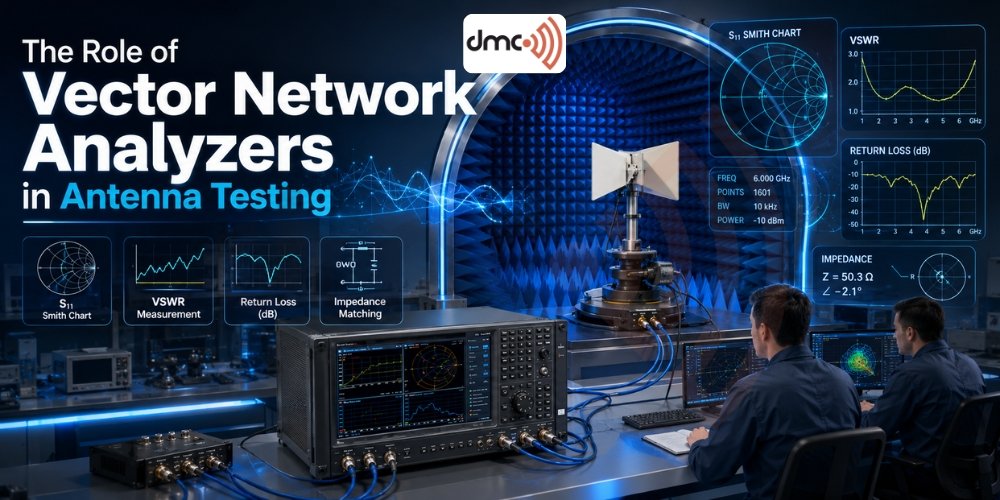
Modern wireless communication systems rely heavily on high-performance antennas to ensure reliable connectivity. Engineers developing 5G infrastructure, satellite communication systems, aerospace equipment, automotive radar systems, IoT devices or defense applications requiring antenna performance testing must ensure antennas perform as intended – thus Vector Network Analyzers in Antenna Testing play an essential part in this validation process by accurately gauging electrical characteristics such as impedance, reflection transmission and frequency response in antenna testing procedures.
At DMC, our antenna measurement solutions are developed to work seamlessly with Vector Network Analyzers (VNAs), providing engineers with repeatable standards-compliant testing across an array of RF and microwave applications.
What is a Vector Network Analyzer?
A Vector Network Analyzer (VNA) is an advanced RF measurement instrument designed to assess how radio frequency signals behave when passing through or reflecting off electronic devices. While Spectrum Analyzers measure signal amplitude alone, VNAs offer much greater insight.
Unlike a Spectrum Analyzer, which measures signal amplitude only, a VNA measures both:
- Signal magnitude
- Signal phase
This provides a complete understanding of RF device performance.
A VNA is widely used for testing:
- Antennas
- Filters
- Amplifiers
- RF cables
- Waveguides
- Connectors
- RF components
- Microwave systems
Why are Vector Network Analyzers Important in Antenna Testing?
Every antenna must efficiently transmit and receive RF energy.
Poor impedance matching or excessive reflections reduce antenna efficiency and degrade wireless communication.
Using Vector Network Analyzers in Antenna Testing helps engineers:
- Verify antenna resonance
- Measure impedance matching
- Analyze reflection coefficients
- Evaluate transmission characteristics
- Identify design problems
- Improve antenna efficiency
- Reduce development costs
- Ensure compliance with international standards
Without accurate VNA measurements, antenna performance cannot be fully validated.
Key Measurements Performed by a VNA
| Measurement | Purpose | Importance |
|---|---|---|
| Return Loss | Measures Reflected Power | Higher Return Loss Indicates Better Performance |
| VSWR | Voltage Standing Wave Ratio | Indicates Impedance Matching Quality |
| S11 | Reflection Coefficient | Determines Antenna Matching |
| S21 | Transmission Coefficient | Measures Signal Transfer |
| Phase Response | Signal Phase Variation | Important for Phased Arrays |
| Impedance | Input Impedance | Ensures Maximum Power Transfer |
| Group Delay | Signal Timing | Critical in Communication Systems |
Understanding S-Parameters
S-Parameters (Scattering Parameters) are the foundation of RF measurements.
The most common parameters include:
S11
Measures reflected energy from the antenna.
Lower S11 values indicate:
- Better impedance matching
- Lower signal reflection
- Higher antenna efficiency
S21
Measures transmitted energy between two ports.
Useful for:
- Coupling analysis
- RF component testing
- Feed network evaluation
S12
Measures reverse transmission.
Often used in:
- Isolation testing
- Duplex systems
S22
Measures output port reflections.
Important for:
- Multiport RF devices
- Amplifier testing
Applications of Vector Network Analyzers in Antenna Testing
VNAs support testing across numerous industries.
5G and 6G Communications
Applications include:
- Massive MIMO antennas
- Beamforming arrays
- Base station antennas
- Small cell antennas
- mmWave antennas
Satellite Communications
Engineers measure:
- High-gain antennas
- Reflector antennas
- Ground station systems
- Space-qualified antennas
Aerospace and Defense
Critical for:
- Radar systems
- Military communication
- Electronic warfare
- Aircraft antennas
- UAV communication
Automotive Industry
VNAs evaluate:
- ADAS radar antennas
- Vehicle communication
- V2X systems
- GPS antennas
IoT and Consumer Electronics
Testing includes:
- Wi-Fi antennas
- Bluetooth modules
- Smart devices
- Wearables
- RFID antennas
Benefits of Using Vector Network Analyzers
The advantages extend far beyond basic RF measurements.
Major benefits include:
- Extremely high measurement accuracy
- Fast testing process
- Wide frequency coverage
- Repeatable measurements
- Better product quality
- Reduced prototype iterations
- Improved manufacturing consistency
- International standard compliance
- Enhanced troubleshooting
- Lower development cost
Integration with DMC Antenna Measurement Systems
DMC provides complete antenna measurement solutions that integrate seamlessly with industry-leading VNAs.
A typical DMC antenna testing setup includes:
- Anechoic chamber
- Precision antenna positioner
- Vector Network Analyzer
- RF cables
- Calibration kits
- Positioning controller
- Measurement software
- Data processing tools
This integrated environment enables automated testing while minimizing human error.
Calibration: Why It Matters
Accurate measurements require proper calibration before every test.
Common calibration methods include:
- SOLT (Short-Open-Load-Thru)
- TRL Calibration
- Electronic Calibration (ECal)
Calibration removes errors caused by:
- RF cables
- Connectors
- Test fixtures
- Adapters
Proper calibration significantly improves measurement accuracy.
Common Challenges in VNA Antenna Testing
Although VNAs are powerful tools, engineers often encounter challenges.
Common issues include:
- Cable movement affecting measurements
- Poor connector quality
- Calibration errors
- Environmental reflections
- Temperature variations
- Incorrect test setup
- RF interference
Using high-quality antenna measurement systems like those from DMC helps minimize these problems.
Pro Tip
Always perform VNA calibration at the exact measurement reference plane. Even a small change in cable position after calibration can affect S-parameter accuracy, especially at microwave and mmWave frequencies. Using phase-stable RF cables and automated positioning systems from DMC significantly improves repeatability.
Conclusion
Vector Network Analyzers in Antenna Testing have become indispensable for evaluating antenna performance across modern wireless technologies. From impedance matching and S-parameter analysis to advanced phased-array testing, VNAs provide the detailed insights engineers need to optimize RF systems.
Combined with DMC’s advanced antenna measurement systems, precision positioners, and anechoic chambers, Vector Network Analyzers enable faster development, improved measurement confidence, and reliable compliance with global standards.
As wireless technologies continue to evolve toward 6G, satellite connectivity, autonomous vehicles, and advanced defense applications, the role of Vector Network Analyzers will only become more significant.
Frequently Asked Questions
A Vector Network Analyzer measures impedance, return loss, VSWR, and S-parameters to evaluate antenna performance accurately.
S11 represents the reflection coefficient and indicates how well an antenna is impedance matched to the transmission line.
Calibration removes systematic measurement errors caused by cables, connectors, and test fixtures, ensuring accurate results.
A VNA can measure parameters required for gain calculations, but antenna gain measurements are typically performed within complete antenna measurement systems like those offered by DMC.
VNAs are widely used in telecommunications, aerospace, defense, automotive, satellite communications, consumer electronics, and research laboratories.