
Table of Contents
- Why EMC Testing Matters for Electric Vehicles
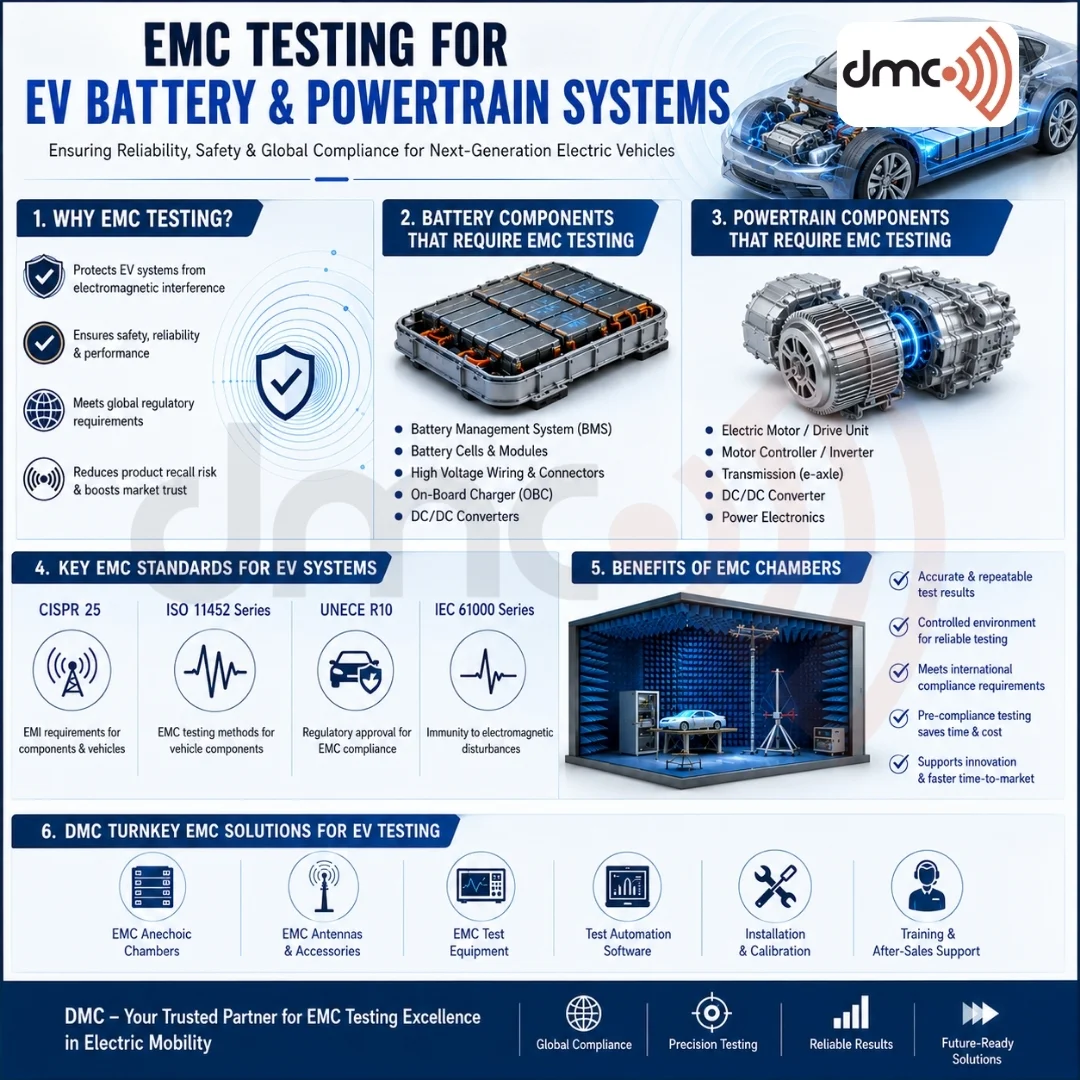
- Why EV Battery Systems Need EMC Testing
- Components Commonly Tested Inside EMC Chambers
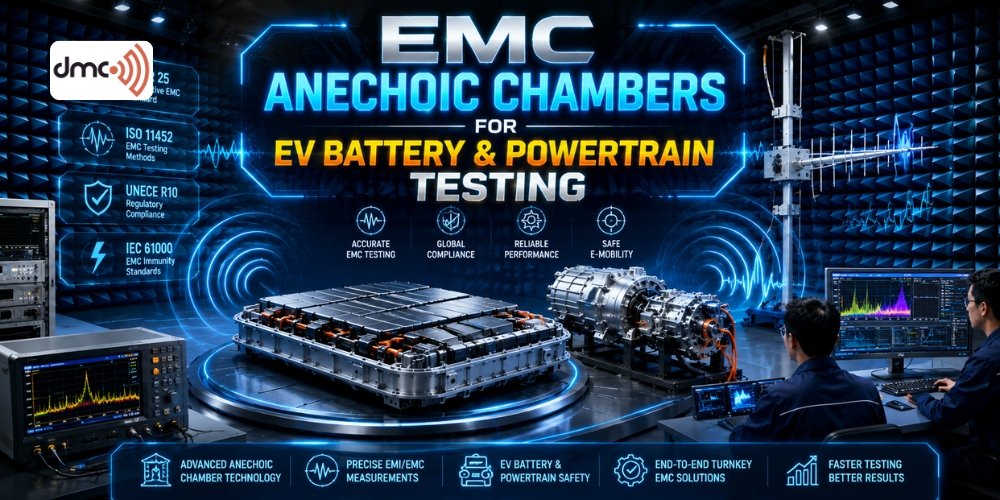
EMC Anechoic Chambers for EV Battery & Powertrain Testing play a critical role in ensuring that these complex electrical systems operate reliably without generating or suffering from electromagnetic interference (EMI). At DMC, we design advanced EMC anechoic chamber solutions that help manufacturers validate EV components according to international automotive EMC standards while ensuring product safety, reliability, and regulatory compliance.
Why EMC Testing Matters for Electric Vehicles
Electric vehicles contain significantly more electronic components than conventional internal combustion engine (ICE) vehicles.
These include:
- High-voltage battery packs
- Battery Management System (BMS)
- Inverters
- Electric motors
- Power converters
- Charging systems
- ADAS electronics
- Radar sensors
- Cameras
- Vehicle communication modules
All these systems continuously exchange electrical signals while operating under high power conditions.
Without proper EMC validation:
- Electronic systems may interfere with one another.
- Communication signals may become unstable.
- Safety systems may malfunction.
- Battery performance may degrade.
- Charging efficiency may decrease.
- Regulatory approval may be delayed.
This is why EMC testing has become an essential part of EV development.
What is an EMC Anechoic Chamber?
An EMC anechoic chamber is a specially designed shielded room lined with RF absorbing materials. It creates a controlled electromagnetic environment by minimizing external radio frequency interference and eliminating internal signal reflections.
Inside the chamber, engineers can accurately evaluate:
- Radiated emissions
- Conducted emissions
- Radiated immunity
- Conducted immunity
- EMI susceptibility
- Signal integrity
- System-level electromagnetic behavior
The chamber simulates a free-space environment, allowing repeatable and highly accurate EMC measurements.
Why EV Battery Systems Need EMC Testing
Battery packs are the heart of every electric vehicle.
A typical battery pack includes:
- Battery cells
- Battery modules
- Battery Management System
- Cooling electronics
- High-voltage connectors
- Sensors
- Communication buses
These systems operate using high switching frequencies that generate electromagnetic noise.
Potential issues include:
- Communication errors
- False sensor readings
- Charging interruptions
- BMS failures
- Reduced battery efficiency
- Unexpected system shutdowns
EMC testing identifies these issues before vehicles reach customers.
EMC Testing for EV Powertrain Systems
The electric powertrain consists of several high-power electronic systems.
These include:
- Electric motor
- Inverter
- DC-DC converter
- Onboard charger
- Motor controller
- High-voltage cables
These components generate significant electromagnetic emissions during operation.
Testing ensures:
- Stable motor control
- Reliable power delivery
- Noise-free communication
- Improved energy efficiency
- Compliance with automotive EMC standards
International EMC Standards for EV Testing
| Standard | Purpose |
|---|---|
| CISPR 25 | Radiated and Conducted Emissions from Vehicle Components |
| ISO 11452 | Radiated Immunity Testing |
| ISO 7637 | Electrical Transient Immunity |
| UNECE R10 | Vehicle EMC Approval |
| IEC 61000 Series | General EMC Immunity and Emissions |
| OEM EMC Standards | Manufacturer-Specific EMC Validation |
Automotive manufacturers follow globally recognized EMC standards to ensure safety and interoperability.
Compliance with these standards helps manufacturers enter global automotive markets with confidence.
Components Commonly Tested Inside EMC Chambers
EMC laboratories test a wide variety of EV systems.
Typical components include:
- Battery packs
- Battery modules
- Battery chargers
- Electric motors
- Inverters
- DC-DC converters
- Vehicle ECUs
- Radar sensors
- Cameras
- ADAS modules
- Charging connectors
- High-voltage wiring harnesses
- Communication modules
- Infotainment systems
Each component undergoes comprehensive EMC evaluation before vehicle integration.
Key Features of Modern EMC Anechoic Chambers
Modern EMC chambers are designed to provide precise and repeatable testing environments.
Important features include:
- RF shielded enclosure
- High-performance RF absorbers
- Ferrite tile absorbers
- Hybrid absorber configurations
- Turntables
- Antenna masts
- Automated positioning systems
- High-capacity power filters
- Optical communication interfaces
- Automated test software
- Real-time monitoring systems
These features improve testing accuracy while reducing measurement uncertainty.
Benefits of EMC Anechoic Chambers for EV Manufacturers
Using a professionally designed EMC chamber offers numerous advantages.
Benefits include:
- Faster product validation
- Accurate EMC measurements
- Reduced design iterations
- Lower product recall risks
- Better customer safety
- Improved battery reliability
- Compliance with global regulations
- Faster certification
- Enhanced product quality
- Reduced development costs
These advantages shorten development cycles while improving overall vehicle performance.
Why Shielding Performance Matters
An EMC chamber is only as effective as its shielding performance.
High-quality shielding prevents external electromagnetic signals from affecting measurements.
Proper shielding helps engineers:
- Capture true emissions
- Measure low-level signals
- Improve repeatability
- Eliminate external RF interference
- Validate sensitive automotive electronics
Poor shielding can produce inaccurate test results and costly engineering delays.
Automation in EV EMC Testing
Today’s automotive laboratories increasingly rely on automated EMC systems.
Automation provides:
- Repeatable testing
- Faster measurements
- Reduced operator errors
- Remote monitoring
- Automated report generation
- Integration with laboratory software
- Better traceability
Automated chambers also improve productivity for high-volume automotive testing.
Pro Tip
Always evaluate EV battery packs and complete powertrain assemblies under realistic operating conditions. Testing only individual components may overlook system-level electromagnetic interactions that occur when multiple high-voltage subsystems operate simultaneously. Comprehensive EMC testing inside a properly calibrated anechoic chamber provides more reliable results and reduces costly redesigns later in the development process.
Conclusion
As electric vehicles continue to evolve, EMC validation has become more important than ever. Battery systems, power electronics, charging infrastructure, and advanced driver assistance technologies all depend on reliable electromagnetic performance.
EMC Anechoic Chambers for EV Battery & Powertrain Testing provide the controlled environment needed to identify electromagnetic issues early, verify compliance with international standards, and ensure safe, dependable vehicle operation.
By investing in advanced EMC testing infrastructure from DMC, manufacturers can accelerate product development, improve quality, and confidently deliver next-generation electric vehicles to the global market.
Frequently Asked Questions
They provide a controlled electromagnetic environment for accurately measuring emissions and immunity, helping manufacturers identify EMI issues before vehicles reach production.
Battery packs, inverters, electric motors, BMS units, DC-DC converters, onboard chargers, ECUs, ADAS modules, communication systems, and charging equipment.
Common standards include CISPR 25, ISO 11452, ISO 7637, UNECE R10, and IEC 61000 series, along with OEM-specific EMC requirements.
They help engineers detect electromagnetic interference, validate immunity performance, and ensure that all electronic systems operate reliably under real-world conditions.
Yes. Modern EMC chambers are designed to accommodate emerging technologies such as high-voltage battery systems, fast charging, autonomous driving electronics, connected vehicle communication, and next-generation power electronics.