
Table of Contents
- Why Antenna Measurements Matter
- Types of Radiation Patterns
- Antenna Gain Measurement Methods
- Applications of Antenna Gain and Radiation Pattern Measurements
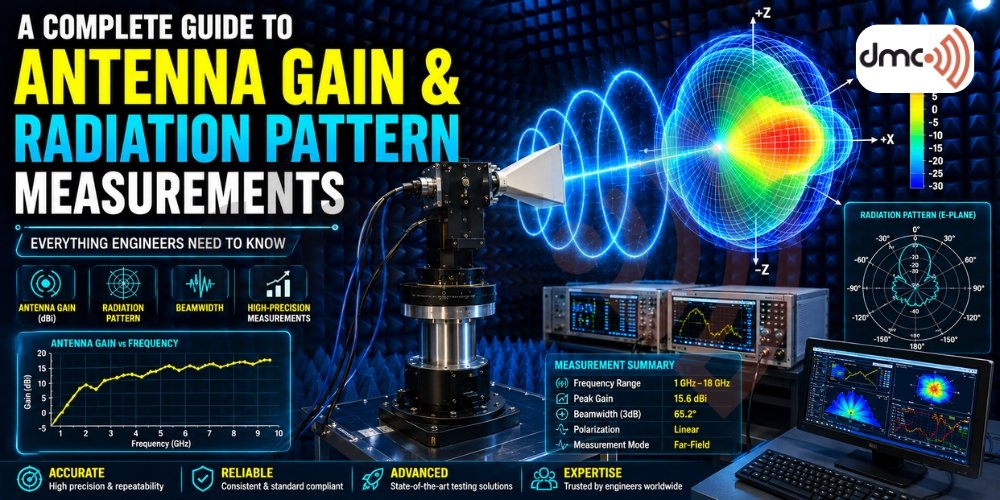
Antenna Gain and Radiation Pattern measurement is critical for most antenna research and development projects and is essential during antenna validation processes. This applies to antennas designed for 5G and 6G networks, satellite and aerospace communications, defense, automotive radar, and IoT technologies. Antenna performance must be measured and assessed prior to deployment.
At DMC, we create and build antenna measurement systems that allow engineers to conduct gain, radiation pattern, and over-the-air (OTA) assessments with the utmost measurement precision and in accordance with measurement standards.
Why Antenna Measurements Matter
Every wireless communications system employs antennas to facilitate the transmission and reception of electromagnetic energy. System efficacy hinges on the antenna’s ability to perform and deliver consistency. This is why the accuracy of antenna measurements is crucial.
Some of the benefits of accurate antenna measurements includes:
- Verify antenna specifications
- Compare prototype performance
- Validate simulation results
- Improve product quality
- Reduce redesign costs
- Meet regulatory requirements
- Ensure consistent manufacturing quality
- Optimize wireless communication performance
Antenna performance, especially in wireless communications, is highly sensitive, and without accurate performance measurements an antenna may fail to meet expectations when compared to the design.
What is Antenna Gain?
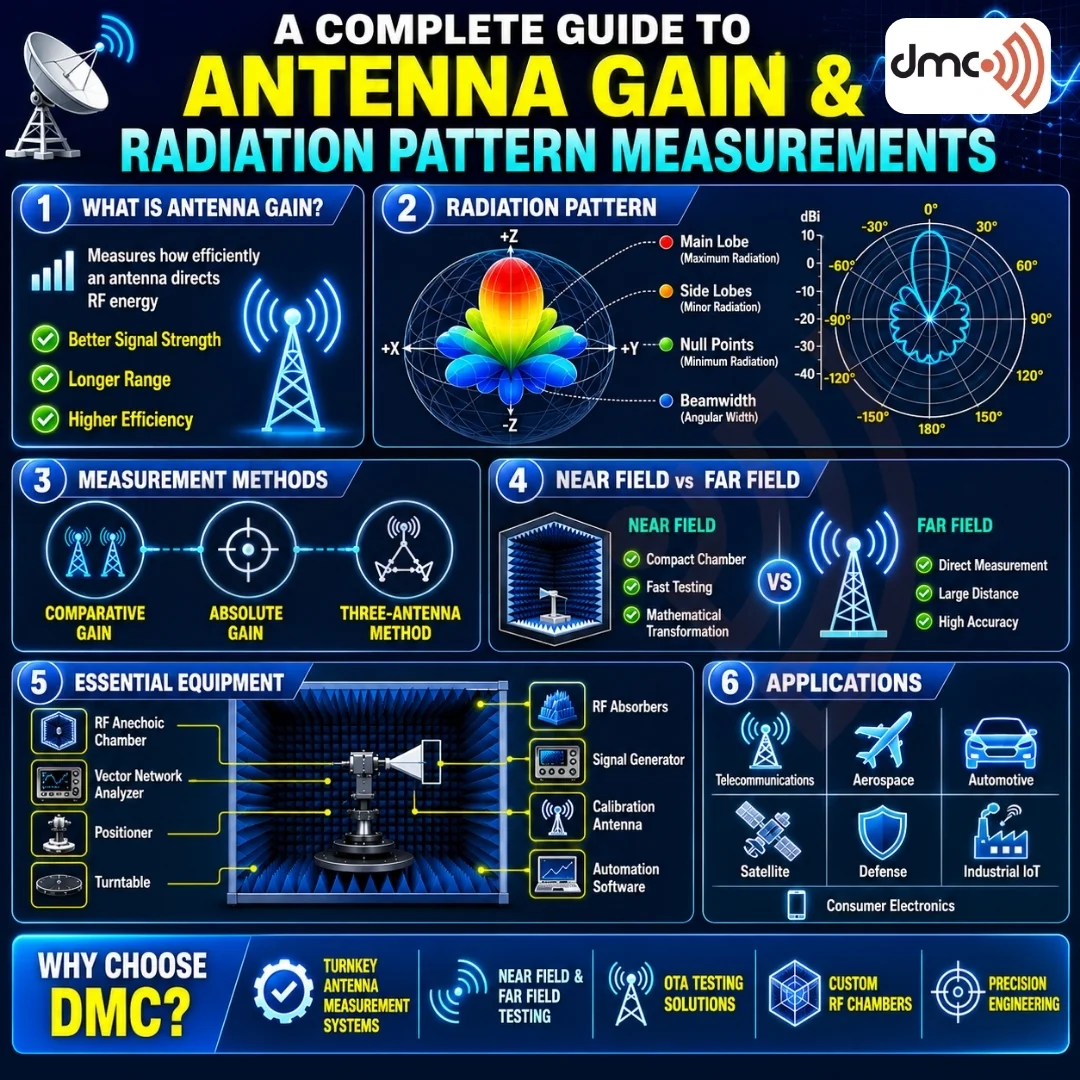
Antenna gain is a measure of an antenna’s ability to focus energy in a particular direction.
Higher antenna gain leads to:
- Better signal strength
- Greater communication distance
- Improved system efficiency
- Reduced transmission losses
- Enhanced wireless coverage
Antenna gain can be defined as:
- dBi (Gain relative to an isotropic antenna)
- dBd (Gain relative to a dipole antenna)
Knowledge of gain helps to ensure that antennas are correctly chosen for their application.
What is a Radiation Pattern?
A radiation pattern shows how, in different directions, antennas can emit and receive radiation.
It assists the understanding of:
- Signal distribution
- Coverage area
- Beam direction
- Side lobes
- Null points
- Beamwidth
- Front-to-back ratio
It is important that antennas meet their defined radiation patterns.
Types of Radiation Patterns
Different applications require different radiation characteristics.
Omnidirectional Pattern
Features:
- Uniform horizontal coverage
- Ideal for Wi-Fi
- Cellular base stations
- IoT devices
Advantages:
- Wide-area coverage
- Simple deployment
- Reliable communication
Directional Pattern
Features:
- Focused signal transmission
- Higher gain
- Narrow beamwidth
Applications:
- Satellite communication
- Radar systems
- Microwave links
- Point-to-point communication
Highly Directional Pattern
Used in:
- Defense systems
- Space communication
- Aerospace testing
- High-frequency research
Benefits include:
- Maximum signal concentration
- Reduced interference
- Longer communication range
Key Parameters Measured During Antenna Testing
Modern antenna testing evaluates several important parameters simultaneously.
| Parameter | Purpose | Importance |
|---|---|---|
| Antenna Gain | Signal Amplification Capability | High |
| Radiation Pattern | Signal Distribution | High |
| Beamwidth | Coverage Angle | High |
| Directivity | Signal Focus | High |
| Polarization | Electric Field Orientation | Medium |
| Front-to-Back Ratio | Forward vs Rear Radiation | High |
| Side Lobes | Unwanted Radiation | Medium |
| Efficiency | Energy Conversion Performance | High |
| VSWR | Impedance Matching | High |
| Return Loss | Reflection Measurement | High |
Antenna Gain Measurement Methods
Several methods are used depending on frequency range and application.
Absolute Gain Measurement
This method determines the antenna’s actual gain without relying on comparisons.
Advantages:
- High accuracy
- Independent measurement
- Research applications
Suitable for:
- Laboratories
- National standards
- Advanced R&D
Comparative Gain Measurement
One of the most commonly used techniques.
The antenna under test is compared with a calibrated reference antenna.
Benefits include:
- Faster testing
- Excellent repeatability
- Industry standard method
- Lower complexity
Three-Antenna Method
This method uses three calibrated antennas.
Advantages include:
- No reference gain required
- High measurement accuracy
- Widely accepted in laboratories
Radiation Pattern Measurement Process
Radiation pattern measurement involves rotating the antenna and measuring the signal received.
The process typically consists of the following steps:
- Installing the antenna
- Positioning the reference antenna
- Frequency calibration
- Polarization alignment
- Azimuth rotation
- Elevation scanning
- Data acquisition
- Pattern plotting
- Result analysis
This process yields a complete set of data representative of a 2D or 3D radiation pattern.
Near-Field vs Far-Field Measurements
Both techniques have advantages over the other depending on the size of the antenna and the frequency of operation.
| Feature | Near Field | Far Field |
|---|---|---|
| Measurement Distance | Short | Long |
| Chamber Size | Smaller | Larger |
| Data Processing | Mathematical Transformation | Direct Measurement |
| Large Antennas | Excellent | Challenging |
| Small Antennas | Good | Excellent |
| Testing Cost | Lower | Higher |
| Measurement Time | Faster | Moderate |
Mathematical transformations enable accurate modeling of far-field patterns based on near field measurements. Near field measurement systems also require significantly less space than far-field measurement systems. Because of these advantages, near field measurements are becoming more commonplace.
Equipment Used for Antenna Measurements
A very large number of different devices and instruments can be used to measure antennas.
Some of the more common devices include:
- Anechoic chamber
- Positioning system
- Antenna positioner
- Vector Network Analyzer (VNA)
- Signal generator
- Spectrum analyzer
- RF cables
- Calibration antennas
- Measurement software
- Data acquisition system
- Turntable
- RF absorbers
- Motion controller
- Automation software
DMC provides customers with tailored integration of all the systems required for antenna measurements.
Applications of Antenna Gain and Radiation Pattern Measurements
Accurate antenna measurements benefit multiple sectors. Some of the most important are:
Telecommunications
- 5G antennas
- 6G research
- Base stations
- Small cells
Aerospace
- Aircraft antennas
- Satellite payloads
- UAV communication
Defense
- Military radar
- Tactical communication
- Electronic warfare
Automotive
- ADAS radar
- Connected vehicles
- Vehicle communication systems
Consumer Electronics
- Smartphones
- Tablets
- Wearables
- Wi-Fi devices
Industrial IoT
- Smart factories
- Wireless sensors
- Industrial gateways
Common Challenges in Antenna Measurements
There are a variety of common measurement challenges.
Some common issues include:
- Chamber reflections
- Positioning errors
- Cable movement
- Calibration inaccuracies
- Mechanical vibration
- Temperature variations
- Alignment errors
- External RF interference
- Polarization mismatch
- Human handling errors
Most of these problems can be avoided by well-designed chambers combined with automation.
Best Practices for Accurate Measurements
To achieve consistent and repeatable results:
- Use calibrated equipment
- Verify chamber performance regularly
- Minimize cable movement
- Perform routine system calibration
- Maintain stable environmental conditions
- Use quality RF absorbers
- Follow international testing procedures
- Automate measurements whenever possible
- Validate measurement uncertainty
- Keep detailed testing records
These practices improve accuracy and reduce measurement errors.
Pro Tip
Always calibrate your antenna measurement system prior to measurement of a new antenna design. Calibration errors, especially in higher frequency ranges (mmWave and future 6G), will yield significant errors in gain and radiation pattern. DMC’s automated calibration and aligned control systems answer the need for accurate, repeatable, and reliable measurements.
Conclusion
Measurement of Antenna Gain and Pattern is one of the central pillars of the development of wireless communication systems that are hinged upon performance. Accurate measurement is a guarantee that the measured antenna satisfies the design requirements and the constraints of regulated operations.
The measurement system’s design, selection of the measurement technique, advanced anechoic chambers, and automated control systems are only a few of the elements that help yield consistent and accurate results. The antenna testing framework will continue to be in high demand with the pace of technological development in 5G, 6G, satellite communication, automotive radar, aerospace, and IoT.
The DMC offers a comprehensive, true turnkey antenna measurement solution. Trusted by the leading organizations, we integrate the latest hardware and intelligent software with advanced engineering support, enabling measurement of antennas that are repeatable, reliable, and efficient.
Frequently Asked Questions
Antenna gain measurement determines how effectively an antenna directs RF energy compared to a reference antenna. It is usually expressed in dBi or dBd.
Radiation pattern measurement shows how an antenna transmits or receives signals in different directions, helping engineers verify coverage, beamwidth, and overall performance.
Near-field measurements are taken close to the antenna and mathematically transformed into far-field results, while far-field measurements are performed at longer distances where the electromagnetic waves are fully formed.
These measurements are widely used in telecommunications, aerospace, defense, automotive, satellite communications, consumer electronics, research institutions, and IoT product development.
DMC offers complete turnkey antenna measurement solutions with advanced anechoic chambers, precision positioning systems, automation software, and expert technical support for accurate and repeatable RF testing.