
Table of Contents
- Why 6G Research Requires Advanced Testing Facilities
- Key Technologies Driving 6G Testing
- Applications of 6G Anechoic Chambers
- Why DMC Supports Future 6G Innovation
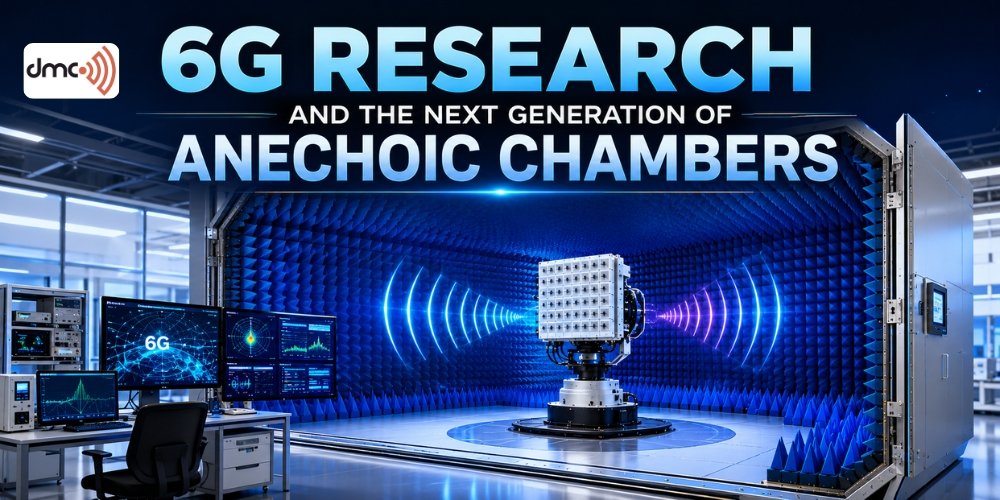
The rapid evolution of wireless communication is leading the world toward 6G Research and the Next Generation of Anechoic Chambers. While 5G is still expanding globally, research organizations, telecom companies, universities, and defense laboratories are already investing in technologies that will define the sixth generation of wireless communication. These advancements require highly accurate RF testing environments capable of handling extremely high frequencies, intelligent beamforming systems, AI-powered communication, and ultra-low latency networks. This is where DMC provides advanced anechoic chamber solutions designed to meet the future demands of 6G research and development.
Why 6G Research Requires Advanced Testing Facilities
6G technology is expected to revolutionize communication by offering speeds that are significantly higher than current 5G networks while enabling intelligent networking between humans, machines, autonomous systems, satellites, and AI-driven applications.
Future communication systems must be validated before deployment. Every antenna, chipset, communication module, radar system, and wireless device must undergo extensive RF testing.
Major challenges include:
- Operating beyond mmWave frequencies
- Terahertz signal propagation
- Intelligent beamforming validation
- Massive MIMO testing
- AI-based communication systems
- Ultra-low latency verification
- Satellite communication integration
- Integrated sensing and communication (ISAC)
These challenges demand highly specialized anechoic chambers capable of eliminating unwanted electromagnetic reflections.
What Makes Next-Generation Anechoic Chambers Different?
Unlike conventional RF chambers, future-ready chambers are designed for higher frequencies and improved measurement precision.
Key improvements include:
- High-performance RF absorbers
- Superior RF shielding effectiveness
- Lower reflectivity
- Wide frequency coverage
- Automated positioning systems
- AI-assisted measurement software
- High-speed antenna scanners
- Modular chamber designs
These improvements ensure reliable measurements even for extremely sensitive 6G devices.
Key Technologies Driving 6G Testing
Several emerging technologies are influencing chamber design.
Terahertz Communication
Future networks may operate above 100 GHz and extend toward terahertz frequencies.
Benefits include:
- Extremely high data rates
- Larger bandwidth
- Faster wireless communication
- Advanced sensing capabilities
Testing these frequencies requires absorbers specifically engineered for ultra-high-frequency performance.
Intelligent Beamforming
Future antennas will dynamically direct signals toward users.
Testing requirements include:
- Beam tracking
- Multi-angle measurements
- Radiation pattern analysis
- Dynamic antenna positioning
Modern chambers provide accurate beam characterization under controlled conditions.
Massive MIMO Systems
Future base stations may contain hundreds of antenna elements.
Testing involves:
- OTA measurements
- Beam steering accuracy
- Isolation testing
- Cross-polarization measurements
Large Anechoic Chambers provide the required measurement space.
AI-Powered Wireless Systems
Artificial Intelligence will become part of communication infrastructure.
Testing environments must support:
- Real-time adaptive measurements
- Automated calibration
- Intelligent data analysis
- High-speed measurement processing
Components of a Next-Generation Anechoic Chamber
A future-ready chamber integrates several advanced components.
| Component | Purpose |
|---|---|
| RF Shielded Room | Prevents External RF Interference |
| Hybrid RF Absorbers | Minimize Internal Reflections |
| Precision Positioner | Rotates DUT Accurately |
| Antenna Measurement System | Measures Radiation Patterns |
| Turntable | Enables 360° Testing |
| RF Instrumentation | Signal Generation and Analysis |
| Cable Filters | Prevent Signal Leakage |
| Honeycomb Ventilation | Maintains Airflow Without RF Leakage |
| Control Software | Automates Testing Procedures |
| Grounding System | Ensures Electrical Stability |

Applications of 6G Anechoic Chambers
The demand for future-ready RF chambers extends beyond telecommunications.
Industries include:
Telecommunications
Applications include:
- Base station testing
- Small cells
- Smart antennas
- Mobile devices
Automotive
Future vehicles rely on:
- Vehicle-to-Everything (V2X)
- Radar systems
- Autonomous driving
- Wireless sensors
Aerospace
Used for:
- Satellite communication
- Navigation systems
- Aircraft antennas
- Space communication research
Defense
Critical for:
- Electronic warfare
- Military radar
- Secure communication
- Surveillance systems
Research Institutions
Universities and R&D centers require chambers for:
- 6G algorithm development
- Antenna research
- Wireless communication experiments
- Electromagnetic compatibility studies
Importance of RF Absorbers in 6G Chambers
As operating frequencies increase, absorber performance becomes even more critical.
Modern RF absorbers provide:
- Better reflectivity performance
- Broadband frequency coverage
- Lightweight construction
- Long operational life
- Fire-retardant materials
Selecting the right absorber directly influences measurement accuracy.
Challenges in 6G Testing
Although technology is advancing rapidly, several challenges remain.
These include:
- Higher propagation loss
- Sensitive measurements
- Increased environmental interference
- Precision positioning
- Large datasets
- Equipment calibration
Modern anechoic chambers are specifically engineered to overcome these limitations.
Why DMC Supports Future 6G Innovation
At DMC, our engineering expertise enables us to develop RF testing solutions for today’s and tomorrow’s wireless technologies.
Our capabilities include:
- Custom RF anechoic chambers
- EMC chambers
- OTA testing systems
- RF shielded rooms
- Compact antenna ranges
- RF absorbers
- RF shielding solutions
- Complete turnkey testing facilities
Every chamber is designed to provide reliable measurements, high shielding performance, and long-term operational stability.
Future Trends in Anechoic Chamber Design
As wireless technology advances, future chamber designs will continue evolving.
Expected developments include:
- AI-assisted chamber automation
- Digital twin simulations
- Robotic antenna positioning
- Smart environmental monitoring
- Terahertz-ready absorbers
- Cloud-based measurement systems
- Sustainable chamber materials
- Faster calibration technologies
These innovations will support next-generation communication research for years to come.
Pro Tip
When planning a 6G testing facility, choose an anechoic chamber that offers modular expansion and wide frequency coverage. This ensures your investment remains compatible with future wireless technologies, including terahertz communication and AI-driven RF systems.
Conclusion
The future of wireless communication depends heavily on accurate RF testing. As 6G Research and the Next Generation of Anechoic Chambers continue to evolve, testing facilities must keep pace with higher frequencies, intelligent antennas, AI-powered communication, and complex wireless environments. Investing in advanced anechoic chambers today helps researchers, manufacturers, and innovators prepare for tomorrow’s communication technologies. DMC delivers cutting-edge RF testing solutions that enable reliable measurements, exceptional shielding performance, and scalable chamber designs for the next generation of wireless innovation.
Frequently Asked Questions
They provide reflection-free environments that ensure highly accurate testing of antennas, RF devices, and wireless communication systems operating at extremely high frequencies.
Researchers expect 6G to operate in sub-THz and terahertz frequency ranges beyond current 5G mmWave bands.
Some can be upgraded, but many require enhanced RF absorbers, improved shielding, and advanced measurement equipment to support higher frequencies.
Telecommunications, aerospace, automotive, defense, semiconductor manufacturing, and research institutions will all require advanced RF testing facilities.
DMC designs custom RF testing environments with advanced shielding, high-performance absorbers, automated positioning systems, and scalable solutions suitable for future wireless technologies.