
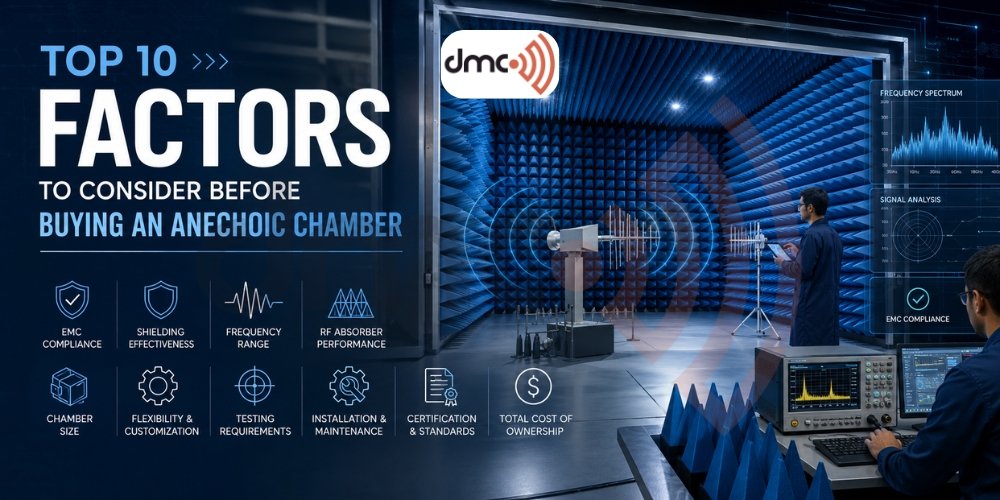
Table of Contents
- Why Choosing the Right Anechoic Chamber Matters
- Top 10 Factors to Consider Before Buying an Anechoic Chamber
- Benefits of Choosing the Right Anechoic Chamber
Anechoic Chambers are a valuable asset to companies in numerous sectors. For example, companies in EMC, RF, antennas, automotive, aerospace, military, telecom, and product certification will benefit greatly from purchasing the right chamber. The right purchase will lead to accurate results and the right regulations will be met.
The goal of this guide is to help you familiarize yourself with the top 10 factors to consider when purchasing an anechoic chamber, and how these factors will help your company makes the right investment.
Why Choosing the Right Anechoic Chamber Matters
Designing an anechoic chamber provides a space that is both electromagnetically isolated and provides anechoic conditions that will yield reflections of a dispersed nature. The chamber provides conditions that will allow the user to repeatedly and accurately perform measurements.
When considering the use of the right chamber for testing, there are a number of factors that the use of a chamber will impact greatly.
- Measurement accuracy
- Regulatory compliance
- Testing efficiency
- Product development speed
- Return on investment
The assessment of multiple operational and technical requirements is critical prior to the investment in an anechoic chamber.
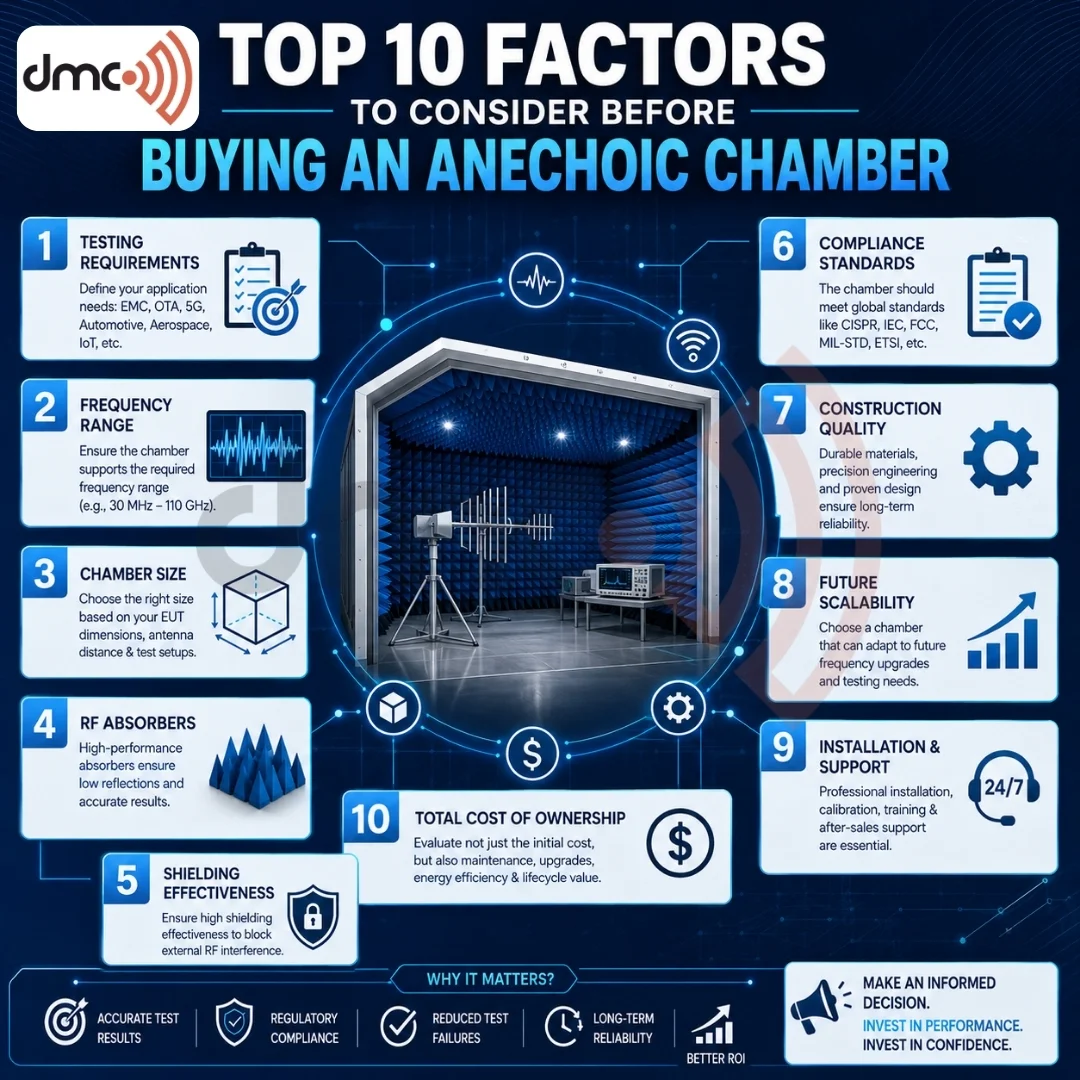
Top 10 Factors to Consider Before Buying an Anechoic Chamber
1. Define Your Testing Requirements
Consider the following questions before proceeding:
- Will the chamber be used for EMC compliance?
- Is it for antenna measurements?
- Do you require RF shielding?
- Will you test automotive radar?
- Is military-grade testing required?
These questions will shed light on your testing capabilities and will assist in determining chamber size, absorber type, shielding effectiveness, and frequency range.
2. Frequency Range
The most critical piece of the puzzle is determining the functional frequency of the chamber.
Various applications demand varying levels of performance, including:
- Low-frequency EMC testing
- Microwave measurements
- 5G testing
- Satellite communication
- Radar systems
- Millimeter-wave applications
The Anechoic Chamber will need to offer the required level of performance for the frequency range of your application.
3. Chamber Size and Internal Dimensions
The physical size of the chamber will limit the size of the products being tested.
Consider:
- Product size
- Antenna distance
- Test equipment
- Turntable requirements
- Future expansion
Buying a chamber that’s too small can restrict future testing capabilities.
4. RF Absorber Performance
The absorber is the key to every anechoic chamber.
There are a number of absorber types, including:
- Pyramidal absorbers
- Hybrid absorbers
- Ferrite tile absorbers
- Broadband absorbers
High quality RF Absorbers help to reduce reflections and help to improve measurement accuracy for a wide range of frequencies. Always check the specifications for absorber reflectivity when selecting an EMC chamber.
5. Shielding Effectiveness
High quality RF shielding will eliminate all interference from outside the chamber.
Poor shielding may cause:
- Failed EMC tests
- Measurement instability
- Repeat testing
- Certification delays
Look for shielding that meets the required standards for EMC Testing with assurance for long-term performance.
6. Compliance with International Standards
Most EMC Testing Chambers will bend to international testing standards.
The standards might include:
- IEC
- CISPR
- MIL-STD
- ISO
- ANSI
- FCC requirements
The results support global certification of your product.
7. Chamber Construction Quality
An anechoic chamber is not a cheap piece of equipment to buy and, thus, should be a consideration for protecting your investment.
You should consider the quality of the following:
- Steel panel construction
- Door sealing
- Ventilation systems
- Cable penetrations
- Lighting
- Structural strength
The quality of the construction will protect the investment by reducing the amount of upkeep.
8. Future Scalability
Because of the rapid growth of technology, the testing chamber may need to accommodate new and varied technology.
This might include the:
- 6G communication
- Advanced automotive radar
- IoT devices
- AI hardware
- Satellite communications
The technology chamber you buy today should be designed to accommodate future needs and be relatively inexpensive to modify.
9. Installation and Maintenance Support
When people purchase equipment, they often overlook the cost of services they will need to buy.
A good manufacturer will provide (EMC) Testing Chambers along with:
- Site evaluation
- Chamber installation
- Calibration
- Training
- Maintenance
- Technical support
Professional services reduce the amount of time you need to wait for testing to begin and protects the money you have invested.
10. Total Cost of Ownership
The price of an EMC Testing Chamber is only an investment for the purchase.
You also need to consider the cost of:
- Installation costs
- Transportation
- Calibration
- Maintenance
- Replacement absorbers
- Power consumption
- Future upgrades
Considering these costs will give you an idea of the value of the purchase.
Comparison Table
| Factor | Why It Matters | Buying Recommendation |
|---|---|---|
| Testing Requirements | Determines Chamber Type | Define Applications First |
| Frequency Range | Ensures Accurate Measurements | Match Required Frequencies |
| Chamber Size | Supports Future Products | Allow Extra Space |
| RF Absorbers | Reduces Reflections | Choose Premium Hybrid Absorbers |
| Shielding | Blocks Interference | Verify Shielding Effectiveness |
| Compliance | Enables Certification | Follow IEC, CISPR, MIL Standards |
| Construction | Improves Durability | Choose Industrial-Grade Design |
| Scalability | Supports Future Technologies | Plan for Upgrades |
| Support | Reduces Downtime | Select Experienced Manufacturer |
| Total Cost | Maximizes ROI | Evaluate Lifecycle Costs |
Buying an anechoic chamber often includes things you should avoid:
- Choosing based only on price
- Ignoring future testing needs
- Purchasing undersized chambers
- Selecting low-quality RF absorbers
- Overlooking maintenance support
- Ignoring international compliance
- Not planning for technology upgrades
Avoid these to keep the investment valuable for a long time.
Benefits of Choosing the Right Anechoic Chamber
A properly selected Anechoic Chamber offers several advantages:
- Higher EMC testing accuracy
- Reduced electromagnetic interference
- Better RF measurement reliability
- Faster product certification
- Lower maintenance costs
- Improved testing efficiency
- Long-term scalability
- Better return on investment
Pro Tip
Scalability and 5G compatible design will lower long-term costs. Don’t buy solely for todays testing. 6G, automotive radar, IoT, satellites and EMC standards will push your design to the limit.
Conclusion
Making the right Anechoic Chamber selection means understanding all your testing requirements and plenty of preparation. Chamber size, frequency range, RF absorber quality, shielding effectiveness, construction quality, support and maintenance, scalability, and cost of ownership all affect successful testing.
These 10 Factors to Consider Before Buying an Anechoic Chamber help organizations make the best chamber choice to enhance testing and certification effectiveness, and maximize return on investment.
Frequently Asked Questions
An anechoic chamber is used for EMC testing, RF measurements, antenna testing, wireless device validation, and electromagnetic compatibility evaluations.
Consider testing requirements, chamber size, frequency range, absorber quality, shielding effectiveness, compliance standards, scalability, and maintenance support.
RF absorbers minimize signal reflections inside the chamber, improving measurement accuracy and repeatability.
Industries include aerospace, defense, automotive, electronics, telecommunications, healthcare, research laboratories, and consumer electronics.
With proper maintenance and quality construction, an anechoic chamber can provide reliable performance for 20 years or more.