
Table of Contents
- Understanding EMC Testing
- The Growing Complexity of EMC Testing
- How DMC Supports Advanced EMC Testing
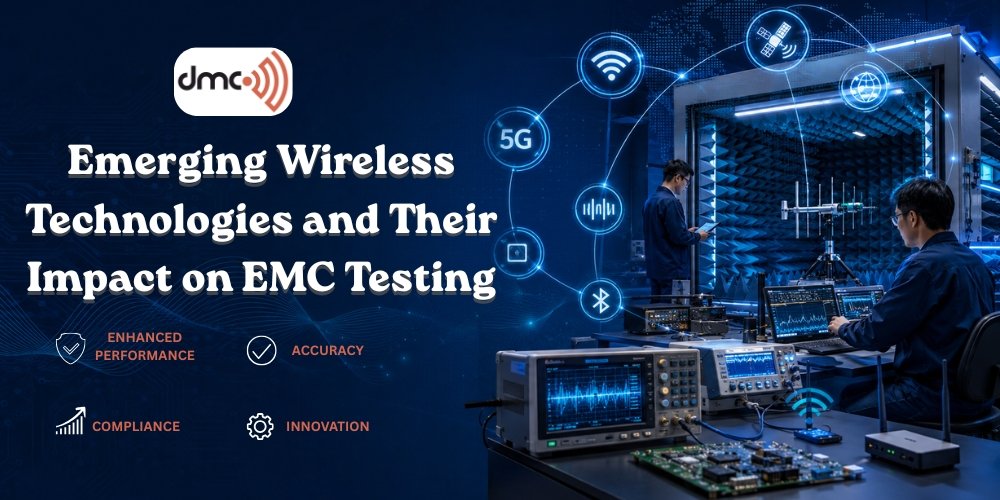
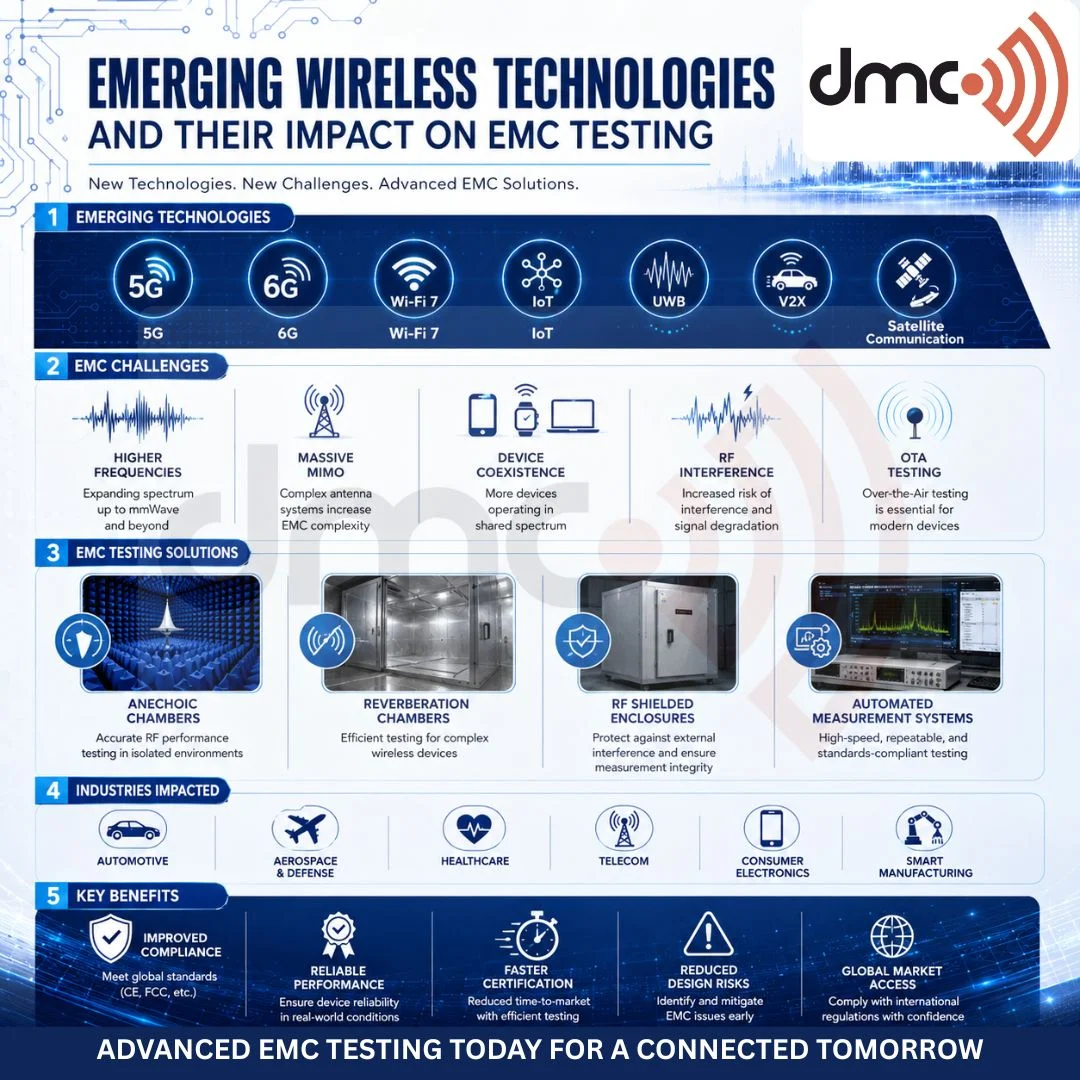
There are more advancements in wireless communication now than ever. Wireless Technologies is newly emerging and evolving at a rapid pace. These communications systems utilize faster speeds, create more complex, dense environments for communications, and use higher frequency signals. These systems include: 5G, Wi-Fi 7, satellite communications, IoT, private cellular networks, and even 6G and future systems already in research. This post will help to address some of the most pressing challenges impact industries via EMC testing because of the rapid expansion of wireless communication.
Electronic device manufacturers have to ensure that their devices will reliably function and will not negatively impact other devices via Electromagnetic Interference (EMI). As wireless technology rapidly evolves, traditional methods of testing electromagnetic compatibility (EMC) will not suffice. Modern methods of testing will address wider ranges of frequencies, more wireless protocols, denser electronic ecosystems, and more stringent global compliance regulations.
DMC provides advanced electromagnetic compatibility (EMC) testing in order to help our clients manufacture and sell products safely and reliably in a world that is more connected than ever.
Understanding EMC Testing
Electromagnetic compatibility (EMC) testing is done in order to determine if a product is able to function in its intended electromagnetic environment without adversely affecting that environment by generating electromagnetic interference.
EMC testing is generally categorized into two main types:
- Emission Testing – Quantifies the unwanted electromagnetic energy given off by the product.
- Immunity Testing – Determines the electromagnetic disturbances the product can endure from its environment.
These tests help manufacturers internationally meet regulations, while also improving product reliability and customer satisfaction.
Why Emerging Wireless Technologies Matter
Compared to earlier systems, newer wireless communications span much broader channels. Many devices can operate multiple standards, including:
- 5G NR
- Wi-Fi 6E
- Wi-Fi 7
- Bluetooth LE
- Zigbee
- LoRaWAN
- NFC
- UWB (Ultra-Wideband)
- Satellite connectivity
- Private LTE
Every wireless standard will have different characteristics that will affect their EMC performance. The increased usage of wireless devices will increase the potential for electromagnetic interference making thorough EMC testing more important.
Major Emerging Wireless Technologies Affecting EMC Testing
| Wireless Technology | Frequency Range | EMC Testing Challenges | Industries Using It |
|---|---|---|---|
| 5G NR | Sub-6 GHz & mmWave | Beamforming, Massive MIMO, High Frequencies | Telecommunications |
| Wi-Fi 7 | 2.4, 5, 6 GHz | Wider Channels, Simultaneous Transmissions | Consumer Electronics |
| IoT Networks | Multiple Bands | Dense Device Environments | Smart Homes, Industry |
| UWB | 3.1–10.6 GHz | Pulse Interference | Asset Tracking |
| Satellite IoT | Various Bands | Long-Distance Communication Interference | Logistics |
| Private LTE/5G | Licensed Spectrum | Enterprise Deployment Testing | Manufacturing |
The Growing Complexity of EMC Testing
Classic electronic designs typically contained only one or two wireless radios. Many modern designs contain multiple communication modules all housed in a single package.
Examples include:
- Smartphones
- Medical devices
- Autonomous vehicles
- Smart appliances
- Industrial automation equipment
- Connected manufacturing systems
Each radio must communicate effectively with its intended modules while not interfering with the other radios.
Because of this, EMC labs need specialized equipment to test a wider frequency channel with the capability of testing multiple communications simultaneously.
Impact of 5G Technology on EMC Testing
The advancement of 5G technology is a landmark point in the evolution of EMC testing in the last 10 years.
5G technology includes the following over previous generations:
- Massive MIMO antennas
- Beamforming
- Millimeter-wave frequencies
- Dynamic spectrum sharing
- Carrier aggregation
All of these significantly complicate the testing procedure.
Among other things, EMC engineers must ensure emissions, performance of the antenna, and the wireless technology’s coexistence and immunity to interference in its operational environment.
Testing often also goes well beyond the bounds of traditional compliance testing.
Wi-Fi 7 Creates New EMC Challenges
Wi-Fi 7 delivers:
- Extremely high throughput
- Multi-link operation
- Wider 320 MHz channels
- Lower latency
These advances also make EMC testing progressively more difficult.
Proper EMC validation will reduce packet loss and increase both the reliability of the connection and the control of the environment.
The Explosion of The Internet of Things (IoT) and its Implications on EMC Testing
Internet of Things (IoT) Devices Require Extensive EMC Validation
There are now tens of billions of IoT devices in the world across:
- Smart factories
- Smart cities
- Healthcare
- Agriculture
- Energy
- Transportation
All of these IoT devices, unlike traditional electronics, operate continuously in crowded radio environments.
Testing of multiple sensors/gateways/controllers that communicate and work in unison to avoid interference is essential to:
- Communication failures
- Sensor inaccuracies
- Reduced battery life
- Unexpected system downtime
EMC testing will ensure proper functioning in all environments for the lifetime of the product.
Automotive Wireless Systems Demand Higher EMC Standards
There can be many different types of wireless technologies used in modern vehicles. These can include:
- Bluetooth
- Wi-Fi
- 5G
- GPS
- Radar
- Vehicle-to-Everything (V2X)
- Tire pressure monitoring
- Keyless entry
Wireless technologies used in autonomous driving adds complexity to the systems.
Interference with radar or safety systems can lead to dire consequences.
Due to this, comprehensive EMC studies are done to simulate real driving conditions prior to manufacturing.
Medical Devices Face Strict EMC Requirements
Wireless medical devices have become more common with the introduction of:
Examples include:
- Patient monitors
- Infusion pumps
- Wireless ECG devices
- Remote diagnostic equipment
- Wearable health monitors
Within the hospital environment, there can be hundreds of devices electronically communicating with each other.
Electromagnetic interference can lead to medical devices causing critical safety issues for patients.
Due to this, intensive EMC testing is conducted to account for less-than-ideal EM conditions.
Industrial Automation and Smart Manufacturing
Industry 4.0 emphasizes the use of wireless communication.
Factories now use:
- Wireless sensors
- Industrial IoT
- Automated guided vehicles
- Robotics
- Machine vision
- Private 5G networks
Electromagnetic noise within the factory from motors, power electronics drives and welding can create EMC challenges.
EMC testing evaluates the noise and assesses the operational environment to ensure effective communication.
International EMC Standards Continue to Evolve
As wireless communication technologies continue to advance, regulatory agencies continue to modify standards with greater frequency.
For manufacturers that sell products in multiple countries, standards may include:
- IEC standards
- CISPR standards
- FCC regulations
- CE requirements
- MIL-STD testing
- Automotive EMC standards
To speed up the certification process and lower the likelihood of costly redesigns due to missing the standard, it is beneficial to conduct EMC testing as one of the first evaluations.
Benefits of Early EMC Testing
Incorporating EMC testing during the development lifecycle provides organizations with the following benefits:
- Reduced product redesigns
- Faster certification
- Lower development costs
- Improved product reliability
- Better customer satisfaction
- Reduced warranty claims
- Faster global market access
Waiting for the final production stage results in costly changes during the production stage.
Common Sources of Electromagnetic Interference
The following products are the most common sources of interference:
- Switching power supplies
- High-speed processors
- Wireless transmitters
- Electric motors
- RF amplifiers
- LED drivers
- USB interfaces
- Ethernet communication
- Automotive electronics
The performance of EMC can be greatly enhanced through proper PCB design, shielding, filtering, and grounding.
How DMC Supports Advanced EMC Testing
With the rapid development of Wireless Technology, the EMC testing problem continues to become more complex. DMC provides advanced EMC testing for multiple industries, including, but not limited to, Aerospace and Defense, Automotive, Medical, Telecommunications, EMC for Industrial Automation, and Consumer Electronics.
Our testing approach includes:
- Pre-compliance evaluation
- Full EMC compliance testing
- Emission testing
- Immunity testing
- Design consultation
- Failure analysis
- Standards guidance
- Product certification support
DMC testing provides manufacturers with the opportunity to identify potential EMC testing issues even earlier to reduce risks related to development and improve both the performance of the product as well as ensure the product is in compliance with Regulations.
Pro Tip
Integrate EMC testing during the design phase and avoid costly changes during the validation phase of the product. Early testing can address issues such as PCB design, shielding, grounding, and antenna placement and avoid expensive redesigns, thus improving development costs and increasing the speed of getting the product to market.
Conclusion
Every industry is being disrupted by new wireless technologies. From telecommunications, to healthcare, to manufacturing and transportation, the effects are widespread. New technologies bring new challenges. Advanced EMC testing will be required to address the new complicated electromagnetic fields that are created.
Manufacturers need to evolve and conduct EMC evaluations as a core competency throughout the entire development process, as opposed to viewing it as a last step. Testing throughout the process increases the reliability of the product and decreases time to market. It also provides assurance to manufacturers that the product is compliant with standards that are continuously updated.
DMC has a wealth of knowledge and experience in the field of EMC testing and works with companies to bring value to the design and production of electronic products, to reassure them that the products will perform as expected in a world that is increasingly more connected. The development of wireless technologies will continue to extend into 6G and beyond. The need for advanced and focused EMC testing, will be imperative.
Frequently Asked Questions
EMC testing verifies that electronic devices do not generate excessive electromagnetic interference and can continue operating correctly when exposed to external electromagnetic disturbances.
Technologies such as 5G, Wi-Fi 7, IoT, and UWB use higher frequencies, wider bandwidths, and multiple antennas, making electromagnetic interactions more complex.
Industries including automotive, aerospace, defense, telecommunications, healthcare, industrial automation, and consumer electronics require EMC testing to meet regulatory standards.
Early EMC testing reduces redesign costs, improves product reliability, speeds up certification, and helps products reach the market faster.
DMC provides comprehensive EMC testing, compliance guidance, pre-compliance evaluation, failure analysis, and certification support to help manufacturers meet international standards efficiently.