
Table of Contents
- Why EMC Testing Is Critical in 2026
- Key EMC Testing Challenges for Next-Generation Electronics
- Impact of EMC Regulations in 2026
- EMC Solutions for Manufacturers
The rapid advancement of technology has made electronic devices faster, smaller, and more connected. AI systems, EVs, 5G-enabled devices, and industrial IoT technology are all examples of devices and systems that must now function reliably in complex electromagnetic environments. With these advances, concerns for product reliability, safety, and global regulatory compliance have made Electromagnetic Compatibility EMC Testing Challenges necessary for all manufacturers.
EMC testing in 2026 brings a new generation of challenges from high operating frequencies, highly integrated electronics, wireless connections, and new international standards. Manufacturers must implement new testing techniques to remain competitive.
Why EMC Testing Is Critical in 2026
EMC means that a device can operate as intended in its environment and will not interfere with, nor be interfered with, by, other devices. As products are built with multiple high-speed communication systems, the probability of EMI (electromagnetic interference) compliance becomes more critical.
Without proper EMI compliance testing, electronic products may encounter:
- Communication failures
- Performance degradation
- Data corruption
- Safety concerns
- Regulatory non-compliance
- Costly product redesigns
Due to these impacts, EMC testing is no longer simply a compliance issue, but has become a necessary step in the product development lifecycle.
Key EMC Testing Challenges for Next-Generation Electronics
Higher Frequencies and Faster Data Transmission
The latest advanced communication systems have made devices operate at higher frequencies. These systems have made international standards for speed and connectivity more challenging due to layered complexity of devices.
Meeting modern 5G EMC standards is difficult because higher frequency signals will easily couple or interfere with other signals, or create emissions. Even slight imperfections in a PCB layout will likely fail compliance testing.
Manufacturers must evaluate:
- High-frequency radiated emissions
- Signal integrity performance
- RF coexistence issues
- Antenna interference
- Electromagnetic susceptibility
More advanced testing is required for each of the above issues when compared to testing for older generations of electronic products.
Increasing Complexity of Electronic Systems
Modern products are highly integrated, containing multiple varied technologies within singular platforms. A smart industrial controller may have AI processing units, wireless communication systems, a whole host of sensors, and integrated cloud and power management.
With high levels of integration of many technologies, there are greater EMC certification issues. Interference can occur both between external and internal subsystems. Testing at the level of individual components is no longer adequate.
Common system-level EMC concerns include:
- Crosstalk between circuits
- Grounding issues
- Power supply noise
- Shared communication pathways
- Signal coupling effects
Extensive system level testing must now be performed to guarantee operation in typical use.
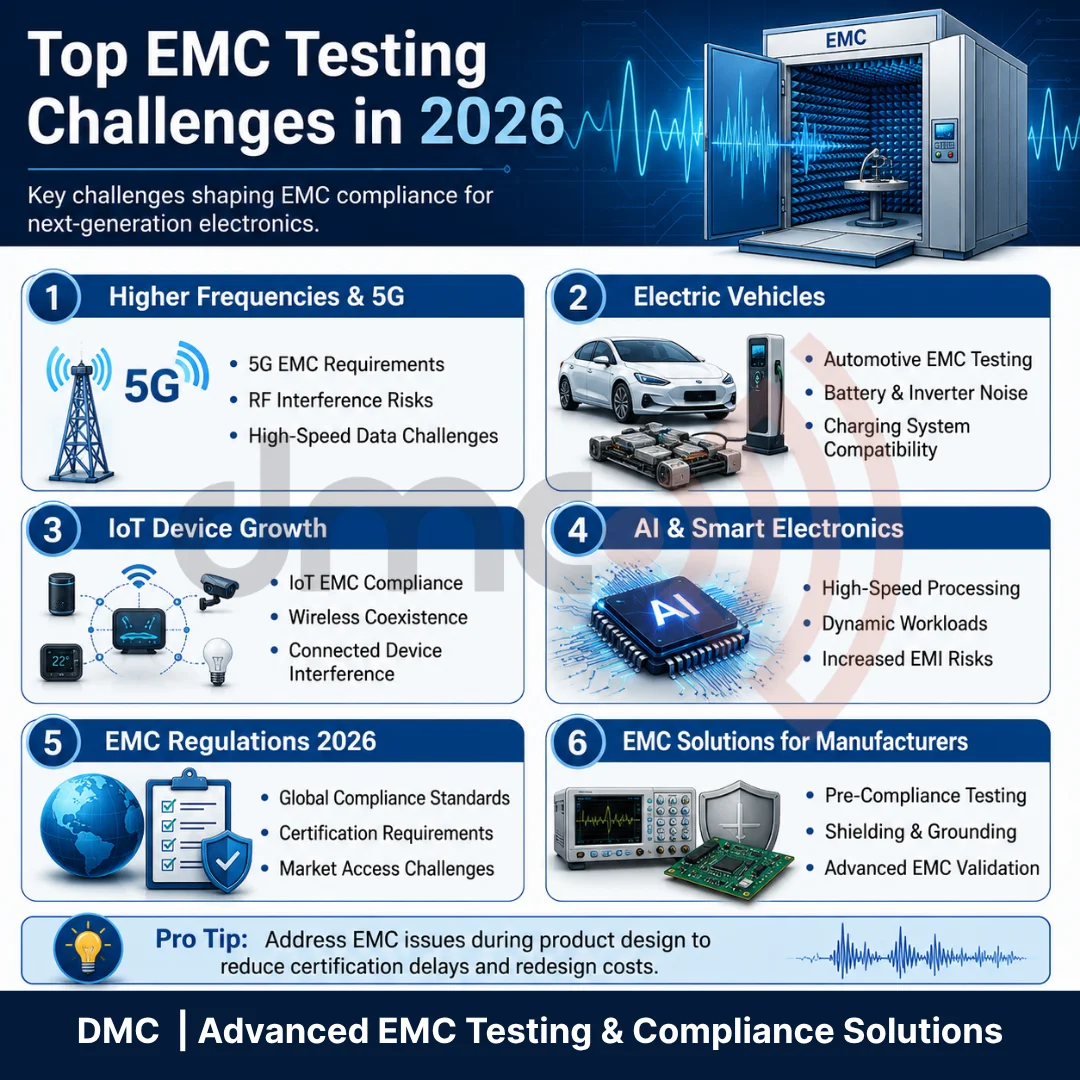
Automotive EMC Testing for Electric Vehicles
The electrification of transportation has changed the automotive industry and created new issues with EMC. EMP of highly active systems, like electric motors and batteries, are combined with advanced driver assistance systems which create even more emissions.
Because of this, automotive EMC testing is now one of the most stringent areas of testing. Manufacturers must validate that systems will function despite high levels of noise.
Key challenges include:
- High-current switching emissions
- Battery management system interference
- Charging infrastructure compatibility
- Radar and sensor performance
- Vehicle communication network reliability
Failure to address these issues can impact vehicle safety, performance, and regulatory approval.
IoT Device Expansion and Connectivity Challenges
The number of connected devices is rapidly increasing. This is affecting multiple industries. Thousands of connected devices are being integrated into smart factories, healthcare systems, smart homes, and smart and connected city infrastructures.
IoT electromagnetic compatibility (EMC) compliance becomes easier when devices do not operate in dense electromagnetic environments. If devices are in dense electromagnetic environments, manufacturers must ensure that devices do not generate too much interference when they operate along side other wireless systems.
Important testing considerations include:
- Wireless coexistence validation
- Simultaneous transmission analysis
- Network congestion effects
- RF performance evaluation
- Multi-device interaction testing
Compliance with IoT systems is challenging, and requires significant consideration for EMC strategies and the performance of every connected device in the system.
Impact of EMC Regulations in 2026
As technology advances, so do the systems of global trade. Manufacturers that produce products that are sold in multiple countries must comply with the local and regional trade systems.
2026 EMC regulations require an increased focus on the reliability of a product, the safety of a product, and the environmental performance of a product, as well as the wireless coexistence of a product. Organizations should improve their knowledge of these requirements, because an organization could be blocked from entering a market due to insufficient evidence for product certification.
Key compliance areas include:
- Radiated emissions testing
- Conducted emissions testing
- Immunity testing
- Wireless coexistence validation
- Product safety assessments
Failure to meet regulatory requirements can result in certification rejection, product recalls, and reputational damage.
Electronics Testing Standards Driving Compliance
Manufacturers can show that their products are compliant with particular standards, established by testing and certifying various products in an industry, by aligning their products with particular testing standards.
The following table illustrates the different areas of the technology sector, the primary focus of their EMC concerns, and the typical testing requirements pertinent to that area:
| Technology Sector | Primary EMC Focus | Typical Testing Requirements |
|---|---|---|
| Consumer Electronics | Wireless Performance | Emissions and Immunity Testing |
| Automotive | High-Voltage Systems | Automotive EMC Testing |
| Medical Devices | Safety-Critical Operation | Immunity and Reliability Testing |
| Industrial Automation | Electromagnetic Resilience | Conducted and Radiated Testing |
| IoT Devices | Connectivity Reliability | IoT EMC Compliance Validation |
| Telecommunications | RF Performance | 5G EMC Requirements Testing |
Standards established for testing various products in an industry aid manufacturers in the quicker certification of their products and the enhancement of reliability.
EMC Solutions for Manufacturers
Modern EMC concerns during the product lifecycle require proactive concerns during the product development process and the integration of EMC concerns during the product design process, instead of at the end during testing for certification.
Manufacturers gain solutions to EMC concerns during the product development process by:
- EMC-focused PCB design practices
- Early-stage pre-compliance testing
- Advanced simulation and modeling tools
- Proper grounding and shielding techniques
- Automated EMC validation systems
- Continuous compliance monitoring
The strategies listed above are highly likely to lead to a successful first certification and lower product development costs.
Manufacturers can gain testing and compliance support and advanced EMC testing by partnering with DMC. We help manufacturers identify problems early, reduce the time required for certification, and gain support to meet compliance in a timely manner for all global EMC regulations.
Pro Tip: You should include EMC testing on prototypes as opposed to waiting for the final certification. This will allow you to find interference issues on the prototypes, which will be less costly to fix. You are also able to get your product to market sooner and the reliability of your product will be better.
Conclusion
The developments in electronics due to AI, 5G, EVs, and the IoT are providing intricate opportunities in the marketplace but are introducing complex problems requiring thoughtful validation. This will challenge many in the field during the EMC testing 2026 era.
In the EMC testing 2026 era, organizations will have to address developments in electronics testing and EMC regulations 2026 to meet higher frequency electronics and more complex systems. Using thorough Electromagnetic Compatibility Testing and EMI Compliance Testing along with a strategic partnership with a leader in the field, such as DMC, will allow companies to meet compliance issues with confidence.
Frequently Asked Questions
EMC testing evaluates whether an electronic device can function correctly without causing or being affected by electromagnetic interference.
The rise of AI, 5G, EVs, and IoT devices has increased electromagnetic complexity, making EMC compliance essential for performance, safety, and regulatory approval.
EMI (Electromagnetic Interference) refers to unwanted electromagnetic disturbances, while EMC (Electromagnetic Compatibility) ensures devices can operate properly despite those disturbances.
Automotive, aerospace, telecommunications, medical devices, industrial automation, consumer electronics, and defense sectors all require EMC testing.
By implementing EMC-focused design practices, performing pre-compliance testing, using simulation tools, and addressing interference issues early in development.