
Table of Contents
- Why Faster EMI/EMC Testing Is Becoming a Priority
- The Rise of Automated EMC Measurements
- Industries Benefiting from Faster EMI/EMC Testing
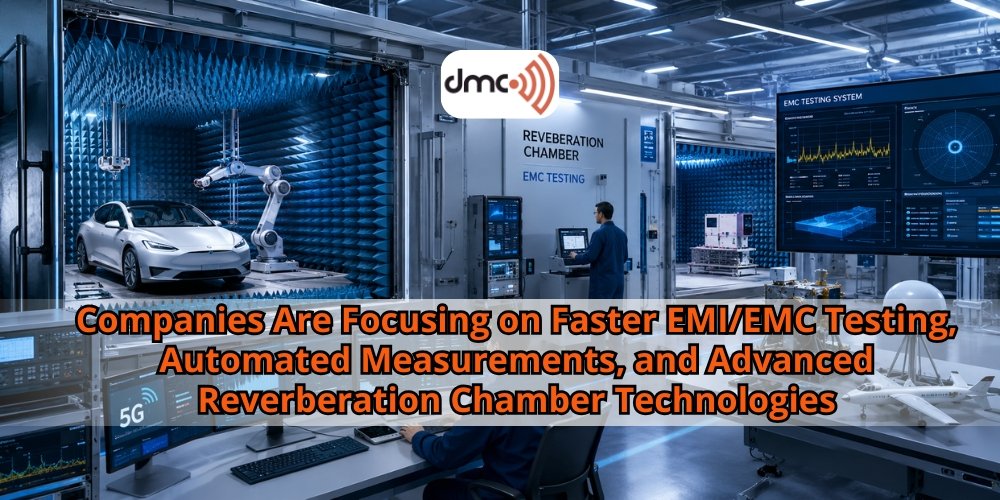
Faster EMI/EMC Testing has become important to manufacturers designing new electronic products due to the connectivity of the world today. Electric vehicles, autonomous systems, 5G, industrial automation, IoT products, systems, and all types of electronics put pressure on companies to shorten design and development cycles while satisfying international testing standards for EMI and EMC. Many organizations invest in developing intelligent, automated systems to speed up testing, certification, and product release to the market.
DMC has observed a major shift in the EMC industry toward rapid testing solutions that integrate automation, precision, and scalability.
Why Faster EMI/EMC Testing Is Becoming a Priority
The design and production of new electronics is very competitive and has a short product life. Testing of EMC is often the bottleneck in the production cycle and has a large impact on profitability.
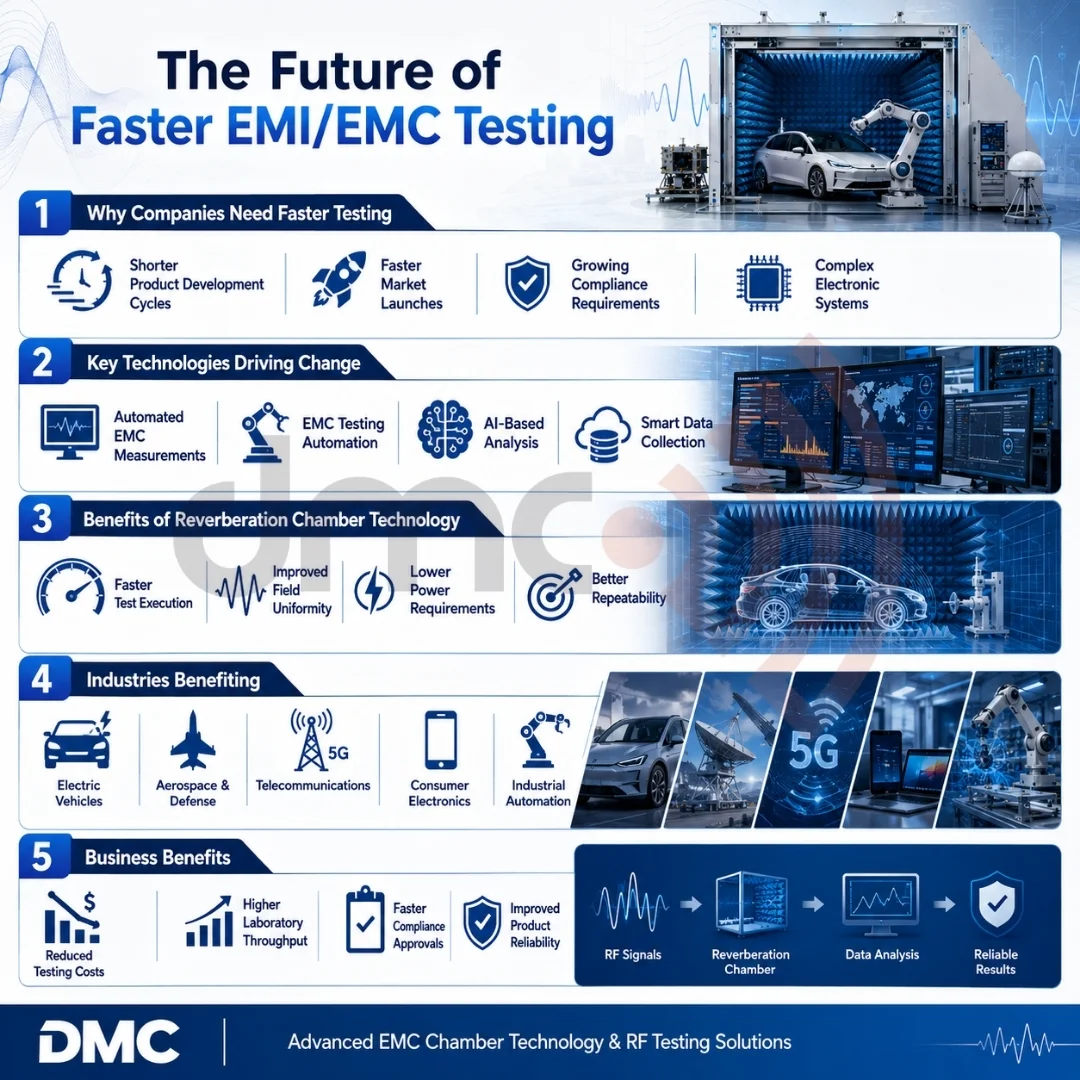
Demand for rapid testing has been caused by:
- Increasing product complexity
- Growing number of wireless technologies
- Shorter development schedules
- Stricter regulatory requirements
- Rapid innovation in automotive and aerospace sectors
- Higher testing volumes across multiple product lines
Most conventional systems of EMC testing require considerable manual assembly, prolonging the test and increasing costs.
Testing systems have evolved to incorporate automation while maintaining precision and repeatability.
Industry Challenges Driving EMC Testing Innovation
The design of new electronics has outstripped the traditional methods for testing EMC.
Common EMC Testing Challenges
- Multiple wireless communication protocols
- High-frequency operation above 6 GHz
- Dense electronic packaging
- Increased susceptibility to interference
- Integration of AI-enabled systems
- Complex automotive electronic architectures
These challenges call for new and advanced testing methods that address diverse operating conditions and provide reliable solutions. EMC Testing Automation solutions are being adopted by manufacturers to address these challenges and provide workflow automation, reduce manual intervention, and improve testing effectiveness and efficiency throughout multiple stages of the product development lifecycle.
The Rise of Automated EMC Measurements
Within the EMC sector, one of the most prominent trends has been the use of Automated EMC Measurements. With the development of advanced testing software and intelligent instrumentation, EMC engineers are now able to perform intricate measurements in a much shorter time frame and with a level of accuracy that was previously unavailable. Automated systems assist test facilities in shortening measurement cycles and achieving regulatory compliance with the least amount of effort.
Benefits of Automated EMC Measurements
- Faster data acquisition
- Reduced human error
- Improved repeatability
- Automated report generation
- Real-time data analysis
- Better resource utilization
- Increased laboratory throughput
The measurement process automation significantly improves the time needed to accomplish an EMC testing project when compared to manual processes.
Areas Commonly Automated
Automated processes in modern EMC laboratories are applicable to:
- Radiated emissions measurements
- Conducted emissions testing
- Immunity testing
- Antenna positioning
- Turntable movement
- Data collection and analysis
- Compliance report creation
Automation of testing processes enables engineers to devote more time to the design of products rather than the performance of repetitive tasks associated with measuring compliance.
Advanced Reverberation Chamber Technologies Are Transforming EMC Testing
The growing number of wireless devices has expanded the need for new testing methods and facilities. Traditional test methods and facilities are inadequate. Testing methods and facilities are needed that can test the impacts of uniformaly distributed electromagnetic fields on the performance of devices and their immunity.
Advanced Reverberation Chamber Technology has a number of unique capabilities:
Key Features of Reverberation Chambers
- Highly efficient field generation
- Uniform electromagnetic environments
- Faster test execution
- Lower power requirements
- High repeatability
- Suitable for large devices
- Ideal for wireless product testing
The unique capabilities of Advanced Reverberation Chambers make them suited for testing complex electronic systems for the automotive, aerospace, and defense industries as well as the telecommunications industry.
How Reverberation Chambers Improve Testing Speed
Advanced EMC Chamber Technology is an investment for many organizations to improve the speed of testing. Modern designs of EMC chambers help reduce the time to set up and improve the repeatability of measurements, as well as help expedite the testing of electronic systems within their intended operational environments.
Advantages for Faster Testing
- Reduced setup time
- Fewer measurement points required
- Rapid field uniformity generation
- Faster immunity testing
- Efficient wireless performance evaluation
- Improved laboratory productivity
As a result, testing cycles can be significantly shortened without compromising measurement quality.
Comparison: Traditional EMC Testing vs Automated Testing
| Feature | Traditional EMC Testing | Automated EMC Testing |
|---|---|---|
| Measurement Speed | Moderate | High |
| Human Intervention | Extensive | Minimal |
| Repeatability | Variable | Excellent |
| Data Processing | Manual | Automated |
| Reporting | Time Consuming | Instant |
| Resource Utilization | Moderate | Optimized |
| Compliance Verification | Slower | Faster |
| Overall Productivity | Lower | Higher |
This comparison clearly illustrates why companies are prioritizing automation and advanced chamber technologies.
Industries Benefiting from Faster EMI/EMC Testing
Many organizations rely on specialized EMC Testing Laboratories to validate product performance before market release. These laboratories are increasingly adopting automation and advanced chamber technologies to handle growing testing demands efficiently.
Automotive Industry
Electric vehicles and systems for autonomous driving are made up of many electronic subsystems, all of which need extensive EMC validation.
Benefits include:
- Faster vehicle certification
- Reduced development cycles
- Improved reliability
- Enhanced safety compliance
Aerospace and Defense
Modern aerospace systems rely on many electronic subsystems, all of which must function in demanding electromagnetic environments.
Benefits include:
- Improved mission readiness
- Accelerated qualification testing
- Better system resilience
Telecommunications
The extensive electromagnetic compatibility (EMC) testing required for the implementation of 5G and 6G technologies are also a concern.
Benefits include:
- Faster product launches
- Improved wireless performance validation
- Efficient compliance testing
Consumer Electronics
Manufacturers of consumer electronic goods are under constant pressure to roll out new products quickly.
Benefits include:
- Reduced time-to-market
- Lower testing costs
- Increased production efficiency
The Role of Artificial Intelligence in Automated EMC Testing
AI is rapidly transforming automated EMI testing. AI-based testing can be faster and more accurate and can be used to better validate testing procedures and identify measurement outliers.
AI Applications in EMC Testing
- Automated anomaly detection
- Predictive failure analysis
- Intelligent test sequencing
- Data trend analysis
- Compliance forecasting
- Test optimization
Automated measurement systems in combination with AI will further reduce testing time and improve the quality of test-related decisions.
Why Companies Choose DMC for Advanced EMC Solutions
At DMC we offer a broad spectrum of chamber technologies and RF Testing Solutions, combined with automated testing, we help organizations:
- Accelerate compliance testing
- Improve testing efficiency
- Reduce operational costs
- Increase laboratory throughput
- Support emerging technologies
- Achieve regulatory compliance faster
As customer demands for EMC solutions and services grow, more organizations require flexible and scalable testing environments to support innovations.
Pro Tip
Pro Tip: Organizations considering new EMC facilities should evaluate automated measurement systems as well as reverberation chamber technologies. The combination of both technologies will significantly improve productivity of the laboratory, optimize measurement times and improve repeatability, while reducing long term costs.
Conclusion
The future of EMC testing will be led by Automated EMC Measurements, EMC Testing Automation, and Reverberation Chamber Technology. The complexity of products and the demands for faster testing solutions have driven organizations to implement innovative RF Testing Solutions along with modern EMC Chamber Technology to perform faster EMI EMC Compliance Testing with the assurance of accuracy. Organizations that incorporate these solutions will gain a competitive advantage in the marketplace.
For organizations looking for innovative EMC solutions, DMC provides the technologies and testing environments for advanced product development.
Frequently Asked Questions
Faster EMI/EMC Testing refers to modern testing approaches that use automation, advanced measurement systems, and innovative chamber technologies to reduce testing time while maintaining compliance accuracy.
Automated measurements eliminate repetitive manual tasks, reduce human error, improve repeatability, and accelerate data collection and report generation.
A reverberation chamber is a specialized EMC testing environment that creates statistically uniform electromagnetic fields through controlled reflections, enabling efficient immunity and wireless testing.
Automotive, aerospace, defense, telecommunications, consumer electronics, and industrial automation industries benefit significantly from faster and more efficient EMC testing solutions.
Companies invest in automation to reduce testing time, improve measurement accuracy, increase laboratory productivity, lower operational costs, and accelerate product certification.