
Table of Contents
- Why Antenna Measurement Systems Matter
- Identify Your Frequency Range Requirements
- Consider Measurement Accuracy Requirements
- Industry-Specific Recommendations
Advancing wireless technology means choosing the correct antenna measurement system is increasingly important for manufacturers, research organizations, aerospace companies, defense contractors, telecommunications providers, and electronics developers. If your company develops devices related to 5G technology, satellite communications, radar, the Internet of Things, and advanced wireless technology, antenna measurement systems are necessary for the performance and regulatory standards of your products.
Organizations developing antenna measurement systems for engineers help analyze parameters including gain, radiation patterns, efficiency, and polarization. With the number of parameters that can be measured, ways to test, and configurations of the systems, choosing a system can be difficult.
DMC has published this document to help identify the most important parameters when choosing antenna measurement systems.
Why Antenna Measurement Systems Matter
The performance of modern wireless systems is heavily reliant on antennas. Even the most advanced systems of modern communications set will not perform as expected if the design of the antennas is not validated.
Precise antenna measurements enable organizations to accomplish the following:
- Verify antenna performance
- Improve wireless coverage
- Reduce product development risks
- Meet regulatory requirements
- Ensure product reliability
- Optimize signal quality
- Accelerate product launches
Ambulatory measurement systems help develop validated systems by providing a means to test design iterations early in the development process to reduce the time and cost of development.
Understanding Different Types of Antenna Measurement Systems
It is important have a general knowledge of the main types of antenna measurement systems prior to selecting a system.
| Measurement System | Best Application | Advantages |
|---|---|---|
| Far-Field Measurement System | Large antennas, satellite systems, radar | Direct measurement of radiation patterns |
| Near-Field Measurement System | Compact test facilities, high-frequency antennas | Smaller chamber requirements |
| Compact Range System | Aerospace, defense, large antenna testing | Simulates far-field conditions in limited space |
| OTA Testing System | Smartphones, IoT, 5G devices | Evaluates real-world wireless performance |
| mmWave Measurement System | 5G, 6G, automotive radar | Supports high-frequency testing |
Every measurement system has its unique purpose and can be employed based on the application.
Identify Your Frequency Range Requirements
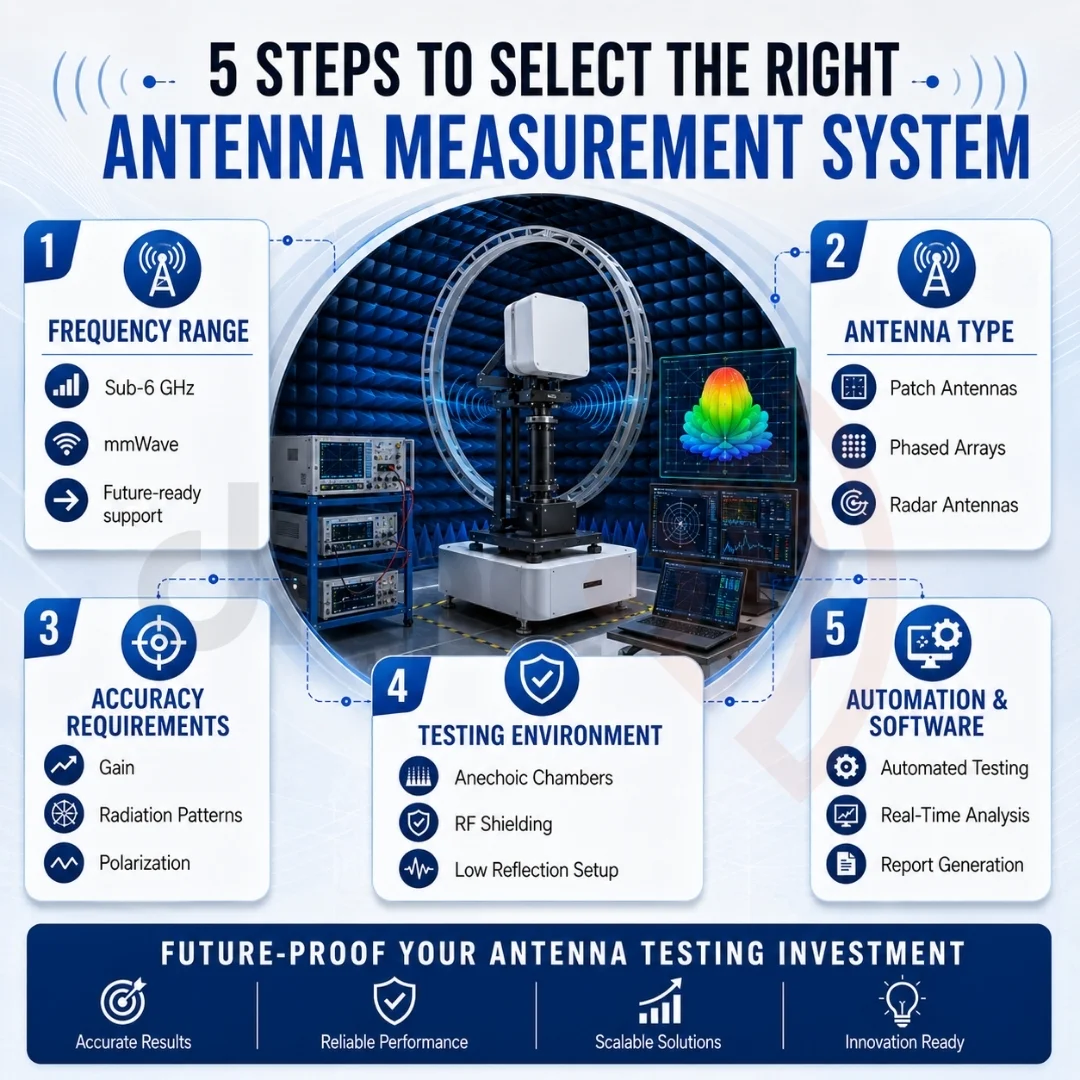
When choosing the Antenna Measurement System that best fits your needs, the operating frequency range mainly drives the choice.
Applications can differ in measurement requirements.
Sub-6 GHz Applications
- Wi-Fi
- IoT devices
- Cellular communications
- Industrial wireless systems
Millimeter Wave (mmWave) Applications
- 5G infrastructure
- Advanced radar systems
- Automotive sensors
- Satellite communications
High-Frequency Research
- Aerospace applications
- Defense systems
- Future 6G technologies
Measurement systems must be designed to meet current and anticipated frequency requirements.
Evaluate Antenna Size and Product Type
Antenna size limits the options for measurement systems.
Small Devices
Examples include:
- Smartphones
- Wearables
- IoT sensors
- Wireless modules
These products often benefit from:
- OTA testing systems
- Compact near-field measurement systems
Medium-Sized Products
Examples include:
- Communication equipment
- Wireless routers
- Base station antennas
Suitable options include:
- Near-field systems
- Compact range systems
Large Antennas
Examples include:
- Satellite antennas
- Radar systems
- Aerospace communication antennas
These applications typically require:
- Far-field ranges
- Large compact range facilities
Recognizing antenna size early can help avoid unnecessary large-scale testing facilities.
Consider Measurement Accuracy Requirements
Different applications require different levels of accuracy.
Some high-performance industries demand a high level of measurement accuracy.
Industries Requiring High Accuracy
- Aerospace
- Defense
- Satellite communications
- Military radar systems
Applications with Moderate Accuracy Requirements
- Consumer electronics
- Smart home devices
- IoT products
- Commercial communication equipment
When evaluating a system, the following should be considered, as they relate to the application:
- Dynamic range
- Measurement uncertainty
- Calibration capability
- Positioning accuracy
- Repeatability
The required accuracy level should align with product performance goals and industry standards.
Assess Chamber and Facility Requirements
The testing environment greatly impacts measurement accuracy.
Most organizations underestimate the infrastructure associated with antenna testing systems.
Key Facility Considerations
- Available floor space
- Chamber dimensions
- Shielding effectiveness
- RF absorber performance
- Environmental control
- Future expansion requirements
A Near-field measurement system can require far less space compared to a far-field range.
If an organization has limited facility space, compact range options can offer excellent solutions.
Determine Automation Needs
Antennas are increasingly more complex. To keep up, testing must become more efficient. Automated antenna testing provides many advantages, including:
- Faster testing cycles
- Reduced operator error
- Improved repeatability
- Higher throughput
- Easier data analysis
- Better reporting capabilities
Time and productivity can be greatly improved if an organization is testing a large number of systems using an automated measurement solution.
When choosing a solution, ensure software has the ability to:
- Automated test sequences
- Remote operation
- Data visualization
- Custom reporting
- Integration with existing workflows
Evaluate Future Scalability
Because of the rapid pace of technology, future needs must be considered in the measure system being purchased today.
Consider future needs such as:
- 5G Advanced testing
- 6G development
- Beamforming technologies
- Massive MIMO systems
- Higher frequency bands
- Advanced OTA testing
The expense of selecting an adaptable solution is less than the expense of making a non-adaptable solution work for future needs.
Compare Total Cost of Ownership
It is important to consider the total cost of ownership (TCO) when purchasing a system.
Factors Affecting Total Cost
- Initial equipment cost
- Installation expenses
- Chamber construction
- Maintenance requirements
- Calibration services
- Software licensing
- Future upgrades
- Training costs
If a system is purchased at a lower cost but does not have the flexibility to adapt for future testing needs, it will be more costly in the long run.
Industry-Specific Recommendations
Telecommunications
Recommended Systems:
- OTA testing systems
- Near-field measurement systems
- mmWave test solutions
Aerospace and Defense
Recommended Systems:
- Compact range systems
- Far-field measurement ranges
- High-precision positioning systems
Automotive
Recommended Systems:
- Radar measurement systems
- OTA testing environments
- mmWave measurement platforms
Research Institutions
Recommended Systems:
- Flexible near-field systems
- Multi-frequency measurement platforms
- Modular testing solutions
Selecting a solution that considers your industry maximizes measurement efficiency and long-term value.
Pro Tip: Plan for Tomorrow’s Technologies
Antenna measurement systems are purchased by many for the projects in hand. Although the wireless technologies are quickly evolving, systems are purchased that provide support for future frequency ranges, beamforming, over-the-air (OTA) testing, and the next generation (6G) technologies. Future scalability helps avoid significant costs down the line.
Why Choose DMC for Antenna Measurement Solutions?
At DMC, we understand each application poses unique challenges. This is the reason our antenna measurement systems are designed for performance on a scalable, customizable, and secure basis across the spectrum of telecommunications, aerospace, defense, and automotive for ease of integration.
The advantages of collaborating with DMC comprise:
- Customized antenna measurement solutions
- Advanced RF testing expertise
- Scalable system architectures
- High-precision measurement capabilities
- Support for emerging wireless technologies
- Comprehensive installation and technical support
DMC helps you choose the right system, from compact solutions to large-scale installations.
Conclusion
There are many aspects to consider when choosing an antenna measurement system, some of which include the system’s frequency range, antenna dimensions, measurement precision, facility limitations, automation, and the ability to adapt to future requirements.
Meeting the testing goals of the organization, along with an understanding of the systems available, will empower organizations to choose a measurement system that will enhance the performance of the organization’s products, lower the risks present in the product development life cycle, and provide a platform for future development.
The right antenna measurement system will provide organizations with the testing tools they need to continue advancing with developing wireless technologies.
Frequently Asked Questions
An antenna measurement system is a specialized testing setup used to evaluate antenna performance parameters such as gain, radiation pattern, efficiency, polarization, and directivity.
Near-field measurements are performed close to the antenna and mathematically transformed into far-field results, while far-field measurements directly evaluate radiation characteristics at larger distances.
For 5G applications, OTA testing systems, near-field measurement systems, and mmWave measurement platforms are commonly used depending on frequency and device type.
OTA testing evaluates real-world wireless performance by measuring how devices transmit and receive signals without direct cable connections.
Consider factors such as operating frequency, antenna size, measurement accuracy, chamber requirements, automation needs, scalability, and budget when selecting a system.