
Table of Contents
- What Makes Near-Field Measurement Different?
- Why Far-Field Measurement Still Matters
- Which One Should You Choose?
The approach taken to evaluate the performance of the antenna during development will determine whether the entire process succeeds. It is essential to decide early on whether to use near-field or far-field techniques when designing 5G equipment, satellites, IoT devices, and more.
In the industry of 5G, aerospace, defense, satellite communication, and IoT, Diamond Microwave Chambers Ltd
provides trustworthy RF chamber and antenna measurement systems.
Understanding the Basics
Evaluation of antennas can be defined as the process of assessing the performance of the antennas in transmitting and receiving signals.
The fundamental difference that exists between the two methods of measuring antennas comes in relation to the location where measurements are made.
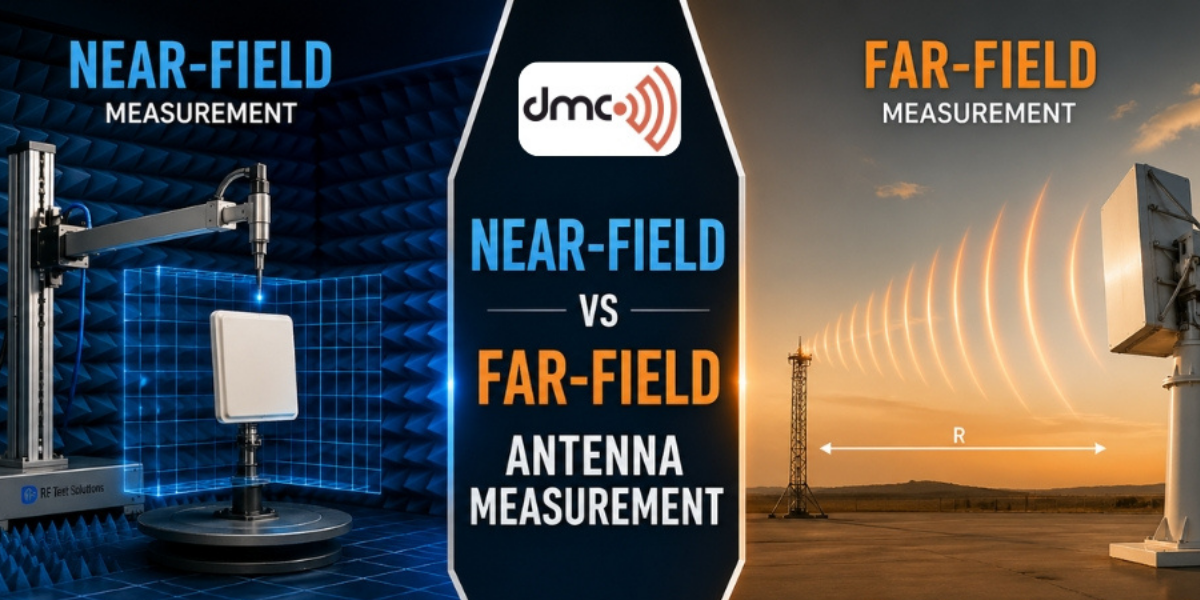
In near-field testing, measurements are carried out close to the antennas, whereby the electromagnetic field is still developing.
In far-field testing, measurements are done far away from the antennas, where the radiation pattern remains stable.
What Makes Near-Field Measurement Different?
Near-field measurement requires obtaining high-quality measurements in proximity to the antenna itself. Since at this point the radiation pattern is not completely formed, the data acquired is further converted mathematically into the data of the far field.
It may be a little tricky to understand what that means; however, the one advantage this system offers is obvious – you do not have to have a vast free area to obtain quality data.
This is precisely the reason for the popularity of near-field systems in anechoic chambers where even large antennas can be tested easily regardless of the distance to the chamber walls.
Nevertheless, it is crucial to note that this type of measurement requires high calibration accuracy, and scanning should be performed flawlessly.
Why Far-Field Measurement Still Matters
Far-field measurements involve a much more straightforward process. As opposed to measuring field data directly and then analyzing it, far-field measurements analyze the actual behavior of the radiation pattern as it occurs in the real world.
This requires the antenna to be at a specific distance from the receiver. The distance depends on the antenna size and frequency and can be determined with a well-known formula.
Of course, one major benefit of far-field measurements is their straightforwardness; there is little post-processing needed for this technique to work.
However, there is an important caveat associated with far-field measurements. Getting the necessary distance may be challenging for some applications.
A Practical Comparison
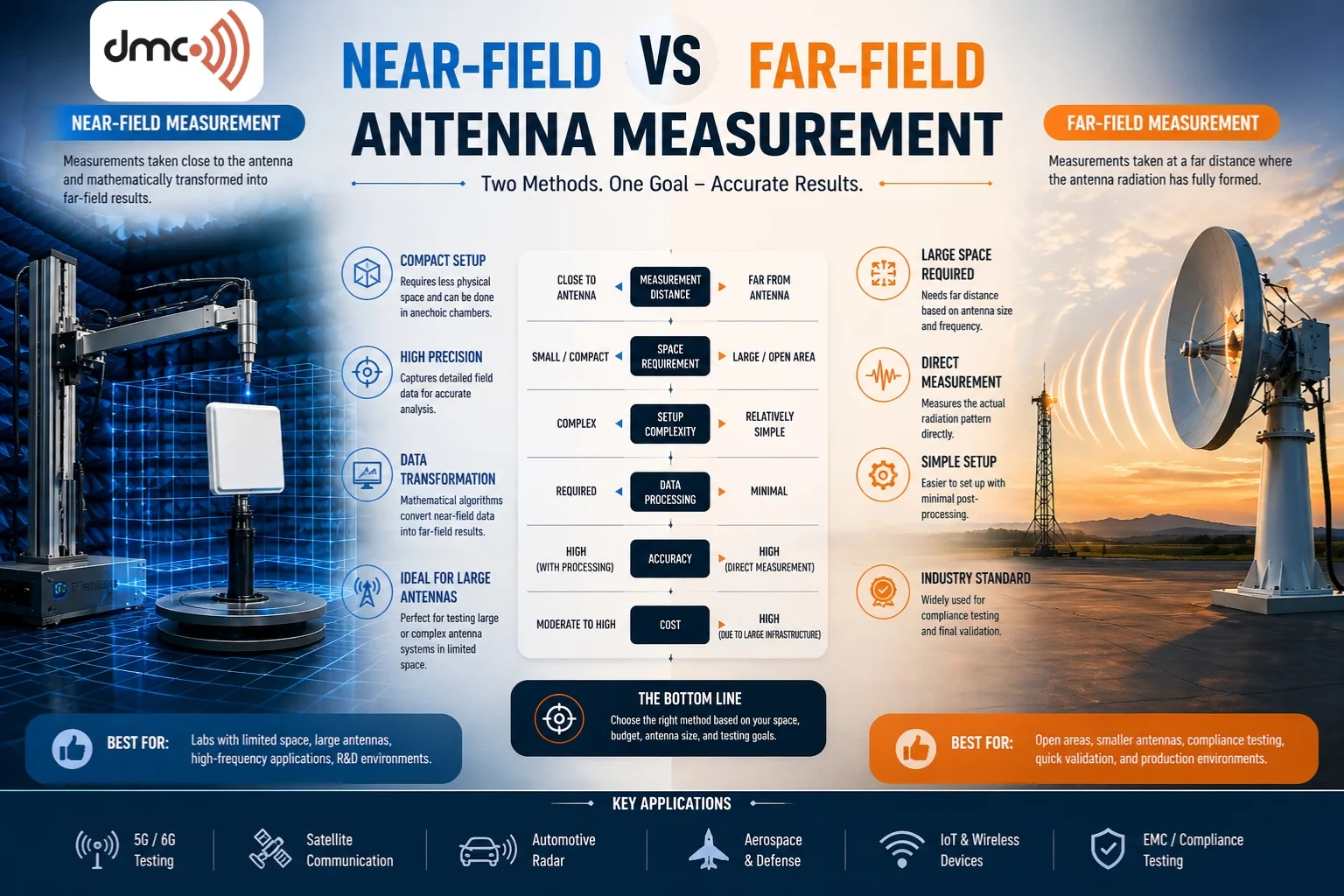
Instead of mentioning many points, let’s make the distinction simple and understandable through visual representation:
| Aspect | Near-Field | Far-Field |
|---|---|---|
| Measurement Distance | Very close to antenna | Far away from antenna |
| Space Requirement | Compact setup | Requires large area |
| Data Handling | Needs transformation | Direct results |
| Setup Complexity | Technically demanding | Relatively simple |
| Ideal Use Case | Large antennas, labs | Small antennas, open ranges |
Which One Should You Choose?
Your answer does not rely heavily on theory but rather on your actual work environment.
When you find yourself in a lab environment with minimal space available, near-field testing will be the most suitable approach. You can achieve high precision without investing in large-scale infrastructure. This technique is ideal for fields such as aerospace engineering and modern communication systems.
Conversely, when you can perform tests in open air and require simple and fast measurement techniques, then far-field testing will be an excellent option. This method works best for small antenna designs and conventional testing procedures.
Practically speaking, companies do not stick to one technique alone but employ both in various phases of their work processes.
Cost vs Efficiency: The Real Trade-Off
The first and foremost misunderstanding is that one process will always be more economical than the other.
The near field system may appear to be more costly due to the hardware and software it utilizes. However, the space savings provided by the near field system is an important consideration when evaluating costs.
The far field system, while easier to understand, often requires a huge testing area or specially-designed chamber, which may become quite costly depending on the location of the test facility.
Thus, instead of asking which is more economical, we should ask which is more effective for our needs.
Accuracy in Real-World Conditions
Both techniques have the potential to provide very accurate data; however, their approaches differ.
Near-field tests are consistent as they take place in a controlled setting. Environmental influence is negligible, which ensures accuracy.
Tests conducted from afar can be influenced by factors such as echoes, weather conditions, or other objects.
This is precisely the reason why engineers rely on near field tests to ensure accuracy and far field tests to validate their results.
Where the Industry is Heading
Due to rapid developments in new technologies such as 5G technology, autonomous devices, and satellite networking, antenna testing techniques have also been changing quite quickly.
It is becoming popular to adopt the method of near field measurement owing to its appropriateness to meet the current requirements, such as less space, precision, and speed.
However, the significance of far field measurement is noteworthy in terms of ensuring compliance with regulations and antenna performance.
These two techniques are not exclusive but rather complimentary to each other.
Emerging Trends in Antenna Testing
In view of the growing trends of 5G, IoT, and satellite communications:
- Near-field measurement techniques are getting popularity owing to the smaller test setup size
- Mixed configurations that use both the techniques are becoming popular
- Automation and artificial intelligence-based calibration have become more efficient
Clearly, the future lies ahead of near-field measurement techniques.
Pro Tip
When designing a contemporary RF test station, consider acquiring the capability for near-field measurements right from the start. It offers advantages in flexibility, scalability, and cost-effectiveness, particularly when dealing with sophisticated or large-scale antenna systems.
As the need for advanced antenna testing grows, Diamond Microwave Chambers Ltd is dedicated to providing industries with innovative RF chamber solutions that accommodate both near-field and far-field measurement applications.
Frequently Asked Questions
Near-field measurement captures data close to the antenna and converts it into far-field results, while far-field measurement directly evaluates radiation at a distance.
Near-field measurement is more suitable because it does not require large distances for testing.
Not necessarily. Both methods are accurate, but near-field provides more consistent results in controlled environments.
Because it reduces space requirements and supports high-precision testing for modern antenna systems.
Yes, many industries combine both methods for development, testing, and final validation.