
Table of Contents
- Understanding EMC Testing
- Key Applications of AI in EMC Testing
- AI and Machine Learning in EMC Laboratories
- What to Expect for the Future of AI and EMC Testing
Industries across the globe are witnessing the impact of the new waves of Artificial Intelligence (AI) technologies. The phenomenon is clearly eliciting the same response within the realm of Electromagnetic Compatibility (EMC) testing. Today’s electronic systems are becoming more and more sophisticated. Verifying that each individual system meets EMC compliance becomes an ever-increasing challenge. The customary techniques for EMC testing require extensive manual analysis, long testing times, and a high degree of testing engineering. The introduction of automation and AI into testing systems is changing the paradigm of traditional systems and is adding predictive capabilities and intelligent decision-making to the EMC testing domain.
From the perspective of manufacturers, engineers, and compliance testing professionals, the impact of AI is already a game changing technology that is improving the efficiency of testing, is economically advantageous, and reducing the time to certify. This article will provide insights concerning the impact that AI is having on EMC testing and the foreseeable ramifications for EMC compliance.
Understanding EMC Testing
Electromagnetic Compatibility (EMC) Testing is a way of ensuring electronic devices are able to function in their designed environment without causing issues to other electronic devices.
EMC testing involves the following types of testing:
- Radiated Emissions Testing
- Conducted Emissions Testing
- Radiated Immunity Testing
- Conducted Immunity Testing
- Electrostatic Discharge (ESD) Testing
- Surge and Transient Testing
These methods of testing are important in achieving various international and regional standards and regulations of product safety.
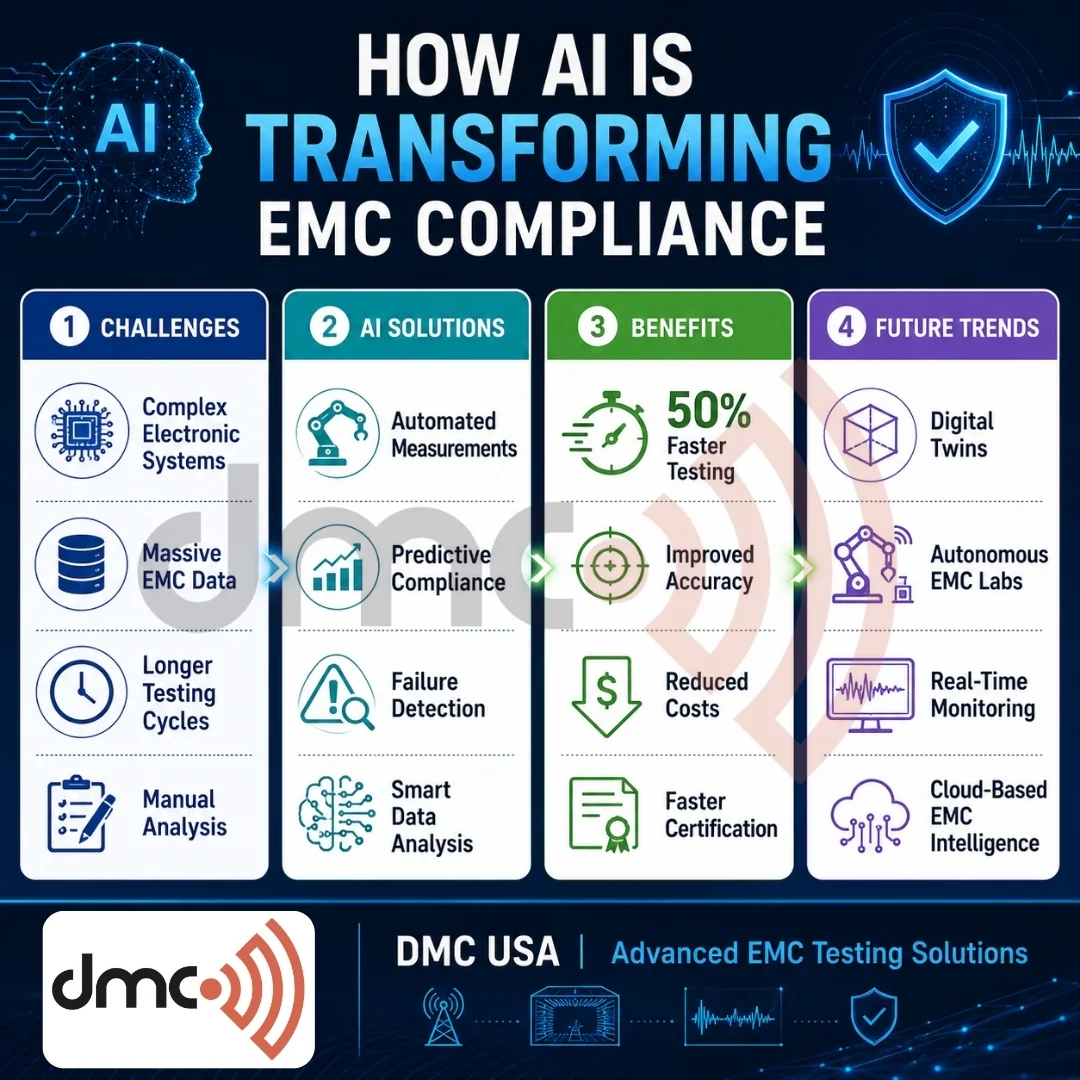
Traditional forms of EMC Testing create a large volume of data which Engineers must analyze without the aid of modern technologies. AI provides the answer to this problem.
Why AI is Becoming Essential in EMC Testing
Today’s complex electronic systems which include circuit architectures, IoT connectivity, wireless technologies, and high-speed processors can make EMC testing even more complicated as the systems become data rich.
AI provides a solution for the following problems by:
- Automating repetitive tasks
- Identifying patterns in large datasets
- Predicting EMC failures before testing
- Optimizing test procedures
- Improving compliance accuracy
- Reducing testing time
AI-powered EMC solutions offer organizations a market edge with swifter product launches and superior compliance.
Key Applications of AI in EMC Testing
1. Automated Data Analysis
Standard EMC testing can generate thousands of data measurements and results. Engineers then have to spend time analyzing spectra in order to find anomalies and diagnose failures.
AI can be programmed to:
- Find peaks in emissions
- Recognize violations of compliance
- Determine and classify causes of interference
- Construct testing documentation
- Identify significant issues
Automation of the above tasks also improves accuracy.
2. Predictive EMC Compliance
Predictive analysis is valued greatly among AI systems.
Compliance for EMC testing can be predicted by analysis of:
- Historical EMC test data
- PCB Dimensions and layouts
- Component placement
- Circuit designs
The predicted cases of EMC prior to testing can be designed to mitigate the redesign costs and potentially achieve a certification faster for a more reliable and test ready product.
3. Intelligent Test Automation
With minimal human control, AI systems can fully automate the process of:
- Setting up EMC test equipment
- Choosing test parameters
- Carrying out testing procedures
This leads to laboratories:
- Boosting testing capacity
- Minimizing the potential for operator errors
- Improving process standardization
- Enhancing repeatability
As the demand for products increases, the importance of fully automated EMC testing increases as well.
4. Failure Root Cause Identification
Diagnosing EMC failures can be a time-consuming process.
With AI, systems can analyze results from large, multiple tests, and identify likely root causes faster:
- Insufficient grounding
- Insufficient shielding
- PCB Routing
- Power Supply Noise
- Component Interactions
This allows the engineers to address the problem faster and reduce the time spent troubleshooting the problem.
5. Smart Reverberation Chamber Optimization
Modern reverberation chambers are becoming the most frequently used in EMC testing.
AI can optimize:
- Chamber Configurations
- Stirrer Positions
- Test Sequences
- Measurement Accuracy
This incremental improvement in a lab allows them to get more reliable results and more repeatable results while optimizing the use of the chamber.
| Benefit | Traditional EMC Testing | AI-Powered EMC Testing |
|---|---|---|
| Data Analysis | Manual and Time-Consuming | Automated and Intelligent |
| Error Detection | Engineer-Dependent | AI-Assisted Accuracy |
| Compliance Prediction | Limited | Highly Predictive |
| Testing Speed | Moderate | Significantly Faster |
| Cost Efficiency | Higher Operational Costs | Reduced Testing Expenses |
| Root Cause Analysis | Slow Troubleshooting | Rapid Diagnosis |
| Test Repeatability | Variable | Consistent and Reliable |
AI and Machine Learning in EMC Laboratories
Most EMC laboratories are beginning to integrate ML technologies into their systems. These AI-driven systems in labs can:
- Continuously learn from historical tests
- Improve prediction accuracy over time
- Recommend corrective actions
- Generate compliance documentation automatically
- Support decision-making processes
With the addition of sufficient volumes of data, these systems will likely improve the chances that engineers will successfully achieve compliance within required time constraints.
The Role of AI in EMC Product Design
AI has now also changed the Product Design itself as AI has also integrated into Simulation.
Design Engineers can now also take advantage of AI Simulations to assess the EMC characteristics of their designs.
AI Simulations for EMC Design Assessments can optimize the following:
- PCB Design
- Grounding
- Shielding
- Cabling
- Component Placement
With advanced Simulation tools available, design teams can mitigate potential EMC issues and minimize redesigns throughout the Product Life Cycle.
Challenges of AI Adoption in EMC Testing
AI has many disadvantages including the following:
Data Quality Requirements
AI systems can only work if they are trained and taught using good Quality data. If Data is of poor Quality, it can lead to the following:
- Bad suggestions
- Positive Failures
- Low Trust
Initial Investment
If AI is to be used for Testing, the following are generally required:
- Specific Software
- Updated Hardware
- Trained Personnel
During the entire life of the Testing system, these costs will be justified.
Regulatory Acceptance
AI has the potential to improve Testing; however, the outcome of Testing must be verifiable and must align to the current EMC regulations in place. AI has potential, but Certification will always be a Manual Task.
What to Expect for the Future of AI and EMC Testing
AI and EMC Testing are a great match and the Testing industry is becoming Rapidly Smarter.
Some of the trends that are beginning to appear are the following:
Digital Twin Technology
Using AI, digital twins will enable engineers to simulate the EMC performance of a design before creating a physical version.
Autonomous Testing Systems
Fully autonomous EMC testing labs may become able to conduct, analyze, and report testing independently.
Real-Time Compliance Monitoring
Employed AI may be able to monitor EMC performance in real time, even after a product is released.
Cloud-Based EMC Intelligence
AI may be used to share EMC knowledge and analytics worldwide.
Pro Tip: AI-Enhanced EMC Analysis will enable organizations to identify design flaws in EMC compliance before the initial design undergoes final compliance testing. This will save organizations significant design and compliance processing time and costs.
Conclusion
AI is changing the game for EMC testing and compliance. Many organizations will benefit from automation of data analysis and test automation, and from optimized lab design and testing. This will result in expedient and economical EMC compliance.
The importance of AI will only grow as manufacturers continue to develop advanced electronic systems that require high quality and safe systems within shortened timeframes to meet demanding Regulations and Standards. Organizations that employ AI will be best positioned to meet the demands of future EMC compliance.
For cutting edge EMC testing, look no further than DMC USA. We are committed to using modern technologies and practices to provide verified solutions for EMC compliance.
Frequently Asked Questions
AI in EMC testing refers to the use of artificial intelligence and machine learning technologies to automate testing processes, analyze data, predict failures, and improve EMC compliance accuracy.
AI improves EMC compliance by identifying potential issues early, automating analysis, reducing human errors, and accelerating certification processes.
No. AI serves as a powerful support tool, but experienced EMC engineers are still essential for interpreting results, validating compliance, and making engineering decisions.
Benefits include faster testing cycles, improved repeatability, reduced operational costs, enhanced accuracy, and quicker troubleshooting.
The future includes predictive compliance systems, digital twins, autonomous testing laboratories, and real-time EMC monitoring powered by AI technologies.