
Table of Contents
We are beginning to understand testing the electromagnetic spectrum in ways we never imagined possible thanks to the rapid development of intelligent electronic systems coupled with modern, advanced means of communication. We are seeing the implementation of 5th and 6th generation (6G) networks, fully autonomous vehicles, smart medical devices, AI-based servers, and augmented IoT infrastructures. The need for testing cutting edge technology at ever more advanced higher frequency testing bands is beginning to occur at an exponential rate.
With modern electronic devices embodying more broadband communication, massive data, and advanced RF architectures at a much greater frequency, the need for advanced reliability testing, compliance and safety assurance is imperative.
5G and 6G devices and beyond will bring unprecedented testing challenges. Telecommunications, aerospace, automotive, and AI hardware businesses will not have the luxury of treating advanced testing as an optional practice. Accuracy and advanced high-frequency testing will be a requirement to maintain market position.
What is Higher Frequency Testing?
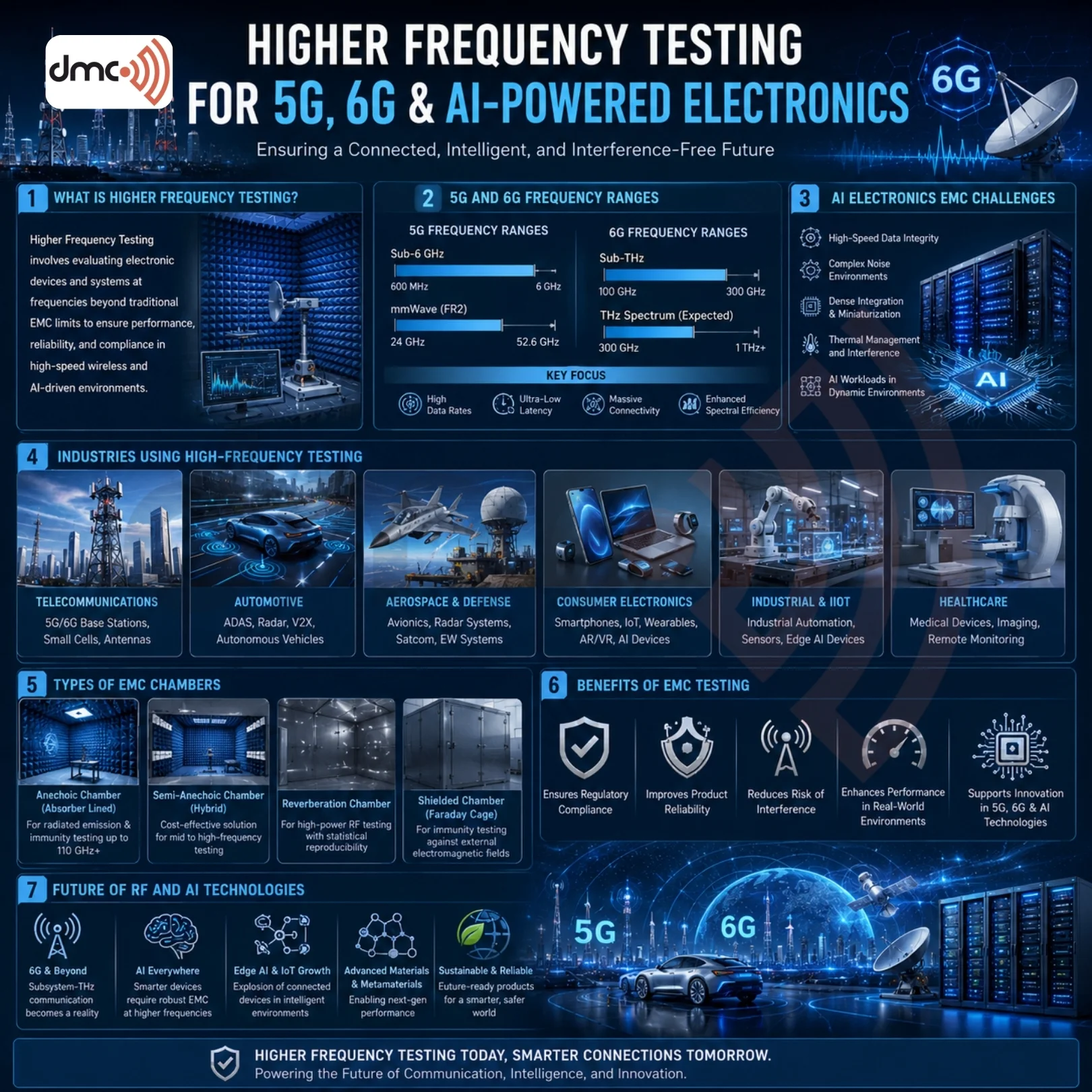
Higher Frequency Testing refers to the testing of electronic hardware, RF systems, and communication hardware in the several gigahertz (GHz) to mmWave frequency range.
These evaluations target measurement of the following aspects:
- Electromagnetic interference (EMI)
- Electromagnetic compatibility (EMC)
- Signal integrity
- RF performance
- Antenna efficiency
- Reliability of data transmission
- Thermal stability
- Wireless communication performance
With the trend of moving toward 5G (and eventually to 6G), many communication devices are beginning to operate at higher frequencies.
The following outlines how different technologies operate at varying frequency ranges:
| Technology | Frequency Range |
|---|---|
| 4G LTE | Below 6 GHz |
| 5G Sub-6 GHz | Up to 6 GHz |
| 5G mmWave | 24 GHz – 100 GHz |
| Future 6G | Above 100 GHz |
| AI Data Center Systems | High-speed RF & signal frequencies |
The shift toward these frequencies requires greater capacity for electromagnetic compatibility EMC testing, precision measurement systems, radio frequency (RF) shielded rooms, and anechoic chambers.
Importance of Testing at Higher Frequencies
There are a number of engineering challenges related to higher frequency communication that can impact the overall quality of products and the performance of an associated network. These include the following:
Signal Integrity
As frequencies increase, signals become more susceptible to interference, distortion, and even noise. These can lead to the following:
- Signal distortion
- Data loss
- Decreased speed of communications
- Connection instability
- Malfunction of devices
Testing at higher frequencies helps engineers address challenges that impact products before they are made commercially available.
Importance to 5G and 6G
5G and future 6G technologies are based on ultra-fast wireless communication, and features such as beamforming, massive MIMO antennas, and low-latency. To ensure that performance is satisfactory, the following need to be assessed:
- Antenna radiation
- RF signals
- Electromagnetic emissions and interoperability
- High-speed data transmission
In the absence of testing at higher frequencies, telecom markets may not comply with the international standards and certifications.
AI-Powered Electronics Generate More Electromagnetic Noise
Systems powered by AI built with high-speed CPUs, GPUs, and even more advanced chipsets process large amounts of data.
Some examples are:
- AI servers
- Edge computing systems
- Mobile autonomous robots
- Smart surveillance systems
- Industrial automation systems
- Smart medical devices
These systems are capable of creating a complex electromagnetic environment that can disrupt other systems. To keep operation within the limits and prevent critical failures due to interference, manufacturers rely on higher frequency EMC testing.
Adherence to International Standards
Globally, the regulatory requirements for high-frequency devices are becoming more stringent.
Manufacturers must operate within the regulations of
- FCC
- IEC
- CISPR
- ISO
- MIL-STD
- ETSI
The products must be tested for compliance of requirements on emissions and immunity products in order to be traded within the global markets.
Sectors Fueling the Demand for Higher Frequency Testing
The increasing cross-sector application for next generation technologies has led to a less frequent generation of technologies.
| Industry | Why Testing Is Important |
|---|---|
| Telecom | 5G/6G infrastructure validation |
| Automotive & EV | Radar, autonomous driving, V2X systems |
| Aerospace | Satellite communication and avionics |
| Defense | Secure RF communication systems |
| Healthcare | Wireless medical equipment reliability |
| AI Data Centers | High-speed processing and server stability |
| Consumer Electronics | Smart devices and IoT connectivity |
These chambers help isolate devices under test for Electromagnetic Interference while creating a controlled environment for precise measurement and verification.
Every Kind of EMC Chamber
Anechoic Chambers
Designed for:
- Tests for antennas
- RF measurements
- 5G devices tests
- Radar testing
These chambers can absorb reflections of electromagnetism and provide an environment for testing antennas in free space.
Semi Anechoic Chambers
Designed for:
- EMC compliance testing
- Electronics of automotive test
- Industrial devices testing
These chambers absorb some levels of electromagnetic radiation and provide an RF absorption.
Reverberation Chambers
Designed for:
- Tests for immunity
- Tests for wireless devices
- Tests for big electromagnetic compatibility (EMC) devices
These chambers electromagnetism for test devices in stimulated electromagnetic environments.
Shielded Rooms
Designed to:
- Stop RF from outside of the room
- Protect RF sensitive devices
- Provide a safe room to do sensitive testing
These environments are vital for testing defense and telecom devices.
Problems for Testing at Higher Frequencies
Though high frequency devices have significant advantages, testing them can be much more difficult than lower frequency devices.
The Issues of Very Short Frequencies
Higher frequencies have shorter wavelengths, making them more sensitive to:
- Physical obstructions
- Cable placement
- Connector quality
- Differences in PCB design
These devices are susceptible to EMC design.
Sophisticated Antenna Arrays
5G and AI communication systems often leverage advanced antenna arrays.
Testing these systems requires:
- Advanced measuring systems
- Special RF software
- Tightly controlled EMC environments
Thermal Loads
AI devices produce large thermal loads.
Overheating can affect:
- RF stability
- Signals
- Device length
- Processing
Testing helps manufacturers to verify cooling and improve system reliability.
The Outlook for Higher Frequency Testing
Electronics of the future will include the following:
- 6G wireless communication
- Integration of AI in Infrastructure
- Smart Factory Systems
- Autonomous Systems of Transport
- More Advanced Satellite Systems
- Quantum Communication Technologies
As operating frequency increases, so will the challenges in testing.
The future of EMC testing will contain:
- AI-driven automation
- Real-time RF monitoring
- Evolution of Simulation Software
- Digital Twin Technologies
- Validation of Millimeter Waves and High-Frequency Testing
The companies that take the lead in investing in this type of EMC testing, will have the upper hand in the future markets and relative business growth.
Advantages of Higher Frequency EMC Testing
The companies that integrate better testing systems will reap the benefits of their investment.
Improved Reliability of Products
Embracing these types of testing systems help to reduce the frequency issues of RF and EMC early on in the product life cycle.
Faster Time to Market
Early testing helps streamline the process of design certification, which helps to launch a product in the market sooner.
Wireless Communication Quality and Reliability Improvements
RF and EMC issues can help to improve a product’s communication and overall connectivity.
Reduced Product Recalls
Potential recalls and subsequent product performance issues can be avoided.
Enhanced Brand Equity
Customers have confidence in companies that produce high-quality products.
Pro Tips
It is recommended that companies integrating 5G, AI, and other next generation wireless products and systems, bring higher frequency EMC testing on board before the product life cycle redesign.
Why DMC USA Believes in Advancing EMC Testing
DMC USA is a firm that supports EMC chamber solutions to serve the future of modern high-frequency tests.
Their answers enable industries focused on:
- Testing for 5G/6G
- Validating AI Electronics
- Automotive EMC Compliance
- RF Testing in Aerospace
- Defense Communication Systems
- Wireless Technologies in Industrial Settings
The electronics sector will always need reliable higher frequency testing in order to innovate and adhere to the evolving communications technologies.
Frequently Asked Questions
Higher frequency testing evaluates electronic devices operating at GHz and millimeter-wave frequencies to ensure RF performance, EMC compliance, and signal reliability.
5G networks operate at higher frequencies that are highly sensitive to electromagnetic interference. Testing ensures stable connectivity, faster speeds, and regulatory compliance.
AI systems use high-speed processors and dense circuitry that generate more electromagnetic noise, requiring advanced EMC testing to prevent interference.
Industries including telecom, automotive, aerospace, defense, healthcare, and AI data centers require higher frequency testing for compliance and performance validation.
Testing commonly uses EMC chambers, anechoic chambers, spectrum analyzers, RF antennas, shielded rooms, and advanced measurement systems.