
Table of Contents
- What is an EMC Chamber?
- AI Servers and Data Centers Driving EMC Demand
- Why EMC Compliance Matters
- Complexities of EMC Testing
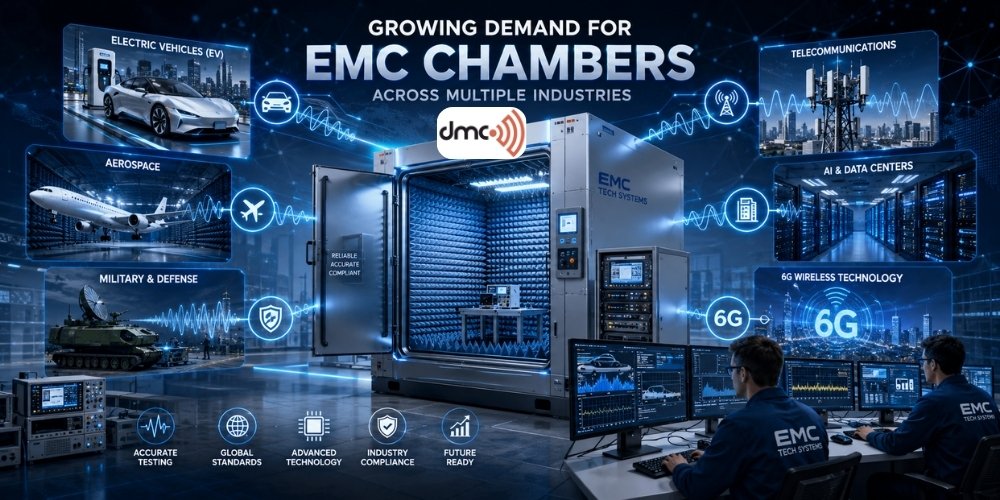
Electromagnetic compatibility (EMC) testing is essential for new electronic products. The global expansion of industries fuels the demand for new electronics. With higher demand for products comes the need for more EMC Chambers testing facilities. The growth of automotive and Electric Vehicle (EV), aerospace, defense, telecom, AI servers, and the upcoming 6G technology will bring an increased demand for EMC testing.
Modern electronic systems incorporate many components and operate at higher frequencies. Systems with more components are more susceptible to interference that results in degraded service and unsafe systems. EMC testing chambers are necessary to provide a controlled laboratory environment to test products for compliance with international standards.
All electronic systems employ wireless communication, rapid information processing, intelligent programs, and automation. These systems are heavily dependent on radar. The international demand for these systems accelerates the need for more EMC testing facilities.
What is an EMC Chamber?
EMC chambers help isolate external interference to create a noise-controlled environment. These chambers allow electromagnetic emissions to test a product’s immunity.
Isolation of external electronic noise enables product testing for electromagnetic interference (EMI), electromagnetic compatibility (EMC) compliance, Radio Frequency (RF) shielding, Antenna, Wireless communication, and other product certification testing.
Many industries require EMC testing to meet international standards. These standards include CISPR, MIL-STD, ISO, FCC, and IEC.
The Growing Demand for EMC Chambers
As advances in electronics progress, smaller, faster devices require more interconnectivity. With an increasing focus on automation and wireless ecosystems, all industries will find limits without EMC testing.
1. The Electric Vehicle Phenomenon
Electric Vehicles (EV) consist of intricate electronic systems. These include:
- Battery management systems
- Advanced Driver Assistance Systems (ADAS)
- Radar systems
- Inverters
- Charge control
- Wireless communication
Each of these systems can create electromagnetic emissions and potentially disrupt adjacent systems. To ensure safety, reliability, and compliance, manufacturers utilize EMC chambers. Industrial investment in OEM (Original Equipment Manufacturer) testing capabilities is growing due to worldwide EV trends.
2. Growth of Automotive Electronics
Modern vehicles contain:
- Information and entertainment systems
- Systems for driving automation
- Global Positioning System and navigation
- Intelligent sensors
- Systems for vehicle communication
All of these components require validation via EMC chambers.
Automotive manufacturers cannot tolerantly compromise on electromagnetic performance because of consequences on vehicle operational integrity.
3. The Aerospace Industry
The systems in an aircraft can receive and transmit electromagnetic waves. Just a small disturbance can cause a failure in the navigation system.
All of the following systems need to pass Aerospace EMC testing:
- Communications systems
- Radar
- Satellite Systems
- Navigation
- Electronics in the cockpit
The aerospace industry demands precision EMC chambers that can meet the most stringent requirements of compliance.
4. The Defense Industry
Defense electronics operate in mission critical environment do require integrity of the signal.
Defense applications include:
- Military radar systems
- Electronic warfare systems
- Secure communication equipment
- Missile guidance systems
- Surveillance technologies
There is a global trend of increasing funding to modernize military capabilities, which is driving the greater need for EMC chambers.
5. Telecom and 5G/6G Expansion
Telecom systems are evolving from 5G to 6G. 5G, and especially 6G, utilize extremely high frequency bands that demand new levels of EMC validation.
In telecom applications, EMC testing is vital for:
- The Base stations
- The Antennas
- The RF modules
- The Systems
- The Wireless communication devices
As the speed of data transmission increases, so does the risk of EMC. To help telecom manufacturers ensure that they are compliant, and to ensure that they are providing the best connections, EMC chambers are used.
AI Servers and Data Centers Driving EMC Demand
AI is changing the way data is processed. AI Servers utilize ultra-fast processors, GPUs, ultra-fast communication components, and ultra-fast, highlyAdvanced cooling components.
The demand for EMC chambers in AI infrastructure is driven by:
- Hyper Scale Data Centers
- The Cloud
- Advanced HPC
- AI Training
- Edge Computing
AI Servers have a high risk of degradation and the loss of communication with systems. EMC chambers are now so sophisticated that they can be utilized for a large array of server systems.
Role of EMC Chambers in 6G Technology Development
6G Technology will have the capacity to change the face of communications with the range of:
- AI with a Network of Holographic Communications
- Communications in the Terahertz Band
- A Network of Massive IoT with Ultra Fast Communications
- Ultra-low latency
Testing these technologies requires next-generation EMC chambers designed for extremely high-frequency environments.
The accuracy of EMC validation directly correlates to the advancement of wireless technology. This is why demand for EMC chambers is projected to grow for a long time.
EMC Chamber Types
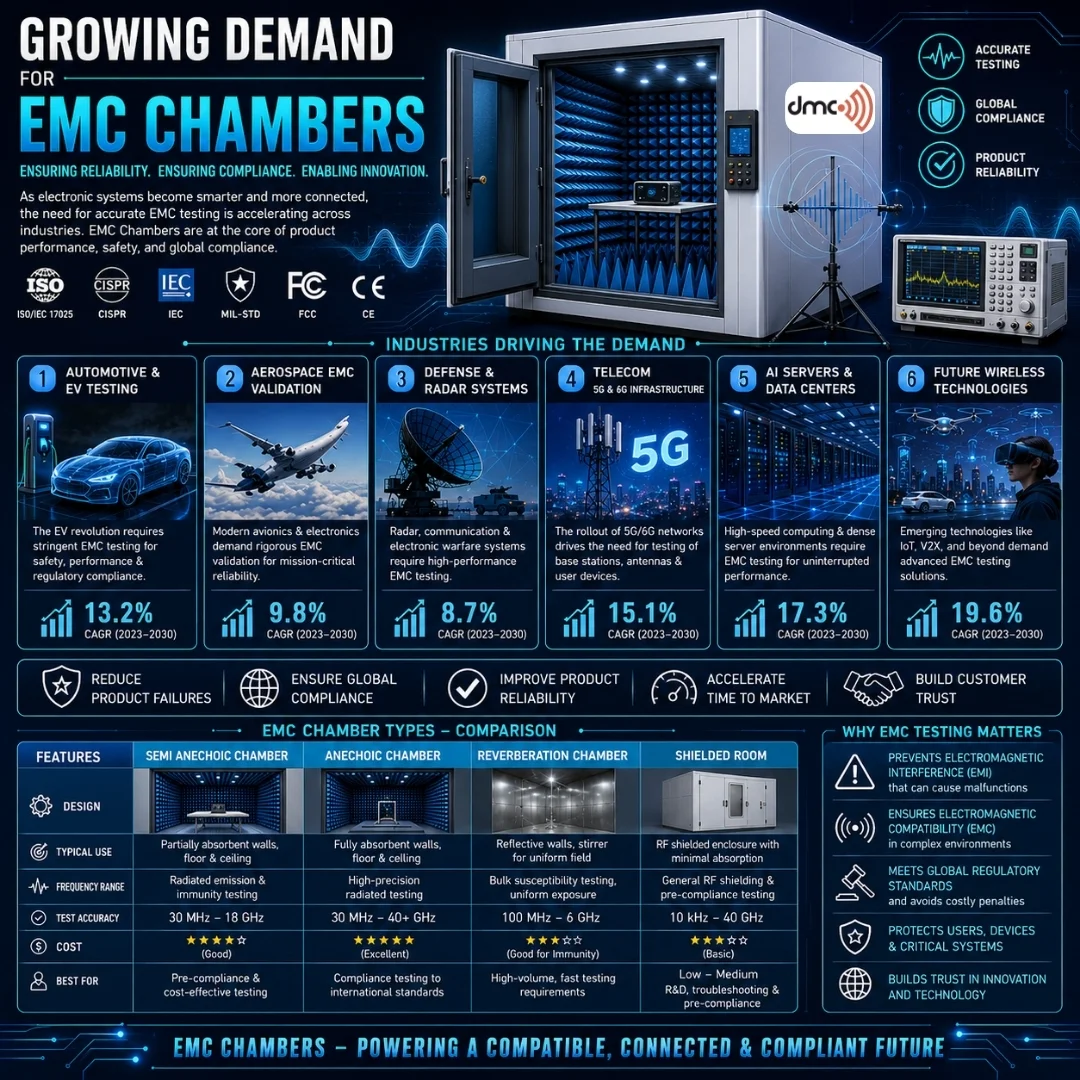
| EMC Chamber Type | Main Application | Industry Usage |
|---|---|---|
| Anechoic Chamber | RF and Antenna Testing | Telecom, Aerospace |
| Semi Anechoic Chamber | EMI/EMC Compliance Testing | Automotive, EV |
| Reverberation Chamber | Immunity Testing | Defense |
| Shielded Room | Isolation Testing | Laboratories |
| GTEM Cell | Pre-compliance Testing | Electronics Manufacturing |
| Compact Range Chamber | Radar and Antenna Testing | Aerospace, Military |
Why EMC Compliance Matters
EMC compliance cannot be ignored for modern industries. Strict international standards need to be met by manufacturers before products can be released.
EMC testing can result in:
- Enhanced reliability of products
- Decreased electromagnetic interference
- Increased customer safety
- Worldwide certification approval
- Improved wireless performance
- Less failure of products
The importance of compliance for electronics manufacturing can be seen in the rising need for EMC chambers.
Industries that use EMC Chambers
Automotive and EV
EMC chambers are used for:
- Developing vehicle electronic systems
- Validation of battery packs
- Development of autonomous driving systems
- Development of EV charging systems
Aerospace and Aviation
EMC testing is done for:
- Development of aircraft electronic systems
- Development of satellites
- Development of communication systems
Defense and Military
EMC chambers are used for:
- Development of radar systems
- Development of electronic warfare systems
- Development of secure military communication systems
Telecom Sector
EMC Testing is required for:
- Development of 5G towers
- Development of 6G research systems
- Development of wireless systems
- Development of RF systems
AI Infrastructure
Testing of manufacturing systems is done for:
- GPUs (Graphics Processing Unit)
- High speed processors
- Networking
- Data center systems
Complexities of EMC Testing
Limited frequencies
New devices now operate at extremely high frequencies
Testing Standards
Government and certification bodies update the EMC regulations
Financial Burden
Large EMC chambers involve a large investment on
- RF shielding
- Absorber materials
- Testing systems
- Calibration
Large EMC chambers involve a large investment on Extensive EMC testing requires the build of specialized facilities
Pro Tip
Businesses that build EVs, AI servers, and 6G communications systems should conduct EMC testing on their designs as a part of the early building design and validation process. Early EMC validation would avoid costly redesign efforts, delivering a reliable design and process, while enhancing the efficiency of regulatory approval and certification processes.
Future of EMC Chambers
The future of the EMC testing sector is very bright. As different sectors’ electronic systems grow increasingly smart and interconnected, the need for EMC chambers will increase.
Here are some predictions about the future:
- AI EMC testing
- Test systems automation
- New absorber materials
- Compact EMC chambers
- 6G testing
- Automated compliance
It is widely anticipated that industries will pour significant investment into additional EMC facilities to protect and promote their investments and to meet necessary regulations.
Conclusion
The enhanced need for EMC chambers disrupts the traditional testing and compliance industry. Aerospace, EVs, and AI/data centers, in addition to the anticipated demand for 6G, make EMC testing central to safety, reliability, and performance.
EMC will always be in demand, and the companies that invest in testing and validation will emerge victorious in the high-speed, interconnected future.
Today’s chambers are the building blocks of the future innovations, as the industries from automotive to AI will benefit from their use.
Frequently Asked Questions
An EMC chamber is used to test electromagnetic interference and compatibility of electronic devices in a controlled environment.
EV vehicles contain advanced electronics and battery systems that can create electromagnetic interference. EMC testing ensures safe and reliable operation.
Automotive, aerospace, defense, telecom, AI server manufacturing, and electronics industries heavily use EMC chambers.
6G technology operates at extremely high frequencies, requiring advanced EMC testing to prevent signal interference and ensure communication reliability.
EMI refers to electromagnetic interference generated by devices, while EMC ensures devices operate properly without causing or receiving interference.