
Table of Contents
- What Causes EMI in Industrial Robotic Systems?
- How Can Electromagnetic Interference Affect Robots?
- Why Robotic Systems Need EMC Consideration
- How to Reduce EMI Risks in Robotic Cells
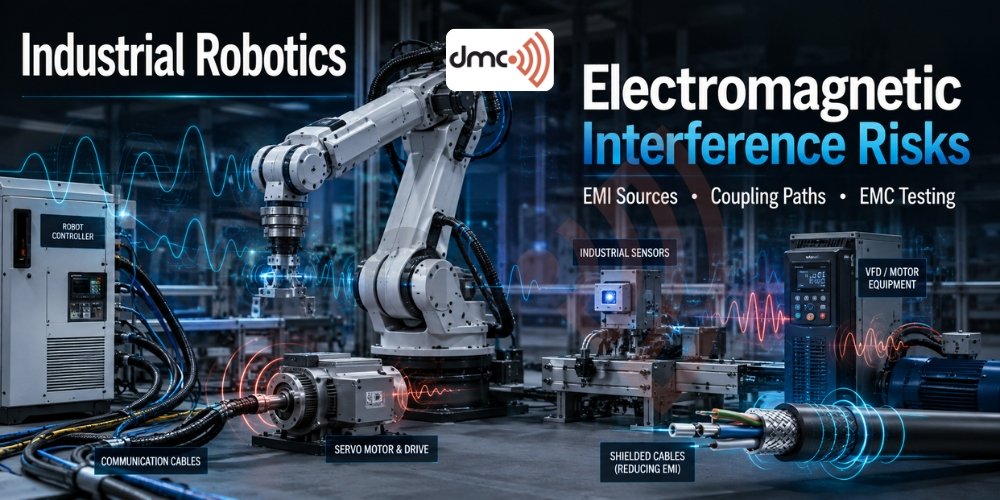
Industrial robots have become an important part of modern manufacturing, supporting welding, assembly, material handling, packaging, machining, painting, and automated inspection. As robotic systems become more connected and electronically sophisticated, Industrial Robotics and Electromagnetic Interference Risks have become an important engineering consideration. A robot may include servo drives, motors, encoders, programmable controllers, communication interfaces, sensors, power electronics, and safety systems—all of which can either generate or be affected by electromagnetic disturbances.
EMI (Electromagnetic interference) in industrial robotics disrupts control signals, corrupts sensor data, and triggers unexpected movements or false safety shutdowns. In some cases, interference may appear as communication errors, inaccurate sensor readings, unexpected controller behaviour, intermittent faults, or degraded system performance. Identifying these risks during design and testing can help manufacturers reduce troubleshooting and improve system reliability.
What Causes EMI in Industrial Robotic Systems?
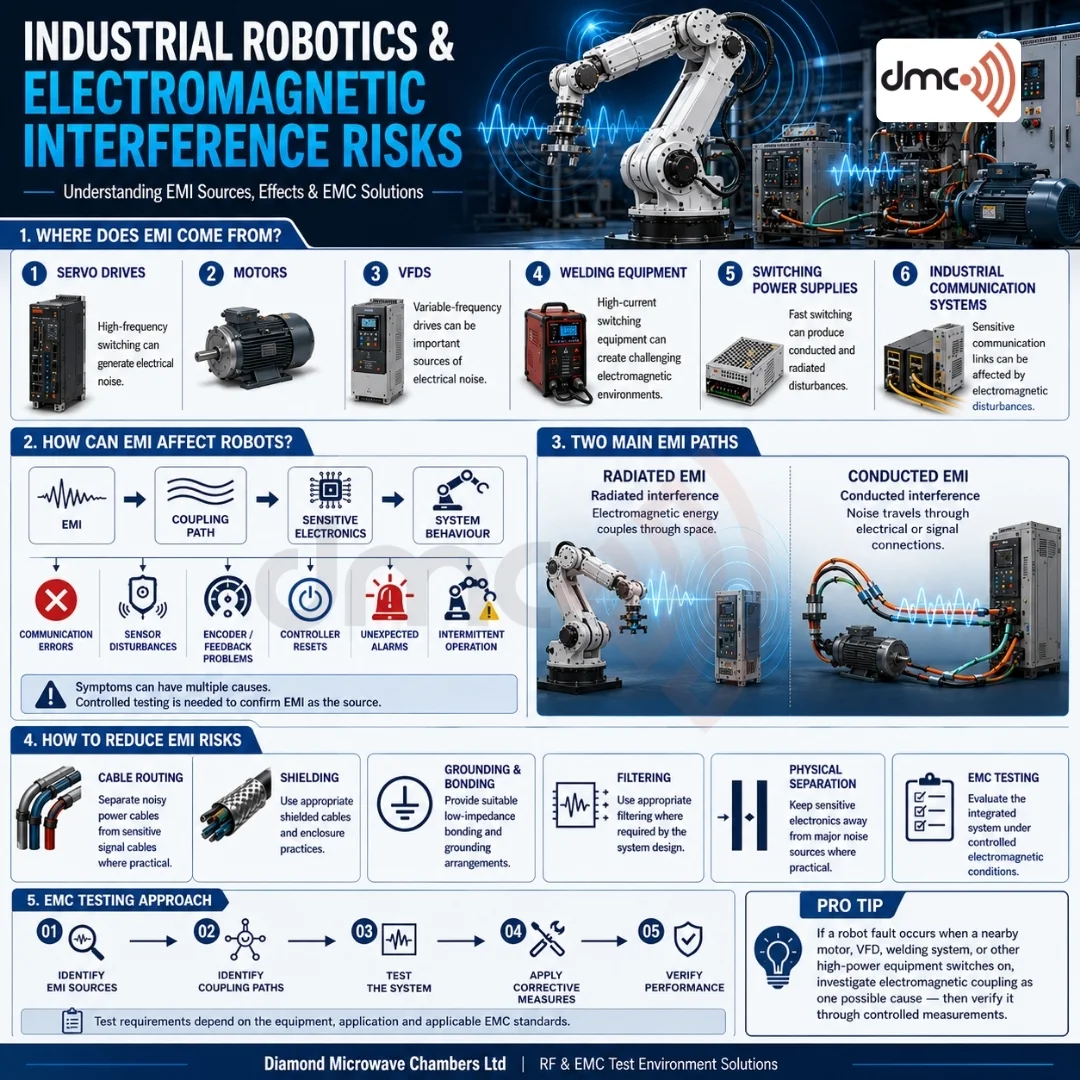
Industrial environments contain numerous electrical devices operating close to one another. Motors, variable-frequency drives, switching power supplies, welding equipment, contactors, and high-current cables can create electromagnetic disturbances.
Common EMI sources around robotic systems include:
- Servo motors and motor drives
- Variable-frequency drives (VFDs)
- Switching power supplies
- High-current welding equipment
- Contactors and relays
- Rapidly switched power electronics
- Long motor and communication cables
- Wireless communication equipment
- Poorly designed grounding or bonding arrangements
The risk increases when sensitive electronics and high-power equipment share the same environment without appropriate EMC design.
How Can Electromagnetic Interference Affect Robots?
The effect of EMI depends on the disturbance, equipment design, frequency, coupling path, and susceptibility of the affected circuit. A robotic system may experience either conducted interference, radiated interference, or a combination of both.
Potential symptoms include:
- Communication dropouts between controllers and devices
- Sensor errors or unstable readings
- Encoder or feedback disturbances
- Unexpected alarms or system resets
- Temporary controller malfunction
- Errors in industrial communication networks
- Unstable operation of electronic interfaces
- Reduced reliability of automated processes
Not every unexplained robot fault is caused by EMI. Mechanical problems, software issues, network configuration, thermal conditions, grounding faults, and component failures can produce similar symptoms. EMC investigation should therefore be based on measurements and controlled testing rather than assumptions.
Conducted vs. Radiated EMI
Understanding the difference between conducted and radiated interference is essential when investigating Industrial Robotics and Electromagnetic Interference Risks.
| EMI Type | Typical Coupling Path | Possible Robot Impact | Example Source |
|---|---|---|---|
| Conducted EMI | Power or signal cables | Controller or communication errors | Switching power supply |
| Radiated EMI | Electromagnetic fields through space | Sensor or electronic circuit disturbance | VFD or motor drive |
| Common-mode noise | Shared reference/ground paths | Communication instability | Poor cable bonding |
| Differential-mode noise | Between conductors | Power or signal degradation | Switching electronics |
| Transient disturbances | Short-duration electrical events | Resets or temporary malfunction | Switching inductive loads |
A practical EMC investigation should consider both the source and the path through which the disturbance reaches the affected equipment.
Why Robotic Systems Need EMC Consideration
Modern robotic cells are rarely isolated machines. A typical installation may combine a robot arm with a controller, PLC, safety equipment, vision system, conveyor, sensors, drives, networking hardware, tooling, and other machinery.
This creates several potential electromagnetic coupling paths.
For example, a welding robot can operate alongside high-current welding equipment. Servo drives and motor cables can also generate electrical noise that may interact with nearby signal or communication wiring. If sensitive cables are routed incorrectly or shielding and bonding are inadequate, intermittent problems can occur.
For this reason, EMC should be considered during the design and integration stages rather than only after a complete robotic cell has been assembled.
EMC Testing for Industrial Robotics
EMC testing helps determine whether equipment can operate reliably in its intended electromagnetic environment and whether it produces unacceptable electromagnetic disturbances.
The exact testing program depends on the equipment, application, market, applicable product standards, and installation environment. Where no dedicated product or product-family immunity standard applies, generic EMC standards may become relevant. For example, IEC 61000-6-2 addresses immunity requirements for electrical and electronic apparatus intended for industrial environments.
Depending on the applicable requirements, an EMC evaluation may consider areas such as:
- Radiated emissions
- Conducted emissions
- Electrostatic discharge immunity
- Radiated RF immunity
- Electrical fast transients
- Surge immunity
- Conducted RF immunity
- Power-frequency magnetic-field immunity
- Voltage dips and interruptions
The actual tests required should be determined from the applicable standards and product configuration rather than using a generic test list for every robot.
Industrial Robot Safety and EMC Are Different
It is important not to confuse robot safety standards with EMC standards.
The current ISO 10218-1:2025 standard addresses safety requirements for industrial robots, while ISO 10218-2:2025 addresses industrial robot applications and robot cells.
These standards are important for robotic safety and integration, but they do not replace an appropriate EMC evaluation.
A robotic system can therefore require attention to several engineering areas at the same time:
- Functional and machinery safety
- Electromagnetic compatibility
- Electrical design
- Mechanical safety
- Industrial communication reliability
- Environmental conditions
- Software and control-system reliability
Treating EMC as one part of the overall engineering process provides a more realistic approach to robotic system reliability.
How to Reduce EMI Risks in Robotic Cells
EMI risk reduction usually starts with good system-level design.
1. Separate Noisy and Sensitive Circuits
Keep high-power motor and drive cables separated from sensitive sensor, encoder, and communication cables where practical.
2. Use Appropriate Cable Shielding
Shielded cables can help control electromagnetic coupling when the shielding system is correctly selected and installed.
3. Pay Attention to Grounding and Bonding
Poor bonding can create unwanted impedance and return paths. Grounding and bonding should be designed according to the equipment and installation requirements.
4. Control Cable Routing
Avoid unnecessarily long parallel runs between high-power cables and sensitive signal cables. Cable routing should be considered during cell layout.
5. Test the Integrated System
Testing an individual component does not always reproduce the electromagnetic environment of the complete robotic cell. System integration can introduce additional coupling paths.
6. Investigate Intermittent Faults Systematically
When an unexplained fault occurs, engineers should document the operating conditions, affected components, frequency of occurrence, nearby equipment activity, and cable configuration before changing the system.
Pro Tip: If a robot fault appears only when a nearby motor, VFD, welding system, or other high-power device switches on, investigate electromagnetic coupling as one possible cause. Use controlled measurements to confirm the relationship instead of assuming EMI is responsible.
Why EMC Testing Should Be Considered Early
Correcting EMC problems after a robotic production line is installed can be expensive and disruptive. Changing cable routes, adding filtering, modifying grounding, or redesigning enclosures may become more difficult once equipment has been commissioned.
Early EMC engineering can help identify potential problems before they become production issues.
A useful development approach is:
Design → Identify EMI Sources → Assess Coupling Paths → Pre-Compliance Testing → Corrective Actions → Final Compliance Testing
This approach allows engineers to identify weaknesses while there is still flexibility to modify the design.
The Role of EMC Test Chambers
Controlled electromagnetic environments help engineers evaluate electronic equipment under repeatable conditions. For robotic controllers, sensors, electronic assemblies, and automation systems, EMC testing can identify potential emissions and immunity issues before compliance testing. Diamond Microwave Chambers Ltd provides RF/EMC chamber solutions for controlled testing applications. The right chamber depends on the equipment, applicable standards, frequency range, test setup, and required measurement accuracy.
Conclusion
Industrial Robotics and Electromagnetic Interference Risks should be addressed early in system design. EMI can affect robot controllers, sensors, communication systems, and motors through cables, radiation, or grounding paths. Proper shielding, cable routing, grounding, filtering, and EMC testing can improve system reliability. Diamond Microwave Chambers Ltd provides controlled RF and EMC test environments to support robotic and automated equipment testing.
Frequently Asked Questions
Industrial Robotics and Electromagnetic Interference Risks refer to the possibility that electromagnetic disturbances generated by robotic equipment or nearby industrial machinery may interfere with robot electronics, sensors, communication systems, or controllers.
Common sources include servo drives, motors, VFDs, switching power supplies, welding equipment, relays, contactors, and other high-power switching equipment.
EMI can contribute to unexpected resets, communication problems, sensor errors, or other abnormal behaviour in susceptible equipment. However, similar symptoms can have many other causes, so testing is needed to identify the actual source.
Common engineering measures include appropriate cable routing, shielding, grounding and bonding, filtering, physical separation of noisy and sensitive circuits, and EMC testing of the integrated system.
EMC testing helps evaluate whether equipment can operate reliably in its intended electromagnetic environment and whether it produces electromagnetic disturbances that could affect other equipment. The specific tests depend on the applicable standards and product configuration.