
Table of Contents
- What is an EMC Chamber?
- EMC Chamber vs Antenna Test Chamber: Detailed Comparison
- Design Differences Between the Two Chambers
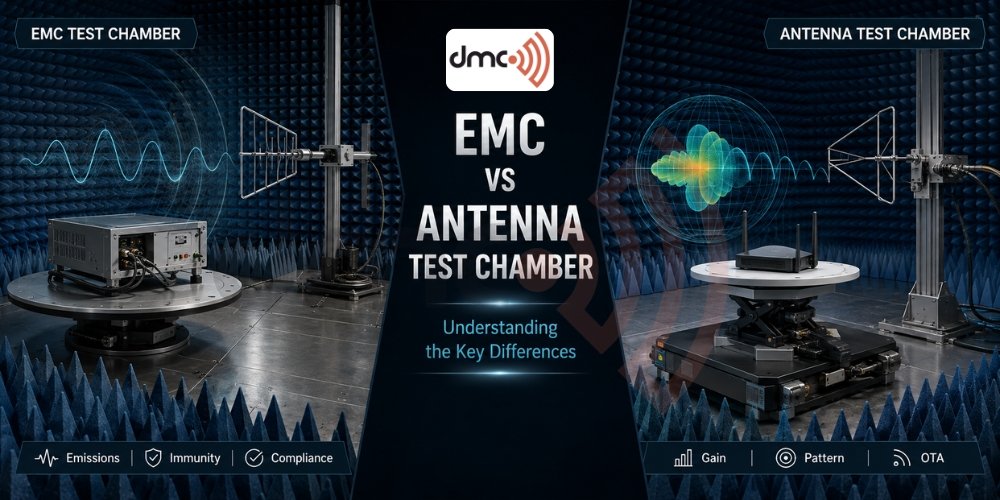
Electromagnetic testing is a critical part of product development for industries like telecommunications, automotive, aerospace, and consumer electronics. Two of the most commonly used facilities for this purpose are the EMC chamber and the antenna test chamber. While both fall under the broader category of anechoic chambers, they serve distinct purposes, follow different design principles, and are built for different testing standards.
At Diamond Microwave Chambers Ltd, we design and manufacture both EMC and antenna test chambers personalized to meet international compliance standards. Understanding the difference between these two chamber types helps engineers, product developers, and procurement teams choose the right facility for their testing needs.
This article breaks down the core differences between EMC and antenna test chambers, covering their purpose, design, frequency range, and applications.
What is an EMC Chamber?
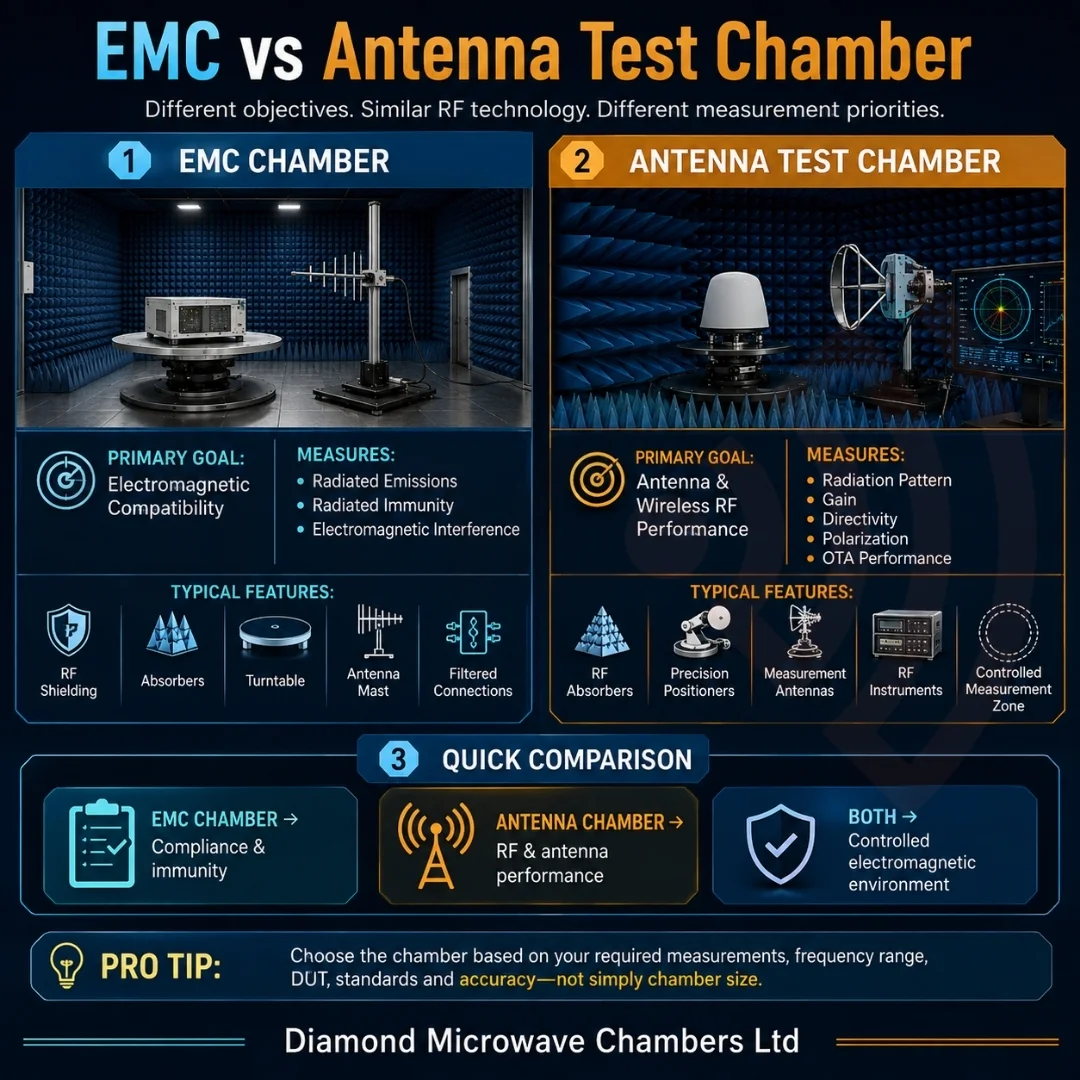
An EMC (Electromagnetic Compatibility) chamber is a shielded enclosure used to test whether electronic devices emit unwanted electromagnetic interference (EMI) and whether they can withstand external electromagnetic disturbances without malfunctioning.
EMC chambers are essential for manufacturers who need to certify products against regulatory standards such as FCC, CE, CISPR, and IEC.
Key functions of an EMC chamber:
- Radiated emissions testing
- Radiated immunity testing
- Conducted emissions and immunity testing
- Electrostatic discharge (ESD) testing
- Compliance certification for global markets
What is an Antenna Test Chamber?
An antenna test chamber is specifically designed to measure the performance characteristics of antennas, including gain, radiation pattern, polarization, and efficiency. These chambers create a controlled, reflection-free environment so that antenna measurements are accurate and free from external signal interference.
Antenna test chambers are widely used in the telecommunications, satellite, defense, and automotive radar industries, where precise antenna performance data is critical for product design and validation.
Key functions of an antenna test chamber:
- Far-field and near-field antenna pattern measurement
- Gain and directivity testing
- Polarization analysis
- Beamforming and phased array testing
- 5G and satellite antenna validation
EMC Chamber vs Antenna Test Chamber: Detailed Comparison
| Parameter | EMC Chamber | Antenna Test Chamber |
|---|---|---|
| Primary Purpose | Tests electromagnetic emissions and immunity | Measures antenna radiation performance |
| Frequency Range | Typically 30 MHz to 40 GHz | Often extends into mmWave (up to 100+ GHz for 5G/radar) |
| Testing Standards | FCC, CE, CISPR, IEC 61000 series | IEEE, CTIA, 3GPP standards |
| Chamber Design | Fully or semi-anechoic with absorbers | Fully anechoic with precision positioners |
| Key Equipment | Turntable, antenna mast, EMI receiver | Antenna positioner, network analyzer, far-field/near-field probes |
| Shielding Requirement | High shielding effectiveness (RF-tight) | High shielding plus precise quiet zone accuracy |
| Typical Users | Product compliance labs, manufacturers | Telecom companies, defense, R&D labs |
| Output | Pass/fail compliance report | Radiation pattern, gain, and efficiency data |
| Floor Type | Absorber-lined or ground plane | Absorber-lined, often with rotating positioners |
| Industry Focus | Consumer electronics, automotive, industrial | 5G, satellite, aerospace, radar systems |
Design Differences Between the Two Chambers
1. Shielding and RF Absorption
Both chambers use RF absorbing materials, but EMC chambers focus on broadband absorption across a wide frequency spectrum for compliance testing. Antenna test chambers require extremely precise “quiet zones” — areas with minimal reflection — to ensure antenna measurements are not distorted.
2. Size and Configuration
EMC chambers are generally designed with a turntable and antenna mast system to rotate the device under test (DUT) and scan for emissions at various angles. Antenna test chambers use sophisticated positioners (azimuth-over-elevation or roll-over-azimuth systems) to precisely orient antennas during far-field or near-field measurements.
3. Frequency Handling
EMC testing typically covers a moderate frequency range relevant to interference issues. Antenna chambers, especially those built for 5G and satellite applications, must handle much higher frequencies, including millimeter-wave bands.
Applications Across Industries
EMC Chambers are used for:
- Consumer electronics compliance testing
- Automotive EMC certification
- Industrial equipment testing
- Medical device electromagnetic safety testing
Antenna Test Chambers are used for:
- 5G base station and device testing
- Satellite communication antenna validation
- Radar and defense antenna testing
- Automotive radar (ADAS) antenna performance testing
Pro Tip: If your product requires both regulatory compliance AND antenna performance validation (common in 5G devices, IoT products, and automotive radar systems), consider a hybrid chamber design. Diamond Microwave Chambers Ltd offers customized chamber solutions that combine EMC testing capability with antenna measurement precision, saving both space and investment for manufacturers who need dual functionality.
Conclusion
While EMC chambers and antenna test chambers may look similar from the outside, they serve fundamentally different purposes. EMC chambers focus on regulatory compliance by testing emissions and immunity, while antenna test chambers focus on precise measurement of antenna performance characteristics. Choosing the right chamber depends on your testing goals, industry standards, and product type.
For expert guidance on selecting the right test chamber for your needs, connect with Diamond Microwave Chambers Ltd
Frequently Asked Questions
Yes, DMC builds hybrid chambers designed to support both EMC compliance testing and antenna performance measurement, though dedicated chambers offer higher precision for each application.
Antenna test chambers typically cover 1 GHz to over 100 GHz, depending on design, including mmWave ranges for 5G and satellite antenna testing.
Yes, most regulatory bodies (FCC, BIS, CE) require EMC testing in a certified chamber before a product can be sold in the market.
High-performance pyramidal or hybrid absorbers with very low reflectivity are used to maintain a clean quiet zone for accurate antenna measurements.
This depends on your antenna size and frequency. DMC’s engineers calculate the required far-field distance and recommend near-field or compact range chambers when space is limited.