
Table of Contents
- What Determines the Chamber Installation Timeline?
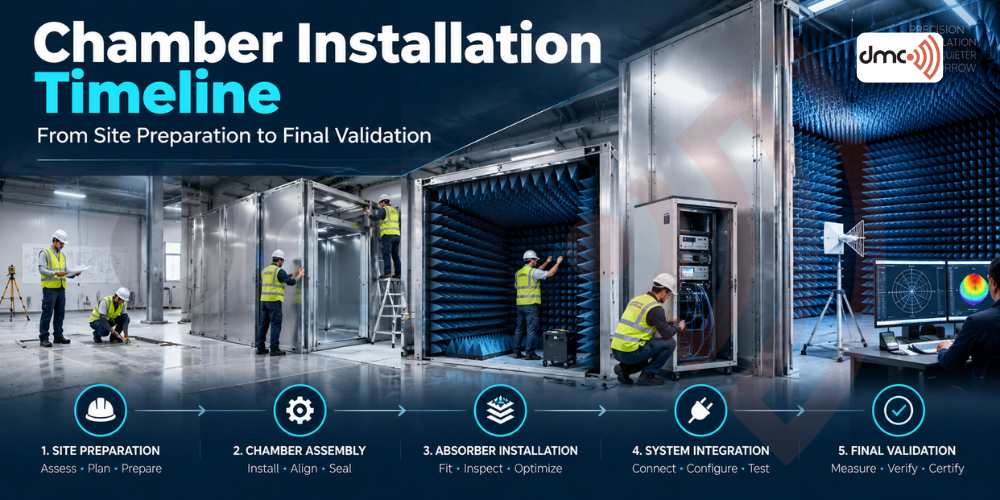
- Typical Chamber Installation Stages
- How Long Does Installation Usually Take?
- Common Causes of Installation Delays
- How to Prepare for a Smooth Installation
- Why Choose Diamond Microwave Chambers Ltd?
Installing an RF or EMC chamber is a structured engineering project that involves much more than assembling a shielded enclosure. The chamber installation timeline normally covers engineering design, site preparation, material delivery, shielding assembly, RF absorber installation, equipment integration, testing, commissioning, and final validation. The actual duration varies according to chamber size, construction type, testing application, facility readiness, customization, and equipment requirements. For this reason, a project-specific schedule is more reliable than a standard installation estimate.
For organizations planning a new testing facility, understanding the installation process helps coordinate facility teams, contractors, equipment suppliers, and chamber specialists. Diamond Microwave Chambers Ltd approaches chamber projects according to the intended testing application and required technical performance, helping customers plan each stage before installation begins.
What Determines the Chamber Installation Timeline?
There is no universal schedule for every RF or EMC chamber. Before manufacturing or installation, the project team needs to establish the technical and operational requirements. These requirements influence the chamber design, materials, installation sequence, and validation process.
Important factors include:
- Chamber dimensions and construction type
- RF, EMC, OTA, or antenna-testing application
- Required operating frequency range
- RF shielding requirements
- Absorber configuration
- Quiet-zone requirements
- Floor loading and structural conditions
- Electrical and HVAC requirements
- Access and material delivery conditions
- Antenna mast or turntable integration
- Measurement equipment requirements
- Final testing and acceptance criteria
A modular chamber may provide panel-based construction and can offer flexibility for certain future modifications or relocation requirements, depending on the design.
Typical Chamber Installation Stages
| Installation Stage | Main Activities | Schedule Consideration |
|---|---|---|
| Project Planning | Requirements, drawings and specifications | Project complexity |
| Site Preparation | Flooring, access, power and HVAC | Facility readiness |
| Material Delivery | Panels, doors and absorbers | Logistics |
| Shielding Assembly | Panels, seams, doors and penetrations | Chamber size |
| Absorber Installation | Walls, ceiling and floor treatment | Absorber design |
| Equipment Integration | Antennas, masts, turntables and cables | Test configuration |
| Testing | Performance measurements | Acceptance requirements |
| Commissioning | Adjustments, documentation and handover | Project scope |
These stages provide a general framework. They should not be interpreted as a guaranteed number of installation days.
Stage 1: Project Planning and Engineering
The installation process starts with engineering. The team first identifies how the chamber will be used and converts those requirements into a practical chamber specification.
Planning may involve:
- Reviewing the testing application
- Confirming chamber dimensions
- Establishing frequency requirements
- Defining measurement areas
- Selecting absorber configurations
- Planning RF shielding
- Positioning doors and access points
- Planning cable and service penetrations
- Coordinating test equipment
Detailed drawings and clear technical documentation can help minimize changes after installation work begins. Early coordination is particularly important when the chamber must integrate with existing laboratory infrastructure or specialized measurement equipment.
Stage 2: Site Preparation
Site preparation is one of the key factors affecting an RF chamber installation timeline. The chamber installation area needs to be prepared before components arrive.
Depending on the project, preparation may involve suitable flooring, structural support, electrical services, HVAC provisions, lighting, access routes, and adequate space for transporting chamber components.
Before installation, the facility team should verify:
- Installation area dimensions
- Floor condition and level
- Structural requirements
- Electrical supply
- HVAC provisions
- Access routes
- Material delivery arrangements
- External service locations
- Safety requirements
If the facility is not ready when the chamber materials arrive, installation can be delayed even when manufacturing has already been completed.
Stage 3: Shielded Chamber Assembly
Once the site is ready, the shielded enclosure can be assembled according to the approved engineering design. For modular systems, panels and associated components are installed on-site to form the RF-shielded structure.
Shielded doors, seams, ventilation components, filters, cable penetrations, and other interfaces require careful installation. These areas are important because improperly integrated interfaces can affect shielding performance.
The assembly sequence varies according to chamber design, construction method, size, and the services incorporated into the chamber.
Stage 4: RF Absorber Installation
After the shielded structure is established, RF absorbers are installed according to the chamber’s frequency requirements and configuration.
Correct installation requires attention to:
- Absorber type
- Absorber placement
- Surface coverage
- Mechanical attachment
- Floor and ceiling treatment
- Protection against physical damage
Diamond Microwave Chambers Ltd also provides technical guidance related to foam RF absorber installation and maintenance. Proper installation and ongoing condition checks are important considerations for maintaining the intended chamber environment.
Stage 5: Equipment and System Integration
The chamber itself is only one part of a complete testing environment. Depending on the application, additional systems may need to be installed and integrated.
These can include:
- Antenna masts
- Turntables
- Positioning systems
- Measurement antennas
- RF cables
- Filters
- Monitoring equipment
- Test instrumentation
- Control systems
For antenna and OTA testing, equipment positioning and measurement geometry are particularly important. Cable routing and system interfaces should also be considered during the engineering stage rather than added as an afterthought.
Stage 6: Testing and Validation
Physical installation does not necessarily mean the project is complete. Performance testing and commissioning are important steps in confirming that the installed chamber meets the agreed technical requirements.
Depending on the application and specification, testing may consider shielding effectiveness, reflection performance, quiet-zone characteristics, absorber performance, or other defined parameters.
Pro Tip
Plan validation from the beginning. Define the acceptance criteria during the engineering stage rather than waiting until installation is finished. This gives the installation and testing teams a clear understanding of what must be demonstrated before handover.
How Long Does Installation Usually Take?
The most accurate answer is that the duration depends on the project scope. A compact chamber may require considerably less installation time than a large, customized, fully integrated chamber.
The overall project schedule can include manufacturing, site preparation, delivery, installation, equipment integration, commissioning, and validation. Larger or more complex projects may therefore extend over several months.
Customers should avoid using a generic installation duration as a firm commitment. A realistic schedule should be developed after reviewing the chamber design, facility conditions, equipment requirements, logistics, and acceptance criteria.

Common Causes of Installation Delays
Several practical issues can affect the planned schedule:
- Incomplete site preparation
- Late engineering changes
- Material delivery delays
- Restricted site access
- Unfinished electrical work
- HVAC installation delays
- Late arrival of test equipment
- Additional integration requirements
- Changes to testing requirements
- Rework during installation
- Undefined acceptance criteria
Early communication between the chamber supplier and facility team can help identify these issues before they affect the installation sequence.
How to Prepare for a Smooth Installation
Facility owners can improve project coordination by completing important preparation activities before the installation team arrives.
Before installation:
- Approve engineering drawings
- Confirm chamber dimensions
- Complete construction work
- Verify electrical requirements
- Confirm HVAC provisions
- Prepare material access routes
- Confirm equipment delivery dates
- Define acceptance criteria
- Coordinate safety procedures
- Assign a project contact
A structured plan gives each project team a clear responsibility and can reduce avoidable delays.
Why Choose Diamond Microwave Chambers Ltd?
Diamond Microwave Chambers Ltd provides engineered solutions for RF, EMC, antenna, and related testing applications. Chamber projects require consideration of shielding, absorbers, chamber configuration, equipment integration, and application-specific performance requirements.
The objective should not simply be to install a chamber quickly. The completed environment should be properly assembled, integrated with the intended test system, and evaluated against the agreed requirements.
Final Thoughts
The chamber installation timeline depends on many connected activities, including engineering, site preparation, logistics, shielding assembly, absorber installation, equipment integration, commissioning, and validation.
Understanding these stages helps organizations prepare their facilities, coordinate suppliers, and establish realistic project expectations. Rather than relying on a fixed installation period, customers should develop a project-specific schedule based on chamber configuration, site readiness, testing requirements, and integration scope.
With proper planning and coordination, an RF or EMC chamber installation can move through each stage in a controlled and measurable manner, creating a reliable environment for future testing and measurement activities.
Diamond Microwave Chambers Ltd can support organizations evaluating chamber requirements, installation planning, RF shielding, absorber integration, and RF/EMC testing environments.
Frequently Asked Questions
The duration depends on chamber size, design, site readiness, customization, equipment integration, and validation requirements.
The project normally begins with requirements definition, engineering drawings, site assessment, facility preparation, and logistics planning.
It can include shielding assembly, RF doors, absorbers, vents, filters, cable interfaces, antenna systems, positioning equipment, and related components.
Performance verification is an important commissioning activity, with the exact tests determined by the chamber specification and intended application.
Site-readiness issues, design changes, delivery delays, restricted access, unfinished electrical/HVAC work, late equipment integration, and additional requirements can affect the schedule.