
Table of Contents
- Pyramidal vs Hybrid vs Ferrite Absorbers
- Which Absorber Performs Best at Different Frequencies?
- Which Is Best for Your Chamber?
When engineers design an anechoic chamber, the absorber material is one of the most important decisions because it controls unwanted reflections. Pyramidal, hybrid, and ferrite absorbers are all proven solutions, but they are not interchangeable. The best choice depends on frequency range, chamber size, test method, required reflectivity, available space, mechanical conditions, and compliance targets.
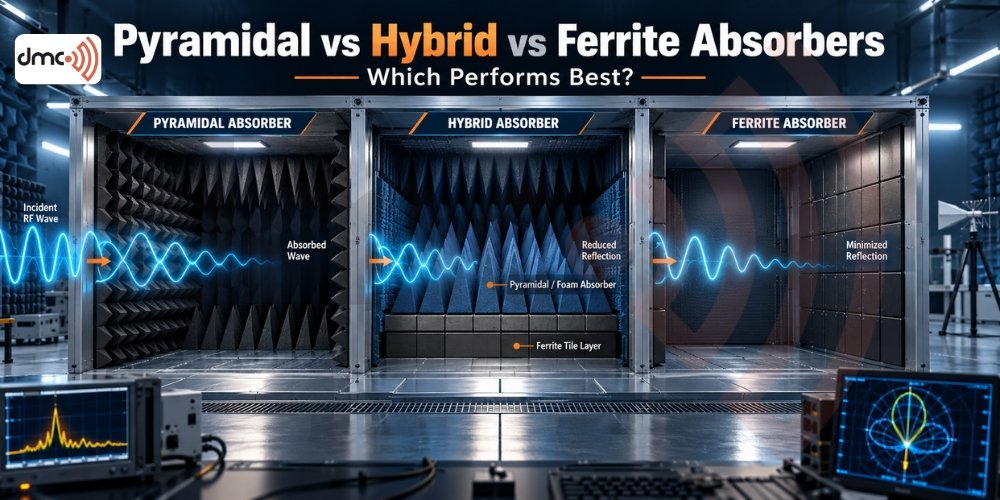
Pyramidal absorbers are usually made from dielectric foam or other low-reflection materials formed into tapered structures. Their geometry creates a gradual impedance transition between free space and the lossy material, helping reduce reflections over a broad high-frequency range. Increasing absorber depth generally improves low-frequency performance, which is why large pyramidal absorbers can require significant chamber volume. For antenna and OTA measurements, where very low reflections and three-dimensional free-space conditions may be required, deep pyramidal absorbers can be particularly useful.
Hybrid absorbers combine two absorption mechanisms, typically ferrite tiles or panels with a dielectric or resistive foam absorber. Ferrite provides magnetic loss in the lower-frequency region, while the foam or pyramidal section extends absorption toward higher frequencies. This combination can provide broadband performance without requiring the same absorber depth as a large conventional pyramid.
Ferrite absorbers are generally thin, rigid magnetic tiles. They are especially valuable for lower-frequency EMC work because ferrite can absorb electromagnetic energy through magnetic loss while occupying relatively little depth. However, ferrite alone does not provide the same broadband high-frequency behavior as a suitably designed composite absorber. DMC notes that EMC testing spans a wide frequency range and that composite absorbers are therefore used to combine ferrite absorption at lower frequencies with dielectric absorption at higher frequencies.
Pyramidal vs Hybrid vs Ferrite Absorbers
| Factor | Pyramidal | Hybrid | Ferrite |
|---|---|---|---|
| Main mechanism | Dielectric/resistive loss | Magnetic + dielectric/resistive loss | Magnetic loss |
| Broadband capability | Excellent with sufficient depth | Excellent | More limited alone |
| Low-frequency performance | Depends strongly on depth | Strong | Strong |
| High-frequency performance | Excellent | Excellent | Limited alone |
| Physical depth | Usually highest | Moderate | Low |
| Space efficiency | Lower | High | Very high |
| Typical use | Antenna, OTA, broadband RF | EMC, immunity, broadband chambers | EMC and lower-frequency absorption |
| Mechanical form | Foam/pyramids | Tile + foam/composite | Rigid tiles |
| Best advantage | Very low reflection at high frequencies | Balanced broadband performance | Thin, durable, space-efficient absorption |
There is no universal winner. A deep pyramidal absorber may outperform a shallow hybrid or ferrite arrangement at high frequencies, but that does not automatically make it the better chamber solution. Likewise, ferrite can be highly effective at lower frequencies, yet a ferrite-only design may not satisfy a broadband requirement. Chamber performance must be judged as a complete system rather than by absorber type alone.

Which Absorber Performs Best at Different Frequencies?
For lower-frequency EMC requirements, ferrite is often an efficient foundation because it provides useful magnetic absorption without consuming large amounts of chamber volume. DMC documentation describes ferrite tiles covering approximately 30 MHz to 1.2 GHz for certain products, although actual performance depends on the specific material, thickness, installation, and test method.
For broadband EMC chambers, hybrid absorbers are often the practical middle ground. They can combine ferrite with foam or another dielectric layer, allowing the chamber to cover a wider frequency range while keeping the absorber depth manageable. Current chamber designs demonstrate the use of hybrid absorbers together with ferrite tiles for broadband EMC performance.
What Should Engineers Consider Before Choosing an Absorber?
Engineers should evaluate the complete test requirement rather than selecting an absorber based only on its appearance or advertised frequency range. The lowest operating frequency, required reflectivity, chamber dimensions, and test methodology all influence the correct configuration.
Engineers should also evaluate:
- Test frequency range and lowest operating frequency.
- Required reflection attenuation or quiet-zone performance.
- Chamber dimensions and available absorber depth.
- Emissions, immunity, OTA, antenna, or microwave testing requirements.
- Floor configuration and whether absorbers must be removable.
- Mechanical durability and expected maintenance.
- Power handling and environmental conditions.
- Applicable standards and the final chamber validation method.
A well-designed chamber may use more than one absorber type. For example, ferrite can provide a compact lower-frequency absorption layer while hybrid or pyramidal absorbers handle higher frequencies.
Pro Tip
Do not select an absorber only from its stated frequency range. Ask for measured reflectivity data, absorber thickness, test method, power-handling information, environmental specifications, and expected chamber-level performance. The absorber must be evaluated together with the shield, geometry, seams, doors, penetrations, floor, antenna system, and quiet zone. A premium absorber cannot compensate for poor chamber design.
Which Is Best for Your Chamber?
There is no single “best” absorber for every application. Pyramidal absorbers are strong candidates when very low reflections and high-frequency broadband performance are priorities. Ferrite absorbers are attractive when compact construction and lower-frequency EMC absorption are important. Hybrid absorbers are often the best overall compromise when a chamber must provide broad coverage while controlling depth and construction space.
The right solution should therefore start with the test specification, not the absorber name. Diamond Microwave Chambers Ltd can help evaluate absorber configuration, chamber dimensions, frequency requirements, and testing objectives. A properly engineered absorber system can improve measurement repeatability, reduce unwanted reflections, and help the chamber achieve its intended EMC or RF performance. Absorber selection is a system-level engineering decision, not merely product comparison.
Frequently Asked Questions
Pyramidal absorbers primarily use dielectric or resistive loss and are particularly effective for broadband and high-frequency reflection reduction. Ferrite absorbers use magnetic loss and are commonly used as compact absorbers for lower-frequency EMC applications.
Not universally. Hybrid absorbers combine ferrite with another absorbing material, allowing broader frequency coverage while controlling absorber depth. They are often useful when both lower- and higher-frequency performance are required.
It depends on the chamber’s frequency range, test application, required reflectivity, available space, and applicable standards. Pyramidal, hybrid, and ferrite absorbers can each be the appropriate choice for different chamber designs.
Pyramidal absorbers use their physical depth and tapered geometry to gradually absorb electromagnetic energy and reduce reflections. Lower-frequency performance generally requires greater absorber dimensions because the electromagnetic wavelength is longer.
Yes. Combining absorber technologies is common in broadband chamber designs. Ferrite can provide compact lower-frequency absorption while pyramidal or hybrid materials extend performance toward higher frequencies.