
Table of Contents
- What Is Repeatability in Antenna Testing?
- Control the Measurement Procedure
- Common Causes of Poor Antenna Test Repeatability
Accurate antenna testing is not only about obtaining a measurement once. The real challenge is obtaining consistent and repeatable results whenever the same antenna is tested under the same conditions. Small changes in antenna positioning, cable routing, calibration, chamber conditions, or measurement equipment can introduce variations that affect the final results.
For engineers, manufacturers, and test laboratories, repeatability is essential when validating antenna designs, comparing prototypes, verifying production units, or investigating performance changes.
A properly controlled antenna test process reduces measurement variation and makes it easier to distinguish between actual antenna performance changes and errors introduced by the test setup.
In this guide, we explore the key best practices for achieving repeatable antenna testing and more reliable measurement results.
What Is Repeatability in Antenna Testing?
Repeatability refers to the ability to obtain similar measurement results when the same antenna is tested multiple times using the same measurement procedure, equipment, and controlled conditions.
For example, if an antenna is tested several times and its measured gain changes significantly between tests without any change to the antenna, the measurement process may not be sufficiently repeatable.
Repeatability can be affected by several factors, including:
- Antenna positioning
- Test distance
- Calibration
- Cable movement
- Connector condition
- Chamber performance
- Measurement equipment stability
- Environmental conditions
- Operator procedures
- Measurement uncertainty
A repeatable testing process helps ensure that differences in measured results are caused by the antenna itself rather than uncontrolled test variables.
Maintain Consistent Antenna Positioning
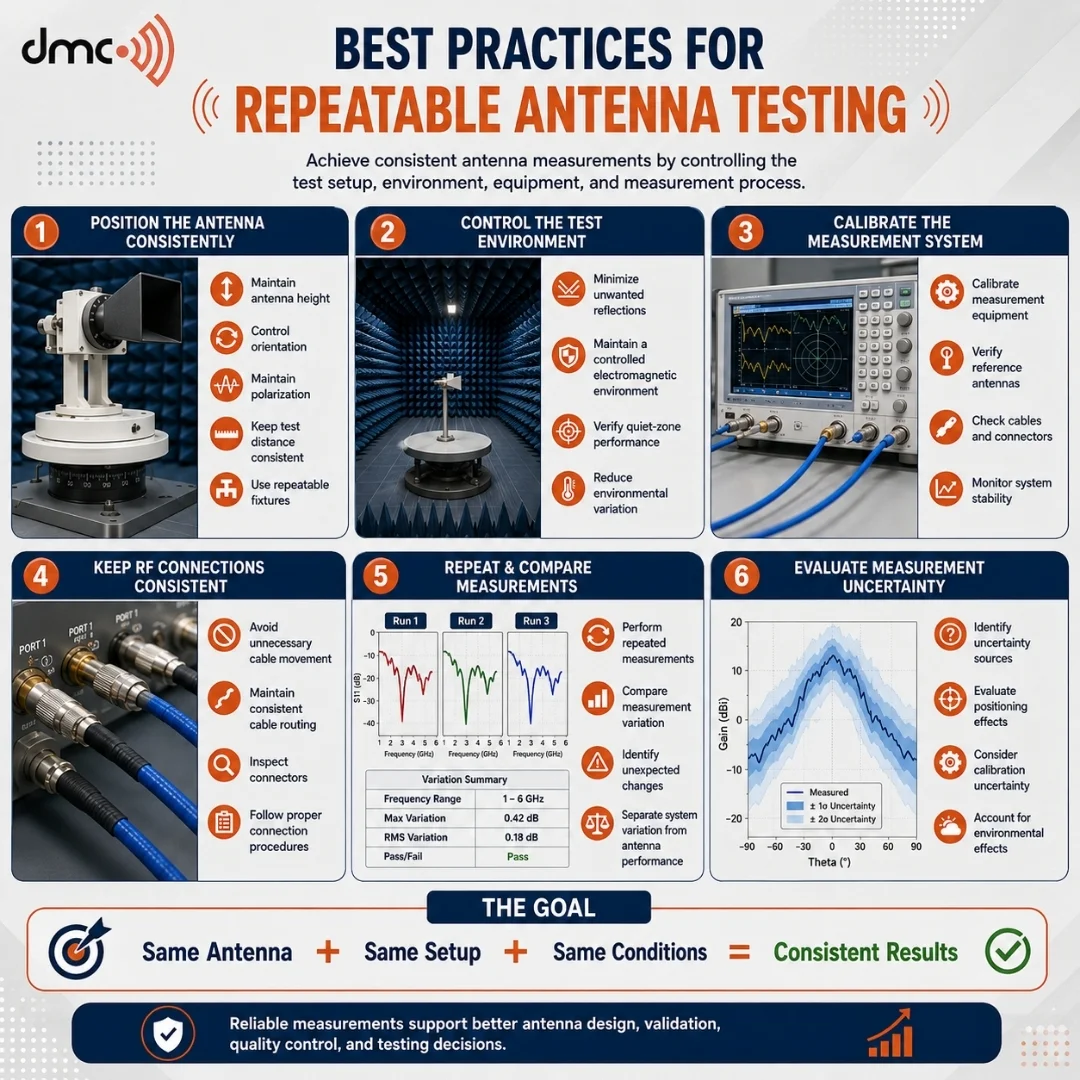
One of the most important requirements for repeatable antenna measurements is consistent positioning of the antenna under test (AUT).
Even small changes in the antenna’s:
- Height
- Orientation
- Rotation
- Polarization
- Phase-center location
- Distance from the measurement antenna
can influence the measured radiation pattern and gain.
The AUT should therefore be mounted using a stable fixture that allows its position and orientation to be reproduced accurately between measurements.
For rotational measurements, the position of the antenna should be clearly referenced so that the same angular coordinates can be used during every test.
Use a Controlled Test Environment
The surrounding electromagnetic environment can significantly influence antenna measurements.
Unwanted reflections from walls, floors, equipment, fixtures, or other objects can interfere with the direct signal and create errors in measured radiation patterns and gain.
A properly designed anechoic chambers helps reduce unwanted reflections and provides a controlled electromagnetic environment for testing.
For near-field systems, chamber layout, probe calibration, echo reduction, and measurement procedures are also important considerations. IEEE’s guidance for near-field antenna measurements specifically addresses these areas.
The test environment should remain as consistent as possible between measurement sessions.
Calibrate the Measurement System Before Testing
Calibration is a fundamental part of reliable antenna measurement.
Before beginning a test sequence, verify that the measurement equipment is properly calibrated and operating within its required specifications.
Depending on the measurement system, this may include:
- Vector network analyzer calibration
- Receiver calibration
- Probe or reference antenna calibration
- Cable calibration
- Power-level verification
- System response calibration
- Positioner verification
Calibration helps compensate for systematic effects within the measurement system and provides a known reference for the measurement.
Recent NIST work also demonstrates how repeated measurements and multiple calibrations can be used to evaluate variance and repeatability in high-frequency measurement systems.
Keep Cables and Connectors Consistent
Cables and connectors are sometimes overlooked when investigating inconsistent antenna measurements.
Cable movement can change the electrical characteristics of the measurement path, particularly at higher frequencies. Poorly connected, damaged, or contaminated connectors can also introduce additional measurement variation.
For repeatable testing:
- Use high-quality RF cables.
- Avoid unnecessary cable movement.
- Maintain consistent cable routing.
- Inspect connectors regularly.
- Use appropriate torque procedures where applicable.
- Avoid repeatedly bending sensitive microwave cables.
- Record cable configurations when they are important to the measurement.
The goal is simple: the RF signal path should remain as consistent as possible between measurements.
Verify the Test Range Performance
A test facility should not simply be assumed to provide accurate results because it is designed for antenna measurements.
The measurement range itself needs to be evaluated and maintained.
Important factors may include:
- Quiet-zone performance
- Reflections
- Field uniformity
- Cross-polarization performance
- Positioning accuracy
- Dynamic range
- Frequency coverage
- System drift
IEEE 149-2021 includes guidance covering antenna test facility design, instrumentation, evaluation of existing ranges, and operation of ranges.
Regular verification helps identify changes in chamber or system performance before they affect important antenna measurements.
Control the Measurement Procedure
A repeatable test requires more than repeatable equipment. The procedure itself must be repeatable.
Different operators may otherwise introduce small differences in:
- Antenna mounting
- Calibration sequence
- Measurement settings
- Frequency steps
- Angular resolution
- Averaging
- Power levels
- Data processing
- Cable connections
Create a standardized test procedure that clearly defines each step.
A documented procedure makes it easier for different engineers or technicians to reproduce the same measurement.
Allow Equipment to Stabilize
Measurement equipment may require adequate warm-up and stabilization time before highly sensitive measurements are performed.
Temperature changes and equipment drift can influence measurement results.
Before collecting final data, allow the system to reach its normal operating condition according to the equipment manufacturer’s recommendations.
Where appropriate, monitor system drift during longer measurement sequences.
This becomes particularly important when testing across many frequencies or performing long automated scans.
Perform Repeated Measurements
If repeatability is important, do not rely on a single measurement.
Perform multiple measurements using the same setup and compare the results.
For example, repeated measurements can help determine whether differences are caused by:
- Instrument noise
- Positioning variation
- Cable movement
- Environmental changes
- Equipment drift
- Actual antenna behavior
The variation between repeated measurements can then be evaluated statistically.
NIST research on antenna measurements emphasizes the importance of identifying and combining individual uncertainty components when evaluating measurement quality.
Example Repeatability Check
| Test Parameter | Measurement 1 | Measurement 2 | Measurement 3 |
|---|---|---|---|
| Frequency | 2.4 GHz | 2.4 GHz | 2.4 GHz |
| Gain | X dBi | X dBi | X dBi |
| Polarization | Same | Same | Same |
| Antenna Position | Reference | Reference | Reference |
| Test Environment | Controlled | Controlled | Controlled |
The actual acceptable variation should be established according to the application’s requirements and measurement uncertainty budget rather than applying one universal limit.
Consider Measurement Uncertainty
No measurement system is perfectly error-free.
Antenna measurement uncertainty can come from multiple sources, including:
- Instrumentation
- Calibration
- Positioning
- Cable and connector effects
- Reflections
- Noise
- Environmental changes
- Reference standards
- Data processing
NIST describes antenna measurement uncertainty as involving multiple component sources that can be evaluated and combined into an overall uncertainty estimate.
Understanding uncertainty helps engineers determine whether an observed difference represents a meaningful change in antenna performance or simply falls within the expected measurement variation.
Use Reference Antennas or Standards When Appropriate
Reference antennas can provide a useful way to verify system performance and identify unexpected changes.
A known reference can be measured periodically and compared with historical results.
If the reference measurement suddenly changes, it may indicate a problem with:
- Calibration
- Equipment
- Chamber performance
- Cable connections
- Positioning
- Test procedures
This approach can help identify system-level issues before testing valuable or production-critical antennas.
Keep Detailed Test Records
Good documentation is essential for repeatable antenna testing.
Record important information such as:
- Antenna identification
- Test date and time
- Frequency range
- Test distance
- Antenna orientation
- Polarization
- Calibration status
- Equipment configuration
- Cable configuration
- Chamber configuration
- Environmental conditions
- Measurement settings
- Operator
- Raw measurement data
Historical records allow engineers to compare current results with previous measurements and identify long-term changes in the measurement system.
Automate Where Practical
Automation can improve consistency by reducing manual variation.
Computer-controlled systems can standardize:
- Antenna positioning
- Rotational movement
- Frequency sweeps
- Data acquisition
- Measurement sequencing
- Data processing
Automation does not eliminate the need for proper calibration or system verification, but it can reduce errors caused by inconsistent manual procedures.
For near-field systems in particular, standardized scanning and data-processing procedures are important parts of producing reliable measurements. IEEE guidance discusses calibration, measurement procedures, documentation, uncertainty analysis, and near-field-to-far-field transformation considerations.
Common Causes of Poor Antenna Test Repeatability
| Cause | What Happens | Typical Fix |
|---|---|---|
| Inconsistent AUT positioning | Small shifts in height, rotation, or orientation change measured pattern/gain | Use a fixed, repeatable mounting jig with reference marks |
| Cable movement | Flexing cables alters phase/amplitude response, especially at higher frequencies | Fix cable routing, avoid unnecessary movement between runs |
| Calibration drift | System response changes between test sessions without a fresh calibration | Recalibrate before each session, not just periodically |
| Chamber reflections | Unwanted signal bounce from walls, fixtures, or equipment skews the pattern | Verify quiet-zone performance regularly, not just at chamber install |
| Equipment not warmed up | Instrument readings drift until the system reaches thermal stability | Allow proper warm-up time before collecting final data |
| Operator-dependent steps | Different technicians mount, sequence, or record data slightly differently | Standardized, written test procedure everyone follows |
| Connector wear or contamination | Degraded connectors introduce signal loss/reflection inconsistently | Inspect and replace connectors on a schedule, use proper torque |
Why Repeatable Antenna Testing Matters
Repeatability is particularly important during antenna development and validation.
When engineers compare two antenna designs, they need confidence that the measured difference comes from the design rather than the test setup.
It is equally important in manufacturing. If production antennas are tested using an inconsistent process, acceptable products may appear to fail while defective products may potentially pass.
Reliable measurements support:
- Antenna design validation
- Prototype comparison
- Production testing
- Quality control
- Regulatory testing
- Research and development
- Performance verification
- Troubleshooting
A repeatable measurement process therefore becomes an important part of the overall engineering workflow.
Final Thoughts
Achieving repeatable antenna testing requires a combination of stable equipment, controlled environments, accurate calibration, consistent positioning, documented procedures, and proper uncertainty evaluation.
For organizations performing advanced antenna characterization, a properly designed and maintained antenna test facility or anechoic chamber provides the controlled environment needed to achieve reliable and repeatable results.
Frequently Asked Questions
Repeatability is the ability to obtain consistent measurement results when the same antenna is tested multiple times using the same equipment, setup, and procedure.
Small changes in antenna height, orientation, polarization, or phase-center position can affect measured gain and radiation patterns. A repeatable fixture helps minimize these variations.
A properly designed anechoic chamber reduces unwanted reflections and provides a more controlled electromagnetic environment, helping reduce measurement variations caused by the surroundings.
Calibration frequency depends on the equipment, measurement requirements, laboratory procedures, and applicable standards. Calibration should also be performed whenever a significant change in the measurement system could affect accuracy.
Common causes include antenna positioning errors, cable movement, connector problems, calibration issues, chamber reflections, equipment drift, and environmental changes.
Repeated measurements help identify random variation and determine whether observed differences are caused by the antenna or by the measurement system.