
Table of Contents
- What Is a Modular Anechoic Chamber?
- What Is a Custom-Built Anechoic Chamber?
- What Affects Anechoic Chamber Performance?
Choosing the right anechoic chambers is an important decision for organisations involved in EMC, RF, antenna, wireless, automotive, aerospace, defence, and electronic product testing. Modular custom-built anechoic chambers offer flexible ways
to create controlled electromagnetic testing environments, but the best solution depends on space, equipment, performance, installation, and future expansion requirements.
A modular anechoic chamber uses engineered panels or sections assembled on-site to create an RF-shielded enclosure. A custom-built anechoic chamber is designed around the customer’s building, equipment, testing methods, and operational requirements.
At Diamond Microwave Chambers Ltd, chamber selection should begin with the intended testing application rather than simply choosing between a standard or customised option.
What Is a Modular Anechoic Chamber?
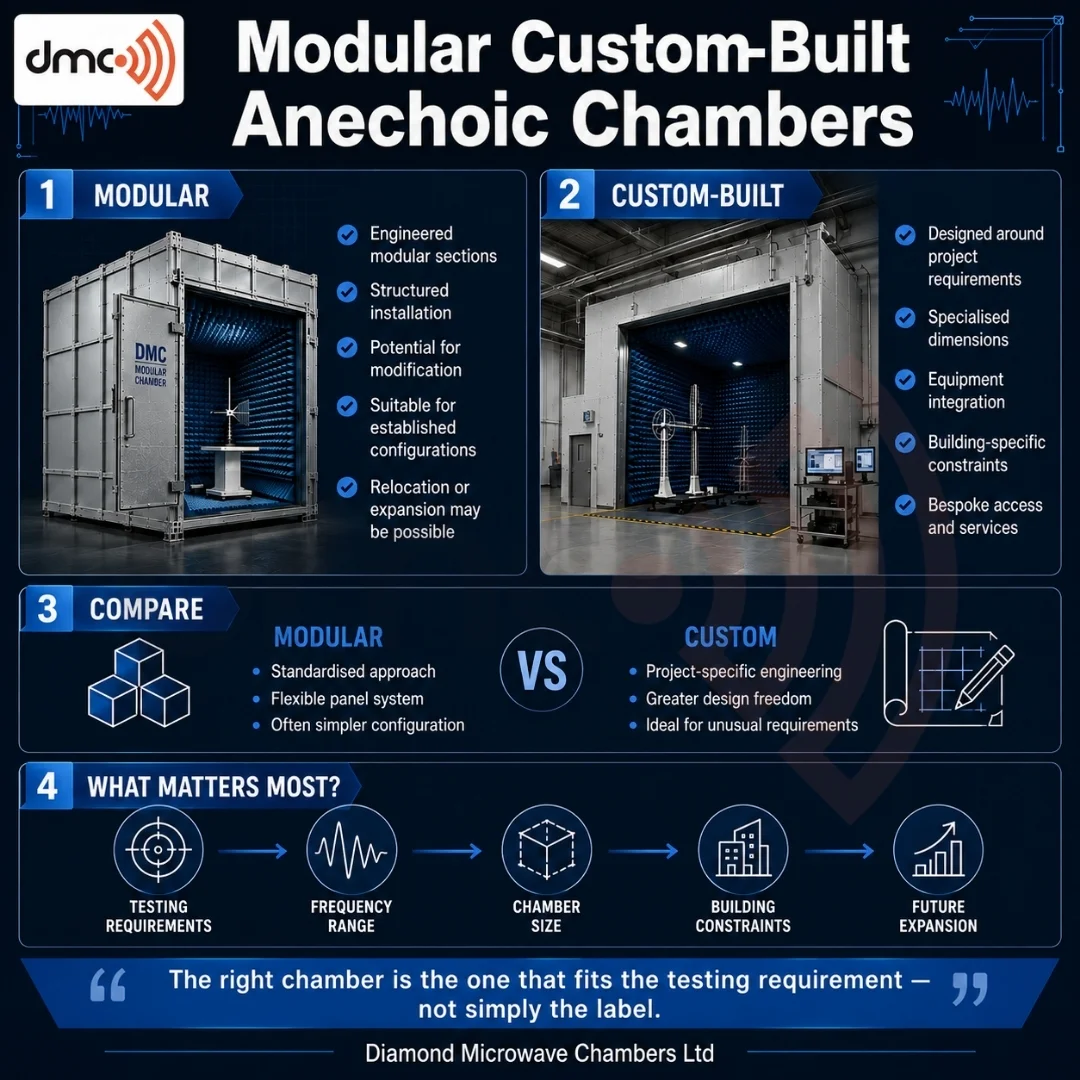
A modular anechoic chamber is constructed from engineered panels or sections assembled on-site to form an RF-shielded enclosure. Because the chamber consists of multiple components, it can provide flexibility when future modification, relocation, or expansion may be required.
Depending on the original engineering design, some modular RF shielding systems can potentially be dismantled, modified, enlarged, relocated, or reinstalled.This can be valuable for organisations developing testing capabilities or anticipating changes in equipment and product sizes.
Key Benefits of Modular Anechoic Chambers
- Structured panel-based installation
- Simplified transportation and assembly
- Standardised components
- Potential for future modification or expansion
- Suitable for established EMC and RF testing applications
- Chamber dimensions designed around test distances and performance requirements
A modular solution can be particularly suitable when the required testing environment fits within an established chamber architecture.
What Is a Custom-Built Anechoic Chamber?
A custom-built anechoic chamber is engineered around specific testing, building, equipment, and operational requirements. Rather than beginning with a predefined configuration, the design can account for unusual room dimensions, large or specialised equipment, access requirements, frequency range, quiet-zone requirements, absorber configuration, antenna positioning, turntables, cable penetrations, ventilation, lighting, and future testing needs.
Custom-built chambers can also be designed around existing building structures and site limitations. This makes them useful when a standard chamber layout cannot be installed efficiently or when the testing application requires a specific internal arrangement.
Key Benefits of Custom-Built Anechoic Chambers
- Designed around available building space
- Accommodates unusual test objects or equipment
- Greater control over chamber dimensions
- Supports specialised doors and equipment integration
- Can address specific frequency and measurement requirements
- Allows future operational requirements to be considered during design
Custom design provides a highly personalized testing environment but generally requires more detailed engineering and planning before construction.
Modular vs Custom-Built Anechoic Chambers: Key Differences
The main difference is how much of the chamber is based on an established system and how much is engineered specifically for the project.
| Factor | Modular Chamber | Custom-Built Chamber |
|---|---|---|
| Approach | Engineered modular sections | Project-specific design |
| Flexibility | High within system limits | Very high |
| Installation | Panel-based assembly | Project-specific installation |
| Space | Compatible layouts | Unusual spaces |
| Modification | May support expansion | Additional engineering |
| Equipment | Standard configurations | Specialised integration |
| Design | More predefined | Detailed engineering |
| Complexity | Often lower | Usually higher |
| Best suited for | Established testing | Specialised requirements |
| Expansion | Possible when engineered | Can be planned into design |
Neither approach is automatically better. The right choice depends on the testing application, available
space, performance requirements, equipment, installation conditions, budget, and future plans.
Which Anechoic Chamber Is More Flexible?
Modular construction can provide strong flexibility when future changes are expected. A panel-based system may be capable of being dismantled, relocated, enlarged, or modified when it has been engineered for those capabilities.
Custom-built chambers can also be highly flexible, but their flexibility comes from designing the chamber around specific future requirements from the beginning. This may include additional service penetrations, larger access doors, adaptable antenna systems, or reserved space for future equipment.
Choose a modular chamber when:
- Testing requirements are well defined.
- A standard configuration matches the application.
- Future relocation or expansion may be required.
- A structured panel-based system is preferred.
- The application fits an established chamber architecture.
Consider a custom-built chamber when:
- The test object is unusually large or heavy.
- The building has unusual dimensions or restrictions.
- Specialised access is required.
- Multiple test systems need integration.
- Specific quiet-zone or frequency requirements exist.
- Standard configurations cannot satisfy the application.
What Affects Anechoic Chamber Performance?
Anechoic chamber performance is not determined simply by whether the chamber is modular or custom-built. Both approaches can be engineered around defined testing requirements.
Important considerations include:
- RF shielding effectiveness
- Absorber performance
- Frequency range
- Quiet-zone requirements
- Test distance
- Normalized Site Attenuation (NSA), where applicable
- Site VSWR
- Ground-plane configuration
- Door performance
- Cable and service penetrations
- Ventilation and filtering
- Antenna positioning
- Turntable performance
- Chamber validation
An effective testing environment requires these components to work together. RF shielding, absorber materials, doors, filters, ventilation, grounding, and test equipment all contribute to a controlled environment.
Installation and Future Expansion
Installation planning should begin before the chamber reaches the site. Important considerations include building access, floor loading, ceiling height, equipment movement, electrical supply, HVAC requirements, cable routing, RF penetrations, door dimensions, maintenance access, test equipment locations, and future expansion.
Future requirements should also be discussed during the initial design stage. An organisation may later introduce larger equipment, additional test systems, new frequencies, or different internal configurations.
A modular system may make certain changes easier when designed for expansion, while a custom-built chamber can incorporate anticipated requirements into the original engineering concept.
How to Choose the Right Anechoic Chamber
Before selecting a modular or custom-built anechoic chamber, define the testing requirements first.
1. Define the Test Application
2. Establish Chamber Size
3. Identify the Frequency Range
4. Review the Building
5. Plan for Future Requirements
6. Plan Validation
Pro Tip: Don’t choose a chamber based only on purchase price. Start with test standards,frequency range, test distance, quiet-zone requirements, EUT size, building limitations, and future expansion plans.
Final Thoughts
Choosing between modular custom-built anechoic chambers ultimately comes down to project fit. A modular chamber can be an excellent option when an established panel-based configuration matches the application and future flexibility is valuable. A custom-built chamber becomes more attractive when the project involves unusual dimensions, specialised equipment, building restrictions, or specific performance requirements.
For organisations planning a new EMC or RF testing facility, Diamond Microwave Chambers Ltd can be considered during the early design stage to determine which chamber approach best matches the project’s technical and operational requirements.
Frequently Asked Questions
A modular chamber uses engineered panels or sections, while a custom-built chamber is designed more extensively around specific project requirements such as dimensions, equipment, access, building constraints, and testing needs.
They can be, provided the original system has been engineered for modification, relocation, or enlargement.
No. Cost depends on chamber size, performance requirements, absorber, shielding, doors, services, equipment, and installation.
Both modular and custom-built chambers can support EMC testing. The appropriate choice depends on the test method, frequency range, chamber size, test distance, quiet zone, equipment, and applicable requirements.
Consider the testing application, frequency range, chamber size, test distance, quiet-zone requirements, EUT size, building constraints, equipment integration, installation needs, and future expansion plans. These factors help determine whether a modular or custom-built anechoic chamber is the better fit for your facility.