
Table of Contents
- What is RF Shielded Tent?
- What Is an RF Shielded Room?
- RF Shielded Tent vs RF Shielded Room
- Advantages of RF Shielded Tents
Today’s wireless world requires industries such as aerospace, defense, telecommunications, automotive,healthcare and electronics manufacturing to control electromagnetic interference (EMI) and radio frequency interference (RFI). RF shielding solutions are used to create controlled environments in which sensitive equipment can function free of external radio signals. Among the most commonly used shielding solutions are RF shielded tents and RF shielded rooms. Both are designed to minimize electromagnetic interference, but they are intended for very different operational requirements. The right solution depends on portability, shielding effectiveness, testing standards, installation requirements, scalability and budget.
This DMC guide explains the difference between RF shielded tents and RF shielded rooms, their benefits, applications, and how to choose the right solution for your testing environment.
What is RF Shielded Tent?
An RF shielded tent is a portable enclosure that is fabricated using conductive shielding fabric that is
designed to block or reduce RF signals and EMI interference. The tents are light-weight, collapsible and
easy to erect in temporary or mobile testing environments.
RF shielded tents are commonly used for:
- Field testing
- Temporary EMC testing
- Wireless device diagnostics
- Portable RF isolation
- Military communications testing
- Quick troubleshooting applications
Most RF shielded tents have an attenuation of approximately 60 dB to 90 dB depending on the quality of
construction and frequency range.
They are cheaper and portable which is perfect for organizations that need to use it rarely or on the go.
What Is an RF Shielded Room?
An RF shielded room is a permanent or semi-permanent enclosure constructed from conductive metal panels
(steel, copper, aluminum, etc.). High shielding effectiveness and stable test conditions of these rooms
are suitable for advanced EMI/EMC applications.
RF shielded rooms are widely used in:
- EMC compliance laboratories
- Aerospace testing facilities
- Defense communication systems
- Medical imaging environments
- Wireless device certification
- Secure data protection environments
- Anechoic chamber integration
Shielded rooms can be designed to attenuate more than 100 dB over a wide range of frequencies.
Unlike portable tents, shielded rooms are built for long-term use, higher durability and precision
testing requirements.
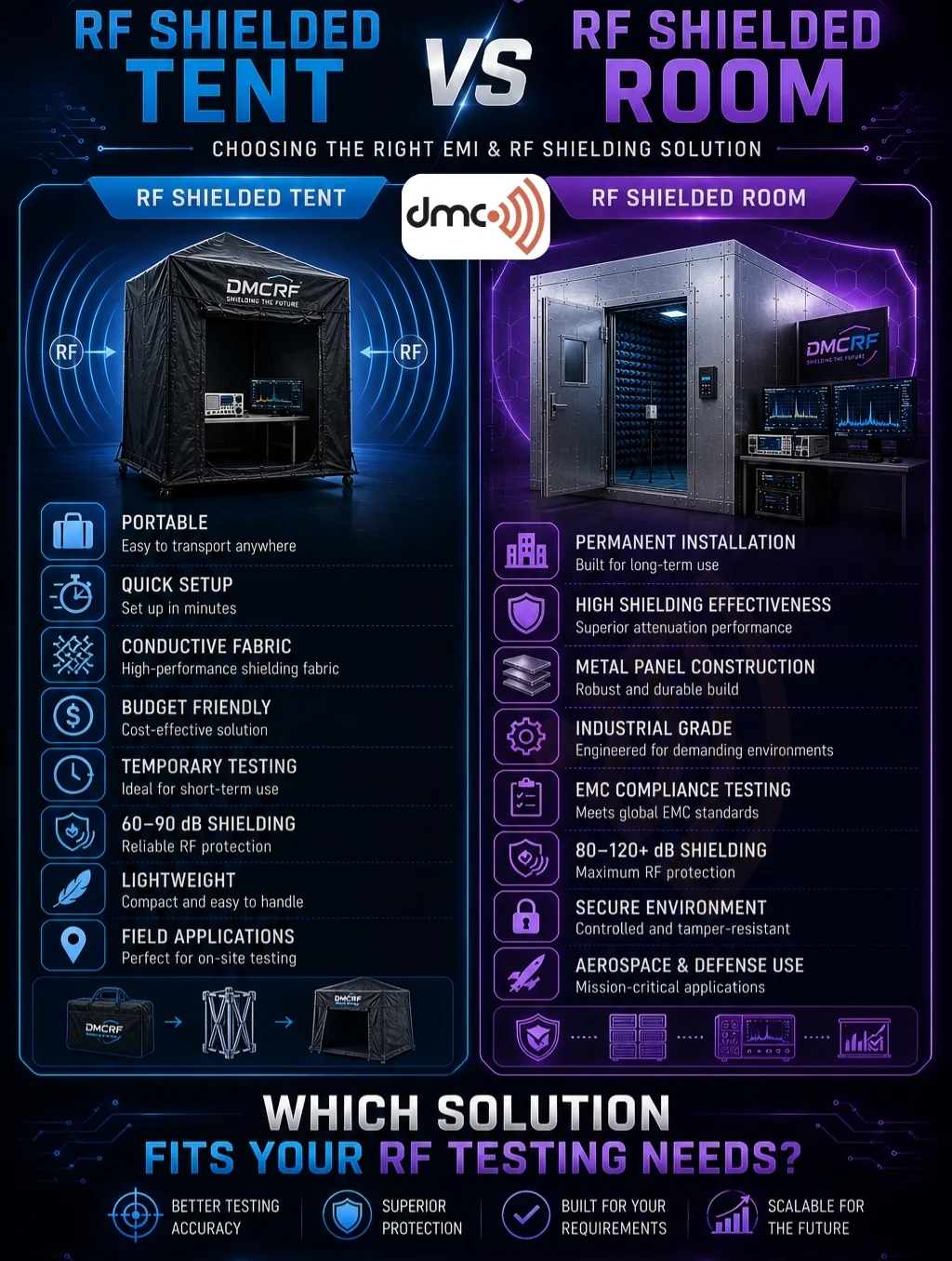
RF Shielded Tent vs RF Shielded Room
The main differences between RF shielded tents and RF shielded rooms are summarized in the following
table.
| Feature | RF Shielded Tent | RF Shielded Room |
|---|---|---|
| Installation | Quick temporary setup | Permanent installation |
| Portability | Highly portable | Fixed structure |
| Shielding Effectiveness | Moderate (60–90 dB) | High (80–120 dB+) |
| Construction Material | Conductive shielding fabric | Steel, copper, aluminum panels |
| Cost | Lower investment | Higher capital investment |
| Testing Accuracy | Suitable for pre-compliance testing | Suitable for certified compliance testing |
| Setup Time | 10–30 minutes | Several days or weeks |
| Scalability | Limited | Highly customizable |
| Durability | Moderate | Long-term industrial durability |
| Ideal Use Case | Field and temporary testing | Permanent EMC/RF laboratories |
| Environmental Control | Basic | Advanced HVAC and filtering integration |
| Security Applications | Limited | High-security RF isolation |
Shielding Effectiveness Comparison
The shielding effectiveness is one of the most important parameters for the comparison of these
solutions.
The shielding effectiveness is the ability of a structure to attenuate electromagnetic signals to or
from the enclosure. The unit of measurement is usually in decibels (dB). Higher dB values correspond to
better isolation performance.
RF Shielded Tent Performance
Shielded tents are good for:
- Precompliance testing
- Rapid diagnostics
- Mobile field operations
- Low to medium sensitivity testing
However, they may encounter as they use flexible conductive fabric instead of inflexible metallic panels
- Signals leaking through zippers or seams
- Lower attenuation at higher frequencies
- Lower long-term durability
RF Shielded Room Performance
Shielded rooms provide better shielding as they contain: Conductive, seam-welded panels
- Doors with RF gaskets
- Filtered power supply lines
- Insulation ventilation systems
- High-level grounding systems
This feature provides highly controlled RF environments for:
- EMC certification testing
- Military communications security
- Health care systems
- Aerospace uses
- Government facilities security
Advantages of RF Shielded Tents
1. Portability
One of the biggest advantages of a shielded tent is its mobility. They are foldable, movable and can be
installed in different places with moderate effort.
2. Cost-Effective Solution
Permanent Rf Shielding Room are too costly to afford. Hence, use of shielded tent can be considered by
startup companies, researchers, etc.
3. Fast Deployment
Most of the covered tents can be assembled in minutes and do not require any special construction work.
4. Flexible Testing
Support for Temporary wireless testing, field diagnostics and portable EMC measurements.
Benefits of RF Shielded Rooms
1. Industry Leading RF Isolation
Shielded rooms have good attenuation performance which is very useful in high precision RF testing and
secure communications.
2. Long-term durability
Metallic material is used in their construction for strength and durability.
3. Following the Rules
Many EMC certification and compliance tests require permanent shielded environments.
4. Advanced Customization
RF shielded rooms may include:
- RF shielded doors
- Honeycomb air vents
- Fiber optic penetrations
- Power line filters
- Raised flooring
- Anechoic absorber integration
5. Secure Environment
The shielded rooms are often used for data protection and military applications that need to prevent RF
leakage.
Pro Tip: If your organization occasionally needs to do an EMI test, or if you need a mobile solution, an RF shielded tent may be a practical solution. But for accredited EMC compliance testing, aerospace validation, military systems or high frequency wireless testing you will get better long term accuracy,reliability and scalability by investing in an RF shielded room engineered by professionals.
Common Applications of RF Shielded Tents
RF shielded tents are commonly used in:
- Temporary wireless testing labs
- On-site troubleshooting
- Military field operations
- Portable RF diagnostics
- IoT device testing
- Mobile communication testing
- Research and development
They are flexible and useful where permanent infrastructure is not possible.
Common Applications of RF Shielded Rooms
RF shielded rooms are essential for:
- EMC compliance laboratories
- Aerospace and defense systems
- Medical imaging facilities
- Antenna testing
- Automotive electronics validation
- Secure government communication centers
- Semiconductor testing
- Wireless device certification
These environments require stable and repeatable RF isolation conditions.
Cost Considerations
RF Shielded Tent Costs
RF shielded tents are generally cheaper because of:
- Use of lightweight materials
- Construction complexity is low
- Cost of installation is low
- Limited infrastructure requirements
This makes them attractive for temporary or budget applications.
RF Shielded Room Costs
RF shielded rooms require high investment because:
- Metal panel construction
- Engineering Accuracy
- RF filter systems
- HVAC integration
- Structural erection
- Long term compliance obligations
The initial cost may be higher, but the long-term operational value of advanced testing environments is
much greater.
Which One Should You Choose?
Depending on your operational needs you will require an RF shielded tent or an RF shielded room.
Select an RF Shielded Tent if you require:
- Portability
- Fast setup
- Short-term testing
- Reduced investment
- Flexibility of field deployment
Select if you require an RF Shielded Room:
- High shielding efficiency
- EMC test certification
- Infrastructure for the long term
- Ensure RF isolation
- High frequency testing accuracy
- Industrial strength ruggedness
RF shielded tents and RF shielded rooms are both important parts of RF and EMI testing environments.Low-cost, portable and flexible shielded tents are available for temporary use while RF shielded rooms provide high-performance isolation for critical industrial, military, medical and compliance testing.
Understanding the variances in shielding effectiveness, durability, scalability and operational needs will help organizations select the right RF shielding solution for their requirements.
DMC Official Website – Advanced RF shielding systems, EMC testing environments, customized shielding solutions.
Frequently Asked Questions
An RF shielded tent is portable and designed for temporary testing, while an RF shielded room is a permanent structure offering higher shielding effectiveness and long-term testing stability.
RF shielded rooms generally provide better attenuation levels, often exceeding 100 dB, whereas shielded tents typically provide 60–90 dB attenuation.
Shielded tents are mainly used for pre-compliance and troubleshooting applications. Certified EMC compliance testing usually requires a shielded room or anechoic chamber.
RF shielded rooms are widely used in aerospace, defense, healthcare, telecommunications, automotive, and EMC laboratories.
The choice depends on portability needs, testing standards, budget, shielding performance requirements, and whether the installation is temporary or permanent.