
Table of Contents
- What is EMC Testing in Vehicles?
- Key Differences Between Hybrid and EV EMC Testing
- Challenges in Hybrid and EV EMC Testing
The automotive industry is shifting fast toward electrification, making EMC testing more critical than ever. Hybrid and fully electric vehicles (EVs) rely heavily on complex electronic systems, high-voltage components, and power electronics.
With this shift comes a new set of engineering challenges. While hybrid and electric vehicles share some testing similarities, they also have distinct requirements based on their powertrain design, voltage levels, and onboard electronics.
Understanding these differences helps manufacturers, suppliers, and testing labs like DMC ensure vehicles meet safety, performance, and regulatory standards before hitting the road.
In this article, we break down the key differences between Hybrid and Electric Vehicle EMC testing, the standards involved, common challenges, and why proper testing matters for modern automotive development.
What is EMC Testing in Vehicles?
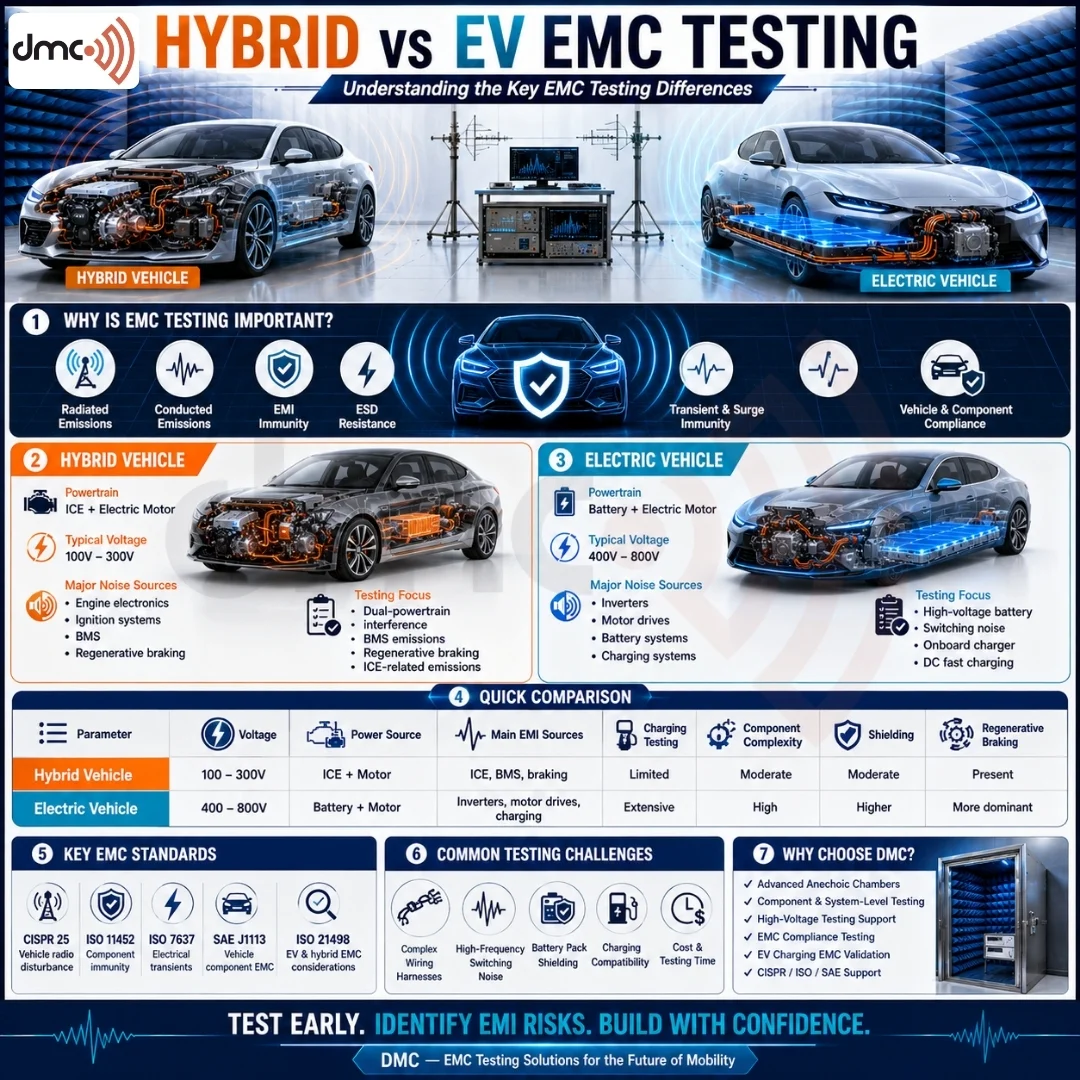
EMC testing evaluates whether a vehicle’s electronic systems can operate without interfering with each other or with external devices, while also being immune to outside electromagnetic interference (EMI). In automotive applications, this includes testing:
- Radiated and conducted emissions
- Immunity to external EMI sources
- Electrostatic discharge (ESD) resistance
- Transient and surge immunity
- Component-level and full-vehicle EMC compliance
For hybrid and electric vehicles, this process becomes more complex due to high-voltage battery systems, inverters, and motor controllers that generate significant electromagnetic noise.
Hybrid Vehicle EMC Testing
Hybrid Electric Vehicles (HEVs) combine an internal combustion engine (ICE) with an electric motor and battery system. This dual-powertrain design creates unique EMC testing needs.
Key Focus Areas for Hybrid EMC Testing
- Dual power source interference: Testing must account for interactions between the combustion engine’s electronics and the electric drive system.
- Battery management system (BMS) testing: Ensures the BMS doesn’t emit interference that affects other vehicle electronics.
- Regenerative braking systems: These systems generate electrical noise during energy recovery, requiring careful EMC evaluation.
- Moderate voltage systems: Hybrid vehicles typically operate at lower voltage ranges (100V–300V) compared to full EVs, which affects testing parameters.
- ICE-related emissions: Spark plugs, ignition systems, and fuel injectors still contribute to EMC profiles, unlike in pure EVs.
Electric Vehicle EMC Testing
Fully Electric Vehicles (EVs) rely entirely on battery power and electric motors, eliminating combustion engine components but introducing high-voltage complexities.
Key Focus Areas for EV EMC Testing
- High-voltage battery packs: EVs often operate at 400V to 800V, requiring specialized shielding and testing protocols.
- Power inverters and motor drives: These generate high-frequency switching noise that must be controlled and tested extensively.
- DC fast charging systems: Charging infrastructure introduces additional EMI sources that need compliance testing.
- Onboard chargers (OBC): Must be tested for both emissions and immunity during charging cycles.
- Absence of ICE noise: Without combustion engine interference, EVs have a cleaner baseline, but power electronics dominate the EMC profile.
Key Differences Between Hybrid and EV EMC Testing
| Parameter | Hybrid Vehicle EMC Testing | Electric Vehicle EMC Testing |
|---|---|---|
| Voltage Range | 100V – 300V (typical) | 400V – 800V (typical) |
| Power Source | Combustion engine + electric motor | Fully battery and motor-based |
| Noise Sources | ICE ignition, BMS, regenerative braking | Inverters, motor drives, charging systems |
| Charging System Testing | Limited or not applicable in mild hybrids | Extensive DC fast charging EMC testing required |
| Component Complexity | Moderate | High |
| Regenerative Braking EMC | Present and tested | Present, more dominant in EMC profile |
| Testing Standards Applied | CISPR 25, ISO 11452 | CISPR 25, ISO 11452, ISO 21498, additional charging standards |
| Shielding Requirements | Moderate shielding needs | Higher shielding due to high voltage |
Common EMC Testing Standards for Hybrid and EVs
Both hybrid and electric vehicles must comply with international EMC standards, including:
- CISPR 25 – Radio disturbance characteristics for vehicle protection
- ISO 11452 – Component immunity testing
- ISO 7637 – Electrical transient conduction testing
- SAE J1113 – EMC testing standards for vehicle components
- ISO 21498 – Specific to EV and hybrid vehicle EMC considerations
Meeting these standards ensures the vehicle’s electronics function safely and reliably in real-world conditions, without causing or suffering from harmful interference.
Challenges in Hybrid and EV EMC Testing
Both vehicle types face unique testing hurdles:
- Complex wiring harnesses: More electronic components mean more potential noise sources.
- High-frequency switching noise: Power electronics like inverters generate broadband EMI that’s difficult to filter.
- Battery pack shielding: Especially critical in EVs due to higher voltage levels.
- Charging infrastructure compatibility: EVs must be tested across various charging stations and power levels.
- Cost and time constraints: Comprehensive EMC testing requires specialized chambers and equipment, increasing development timelines.
Why Choose Professional EMC Testing Services?
Given the complexity of hybrid and EV EMC requirements, manufacturers need access to advanced testing facilities, certified engineers, and standardized protocols. Professional EMC testing partners like DMC provide:
- Fully equipped anechoic chambers for radiated emissions and immunity testing
- Component and system-level EMC evaluation
- Compliance testing aligned with CISPR, ISO, and SAE standards
- Support for high-voltage battery and inverter testing
- Charging system EMC validation for EVs
Partnering with an experienced EMC testing provider reduces compliance risks, speeds up product development, and ensures vehicles meet global safety standards before market launch.
Pro Tip
Always conduct EMC pre-compliance testing early in the design phase, especially for high-voltage EV components like inverters and battery packs. Identifying interference issues during prototyping is significantly cheaper and faster than fixing them after full vehicle assembly.
Conclusion
While hybrid and electric vehicles share the goal of reducing emissions and improving efficiency, their EMC testing requirements differ significantly due to voltage levels, power sources, and onboard electronics. Hybrid vehicles must manage interference from both combustion and electric systems, while EVs face challenges primarily from high-voltage batteries, inverters, and charging systems.
Choosing a reliable EMC testing partner ensures your hybrid or electric vehicle meets all regulatory standards, performs reliably, and is ready for global markets. DMC offers comprehensive EMC testing solutions tailored to the unique needs of both hybrid and electric vehicles, helping manufacturers stay compliant and competitive.
Frequently Asked Questions
The primary difference lies in voltage levels and noise sources. Hybrids operate at 100V–300V and deal with interference from both combustion engines and electric systems, while EVs operate at 400V–800V and focus mainly on power electronics and charging system interference.
EMC testing ensures that high-voltage components like batteries, inverters, and motor drives don’t interfere with other vehicle electronics, and that the vehicle can withstand external electromagnetic interference safely.
Common standards include CISPR 25, ISO 11452, ISO 7637, SAE J1113, and ISO 21498, covering emissions, immunity, and transient testing for automotive components.
Yes, DC fast charging systems and onboard chargers introduce additional EMI sources that require specific compliance testing, which is generally not applicable to non-plug-in hybrids.
By conducting pre-compliance EMC testing early in the design phase, using proper shielding for high-voltage components, and partnering with experienced EMC testing labs like DMC.