
Table of Contents
- Why Budget Planning Matters
- Key Components That Affect Your Budget
- Factors That Increase Laboratory Cost
Planning an Antenna Measurement Laboratory is a major investment for organizations involved in wireless communications, aerospace, defense, automotive, satellite communications, IoT, and research & development. Budget Planning for an Antenna Measurement Laboratory is more than estimating the price of an anechoic chamber—it requires careful consideration of testing requirements, RF instruments, infrastructure, software, calibration, installation, and long-term maintenance.
At Diamond Microwave Chambers Ltd, we understand that every laboratory has unique testing objectives. Whether you are building a compact R&D facility or a fully automated production testing laboratory, having a realistic budget helps prevent unexpected costs while ensuring your investment delivers accurate and reliable antenna measurements.
This guide explains the major budget components, cost drivers, and practical considerations to help organizations make informed purchasing decisions.
Why Budget Planning Matters
A poorly planned laboratory budget often leads to delays, unexpected expenses, and equipment limitations. On the other hand, a well-planned investment provides long-term value and supports future technology upgrades.
Benefits of proper budget planning include:
- Better investment decisions
- Reduced project risks
- Improved testing accuracy
- Faster project completion
- Easier future expansion
- Lower maintenance costs
- Improved return on investment
Instead of focusing only on equipment prices, organizations should evaluate the complete lifecycle cost of the laboratory.
Key Components That Affect Your Budget
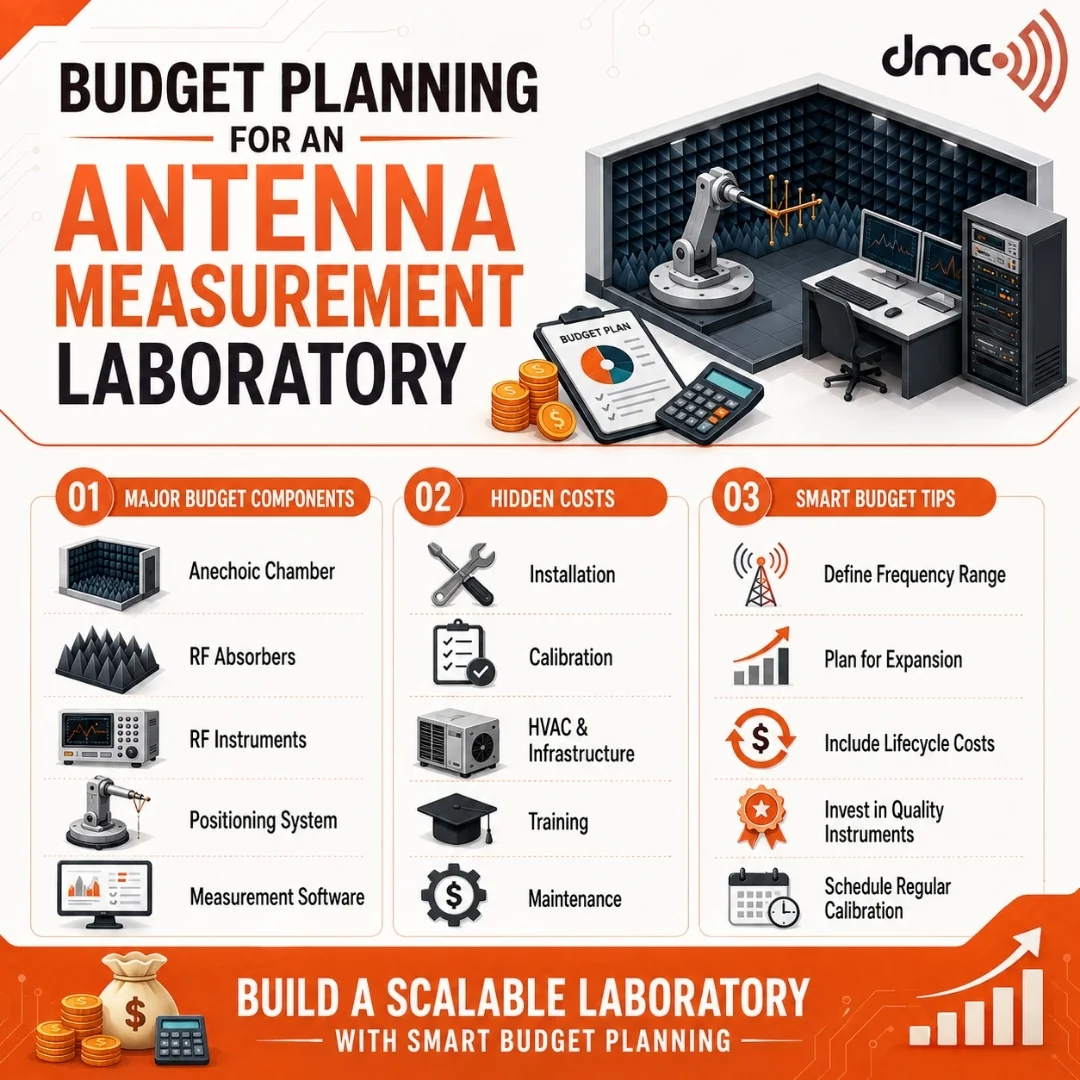
An antenna measurement laboratory consists of several integrated systems. Each contributes to the overall project cost.
| Component | Purpose | Budget Impact |
|---|---|---|
| Anechoic Chamber | Reflection-free testing environment | Very High |
| RF Absorbers | Minimize signal reflections | High |
| Antenna Positioner | Precise antenna movement | Medium to High |
| Vector Network Analyzer (VNA) | RF measurements | High |
| Signal Generator | RF signal creation | Medium |
| Spectrum Analyzer | Signal analysis | Medium |
| Measurement Software | Automation and reporting | Medium |
| Control Computer | Laboratory operation | Low |
| RF Cables & Accessories | Connections and calibration | Medium |
| Installation | System integration | Medium |
| Calibration | Measurement accuracy | Medium |
| Operator Training | Efficient operation | Low |
1. Anechoic Chamber
The anechoic chamber is usually the largest investment in the laboratory.
The required chamber size depends on:
- Frequency range
- Antenna dimensions
- Far-field distance
- Measurement type
- Future expansion
A larger chamber provides greater flexibility but also increases construction, shielding, absorber, and installation costs.
Organizations should avoid oversizing or undersizing the chamber. Proper engineering calculations help determine the optimum dimensions.
2. RF Absorbers
RF absorbers create a reflection-free environment inside the chamber.
Common absorber types include:
- Polyurethane absorbers
- EPP absorbers
- High-power absorbers
The choice depends on:
- Frequency coverage
- Power handling
- Durability
- Environmental conditions
Lower-frequency testing generally requires larger absorbers, increasing material costs.
3. Antenna Positioning System
The positioning system determines how accurately the antenna can be rotated and measured.
Budget depends on:
- Number of axes
- Payload capacity
- Positioning accuracy
- Rotation speed
- Automation features
Production laboratories often require fully automated multi-axis positioners, while research laboratories may only require simpler systems.
4. RF Measurement Instruments
High-quality RF instruments directly affect measurement reliability.
Typical equipment includes:
- Vector Network Analyzer (VNA)
- Spectrum Analyzer
- Signal Generator
- Power Meter
- Low Noise Amplifier
- RF Switch Matrix
Higher frequency ranges generally require more advanced instruments with increased measurement accuracy.
5. Measurement Software
Modern laboratories rely heavily on software for:
- Test automation
- Data acquisition
- Pattern plotting
- Gain calculations
- Report generation
- Remote operation
Although software may represent a smaller portion of the budget, it significantly improves productivity and repeatability.
6. Calibration and Verification
Every antenna laboratory requires regular calibration to maintain measurement confidence.
Calibration includes:
- Reference antennas
- Cable characterization
- Positioner verification
- Instrument calibration
- Chamber validation
Skipping calibration may reduce measurement reliability and affect compliance testing.
7. Laboratory Infrastructure
Infrastructure costs are often underestimated during project planning.
Important considerations include:
- Power supply
- Air conditioning
- Grounding
- Network connectivity
- Lighting
- Safety systems
- Fire protection
Environmental stability helps maintain measurement consistency throughout the year.
8. Installation and Commissioning
Professional installation ensures that every subsystem works together correctly.
Typical activities include:
- Chamber assembly
- RF absorber installation
- Instrument integration
- Software configuration
- System verification
- Acceptance testing
Experienced installation teams can significantly reduce commissioning time.
9. Training Costs
Even the best equipment cannot deliver optimal results without trained operators.
Training typically covers:
- Equipment operation
- Measurement procedures
- Software usage
- Maintenance
- Troubleshooting
- Safety practices
Well-trained engineers improve productivity and reduce measurement errors.
10. Maintenance Budget
Long-term maintenance should be included in every project budget.
Maintenance activities include:
- Instrument servicing
- RF absorber inspection
- Software updates
- Positioner maintenance
- Calibration
- Spare parts
Planning annual maintenance costs helps avoid unexpected downtime.
Factors That Increase Laboratory Cost
Several factors can significantly influence the final investment.
Higher Frequency Range
Testing at millimeter-wave frequencies often requires:
- Greater positioning accuracy
- Better absorbers
- Precision instrumentation
Larger Chamber
Larger chambers require:
- More shielding material
- More absorbers
- Larger positioners
- Increased construction work
Automation
Automated laboratories improve efficiency but require:
- Advanced software
- Motion controllers
- Robotics
- Additional sensors
Accuracy Requirements
Higher measurement accuracy generally requires:
- Premium instruments
- Better calibration
- Improved chamber performance
Hidden Costs Many Buyers Forget
Some expenses are often overlooked during budgeting.
These include:
- Shipping
- Customs duties
- Civil construction
- Power upgrades
- HVAC improvements
- Operator training
- Annual calibration
- Software licenses
- Spare parts
- Warranty extensions
Considering these items early helps avoid budget overruns.
Budget Planning Tips
A successful laboratory project starts with clear technical requirements.
Consider the following recommendations:
- Define your frequency range before purchasing equipment.
- Choose chamber dimensions based on current and future needs.
- Invest in reliable RF instruments.
- Include installation and training costs.
- Budget for annual maintenance.
- Plan for future expansion.
- Work with experienced system integrators.
Pro Tip
Design your antenna measurement laboratory with future technologies in mind. If your current requirement is below 6 GHz, consider infrastructure that can be upgraded for higher frequencies such as mmWave, advanced 5G, and future wireless research. Planning for scalability today can reduce major upgrade costs later.
Common Budget Allocation Example
| Category | Approximate Share of Budget |
|---|---|
| Anechoic Chamber | 35–45% |
| RF Instruments | 20–30% |
| Positioning System | 10–15% |
| RF Absorbers | 10–15% |
| Software | 5–8% |
| Installation | 3–6% |
| Training | 1–3% |
| Maintenance & Calibration | Ongoing Annual Cost |
Actual percentages vary depending on laboratory size, frequency range, automation level, and project requirements.
Conclusion
Budget Planning for an Antenna Measurement Laboratory requires more than comparing equipment prices. A successful project considers the complete laboratory ecosystem, including chamber design, RF absorbers, measurement instruments, automation software, infrastructure, installation, calibration, and ongoing maintenance.
Working with an experienced supplier such as Diamond Microwave Chambers Ltd helps organizations develop cost-effective, scalable, and high-performance antenna measurement laboratories that deliver accurate results for years to come.
Frequently Asked Questions
The anechoic chamber is typically the largest investment, followed by RF measurement instruments and the antenna positioning system.
Clearly define your testing requirements, avoid oversizing the chamber, plan for future expansion, and include lifecycle costs such as calibration and maintenance in your budget.
Yes. Measurement software is essential for automation, data analysis, report generation, and improving testing efficiency.
Calibration ensures measurement accuracy, maintains confidence in test results, and supports consistent long-term laboratory performance.
Yes. A well-designed laboratory can be expanded with additional RF instruments, upgraded software, larger positioning systems, or support for higher-frequency testing as future requirements evolve.