
Table of Contents
- What is an ECU?
- Why Modern Cars Need Over 100 ECU EMC Tests
- How Advanced EMC Chambers Improve Testing
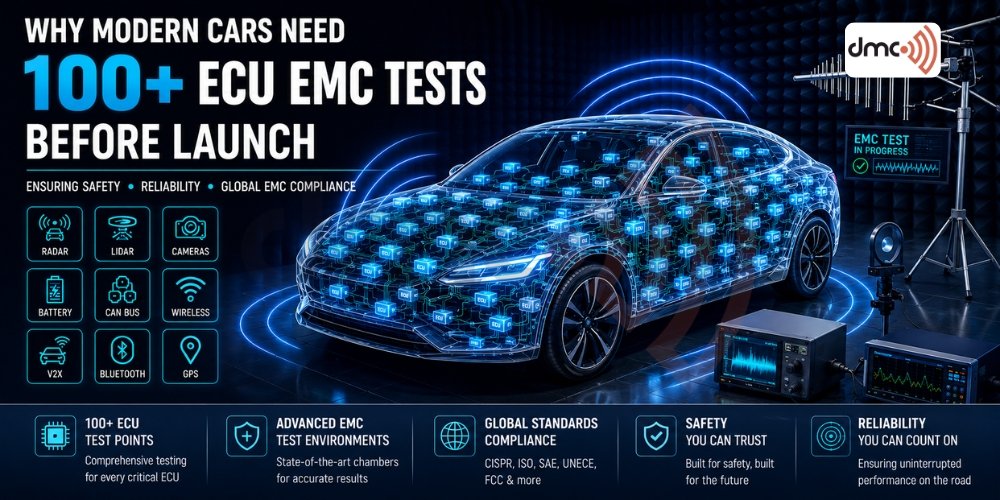
Modern vehicles are powered by over 100 Electronic Control Units (ECUs) that manage everything from braking and battery systems to infotainment and autonomous driving. As automotive electronics become more advanced, ensuring they operate without electromagnetic interference (EMI) is essential for safety, reliability, and regulatory compliance. This is why manufacturers perform more than 100 ECU EMC tests before launching a vehicle. In this blog, we’ll explore why these tests are critical and how they help ensure the performance of today’s connected and electric vehicles.
What is an ECU?
An Electronic Control Unit (ECU) is a microcomputer that manages specific vehicle functions.
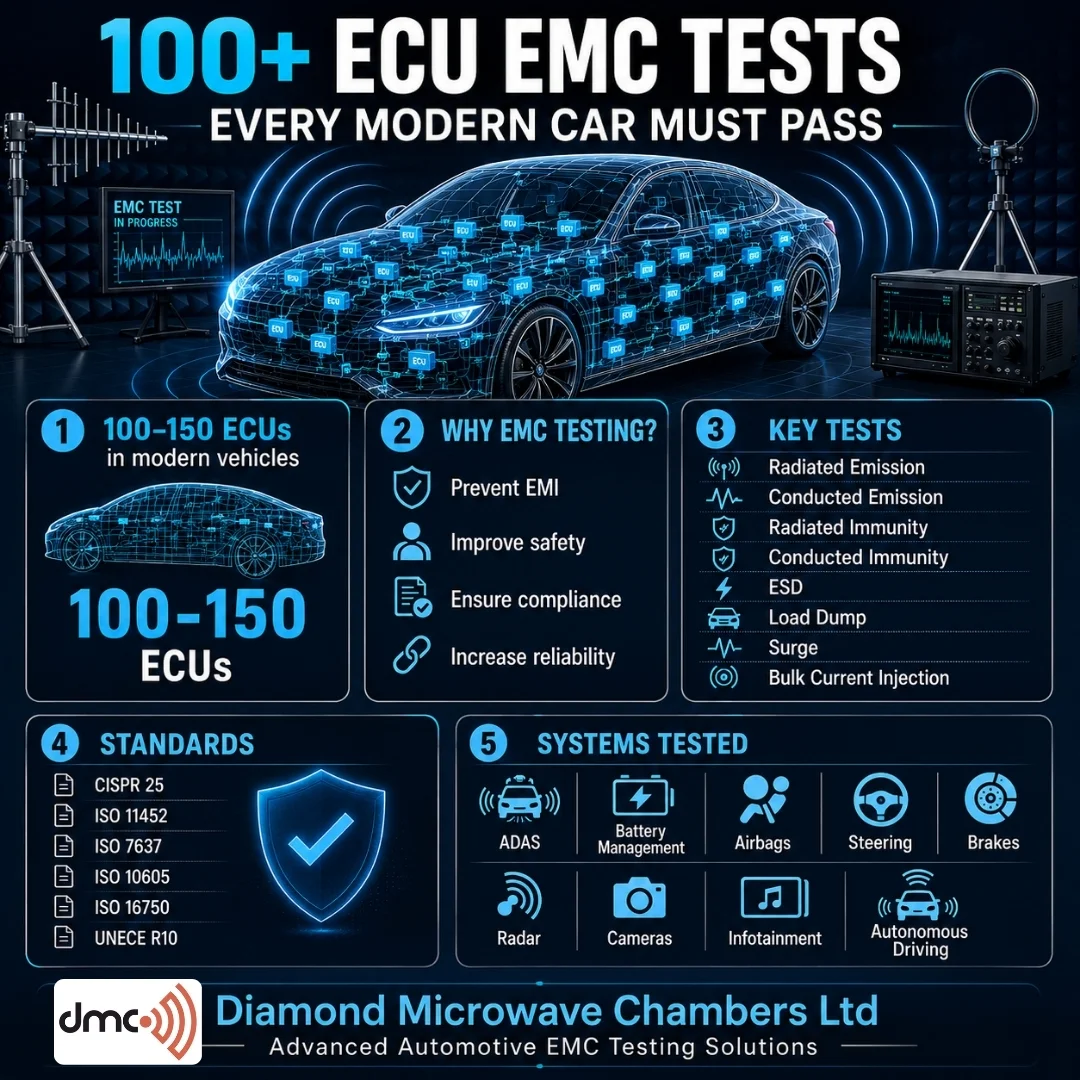
Modern premium vehicles can contain 100–150 ECUs, while electric and autonomous vehicles may include even more.
Common ECUs include:
- Engine Control Unit
- Transmission Control Unit
- ABS Control Module
- Airbag Controller
- Body Control Module
- Battery Management System (EV)
- Infotainment System
- Navigation Controller
- ADAS Controller
- Radar Processing Unit
- Camera Processing Unit
- Power Steering Controller
- Climate Control Module
Each ECU continuously exchanges data across CAN, LIN, FlexRay, Automotive Ethernet, and wireless communication networks.
Why EMC Testing Matters
Electromagnetic Compatibility (EMC) ensures that electronic devices:
- Operate correctly
- Do not emit excessive electromagnetic noise
- Resist interference from nearby devices
- Continue functioning during electrical disturbances
Without proper EMC validation:
- Safety systems may malfunction
- Radar sensors may lose detection capability
- Camera systems may provide incorrect information
- Vehicle communication networks may become unstable
- Autonomous driving functions may fail
These risks make EMC testing mandatory before vehicle certification.
Why Modern Cars Need Over 100 ECU EMC Tests
Each ECU is validated individually and then again as part of the complete vehicle.
Manufacturers perform numerous EMC evaluations because every ECU behaves differently under varying electrical and electromagnetic conditions.
Major reasons include
- Increasing electronic complexity
- Connected vehicle technologies
- Autonomous driving systems
- High-speed communication networks
- Electric vehicle power electronics
- Wireless charging
- Multiple RF transmitters
- Functional safety requirements
- Global certification regulations
Common EMC Tests Performed on Automotive ECUs
| EMC Test | Purpose | Standard |
|---|---|---|
| Radiated Emission | Measures Electromagnetic Radiation from ECU | CISPR 25 |
| Conducted Emission | Measures Noise Through Cables | CISPR 25 |
| Radiated Immunity | Checks ECU Resistance to RF Fields | ISO 11452 |
| Conducted Immunity | Evaluates Cable Interference Immunity | ISO 11452 |
| Electrostatic Discharge (ESD) | Simulates Human Electrostatic Discharge | ISO 10605 |
| Electrical Fast Transient | Tests Switching Disturbances | ISO 7637 |
| Surge Test | Simulates Voltage Surges | ISO 7637 |
| Load Dump Test | Simulates Alternator Disconnection | ISO 16750 |
| Magnetic Field Immunity | Tests Resistance to Magnetic Fields | ISO 11452 |
| Bulk Current Injection | RF Current Immunity Testing | ISO 11452 |
Automotive Systems That Require EMC Validation
Virtually every electronic subsystem in a modern vehicle undergoes EMC testing.
These include:
- Engine Management
- Brake Systems
- Steering Systems
- Airbags
- Battery Management
- Electric Motors
- Charging Systems
- Infotainment
- Navigation
- Bluetooth
- Wi-Fi Modules
- GPS
- Vehicle-to-Everything (V2X)
- Radar
- Cameras
- LiDAR
- Parking Assistance
- Autonomous Driving Controllers
EMC Testing Throughout the Vehicle Development Cycle
EMC validation is not a one-time activity. It is integrated throughout the product lifecycle.
Development stages include:
Component Testing
Each ECU is tested independently.
Subsystem Testing
Multiple ECUs communicate together.
Integration Testing
Complete vehicle electrical architecture is evaluated.
Pre-Compliance Testing
Potential EMC issues are identified before certification.
Certification Testing
Final testing against international automotive standards.
Major Automotive EMC Standards
Several international standards govern automotive EMC testing.
Widely adopted standards include:
- CISPR 25
- ISO 11452
- ISO 7637
- ISO 10605
- ISO 16750
- UNECE Regulation No. 10 (UN R10)
- OEM-specific EMC requirements (Volkswagen, BMW, Mercedes-Benz, Toyota, Ford, GM, Stellantis, Hyundai, etc.)
Meeting these standards is essential for global vehicle approval.
Challenges in ECU EMC Testing
Modern automotive electronics present several testing challenges.
Engineers must address:
- High-frequency interference
- Dense electronic packaging
- High-voltage EV architectures
- Wireless communication coexistence
- Autonomous driving sensors
- Multiple operating modes
- Real-time communication buses
- Thermal operating conditions
- Battery-powered systems
- Functional safety integration
Specialized EMC chambers help simulate these conditions accurately.
How Advanced EMC Chambers Improve Testing
Modern EMC facilities provide controlled environments for repeatable measurements.
Benefits include:
- High measurement accuracy
- Low ambient RF interference
- Fast testing cycles
- Repeatable results
- Global standard compliance
- Automated testing
- Reduced engineering time
- Better product reliability
These capabilities are critical for validating increasingly complex automotive electronics.
Why Manufacturers Perform More Than 100 EMC Tests
A single ECU may undergo dozens of EMC evaluations under different operating conditions.
When multiplied across 100+ ECUs, manufacturers can perform several thousand individual EMC measurements during a vehicle development program.
Testing combinations include:
- Different temperatures
- Various battery voltages
- Engine ON/OFF
- Charging mode
- Driving mode
- Sleep mode
- Communication active
- RF exposure levels
- Multiple frequencies
- Different cable configurations
This comprehensive validation ensures dependable vehicle performance throughout its lifecycle.
Pro Tip
Begin EMC validation early in the ECU development process. Identifying electromagnetic compatibility issues during prototype testing is significantly more cost-effective than redesigning hardware after vehicle integration. Early pre-compliance testing helps reduce delays, minimize development costs, and improve first-time certification success.
Conclusion
Modern vehicles depend on a vast network of electronic control units that must work together reliably in increasingly complex electromagnetic environments. From safety-critical braking systems to advanced driver assistance technologies, every ECU must withstand interference while avoiding emissions that could affect other systems.
This is why manufacturers conduct more than 100 ECU EMC tests before launching a new vehicle. Comprehensive EMC validation reduces safety risks, supports regulatory compliance, and enhances vehicle reliability.
As automotive technology continues to evolve toward electrification, connectivity, and autonomous mobility, robust EMC testing will remain a cornerstone of successful vehicle development. Organizations such as Diamond Microwave Chambers Ltd play an important role by providing specialized EMC testing environments that enable accurate, standards-compliant evaluation of modern automotive electronics.
Frequently Asked Questions
An ECU (Electronic Control Unit) is a computer that controls specific vehicle functions such as the engine, brakes, airbags, battery management, infotainment, and ADAS systems.
EMC tests verify that automotive electronic systems operate reliably without causing or suffering from electromagnetic interference, helping ensure safety, performance, and regulatory compliance.
Common standards include CISPR 25, ISO 11452, ISO 7637, ISO 10605, ISO 16750, and UNECE R10, along with manufacturer-specific EMC requirements.
Many modern vehicles contain between 70 and 150 ECUs, while advanced electric and autonomous vehicles may incorporate even more electronic control units.
Diamond Microwave Chambers Ltd provides EMC chambers, RF shielding solutions, anechoic chambers, OTA testing facilities, and customized EMC testing environments to help automotive manufacturers achieve accurate and standards-compliant testing.