
Table of Contents
- Why Shielding Matters
- What Is an Anechoic Chamber?
- How MRI Shielding Works
- Advantages of MRI Room Shielding and Anechoic Chambers
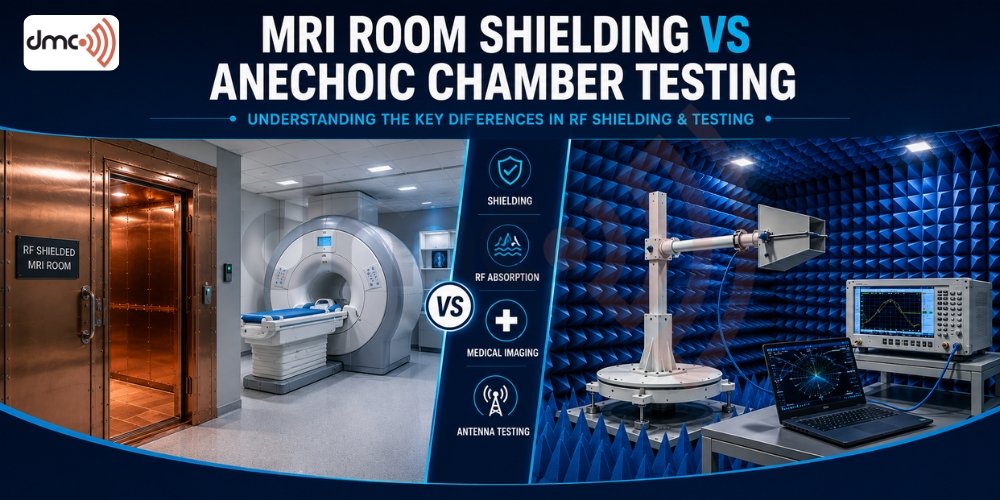
Medical imaging systems and electromagnetic testing facilities both rely on carefully controlled radio frequency (RF) environments, but they are designed to achieve entirely different objectives. When comparing MRI Room Shielding vs Anechoic Chamber Testing, many people assume they perform similar functions because both involve shielding and electromagnetic control. In reality, they are built using different engineering principles and serve different industries.
An MRI room is designed to prevent external radio frequency interference from degrading medical images while containing RF energy generated by the MRI scanner. An anechoic chamber, on the other hand, creates a reflection-free environment for testing antennas, wireless devices, satellites, radar systems, and electronic equipment.
At Diamond Microwave Chambers Ltd, we specialize in advanced RF and EMC testing solutions, including anechoic chambers, RF shielded enclosures, RF absorbers, and customized testing environments that meet international testing requirements.
Why Shielding Matters
Radio frequency interference is everywhere.
Nearby cellular towers, Wi-Fi routers, broadcasting stations, industrial machinery, and electronic devices continuously emit electromagnetic signals.
Without proper shielding:
- MRI images become noisy and distorted.
- Antenna measurements lose accuracy.
- EMC compliance tests become unreliable.
- Wireless device performance cannot be validated correctly.
Although both facilities reduce unwanted electromagnetic interference, they accomplish this in different ways.
What Is MRI Room Shielding?
MRI room shielding is a specialized construction technique that creates a controlled electromagnetic environment around an MRI scanner.
Its primary objective is:
- Prevent outside RF interference
- Keep MRI operating frequencies isolated
- Improve image quality
- Ensure patient safety
- Meet healthcare regulations
MRI systems operate using extremely sensitive radio frequency signals.
Even a small amount of interference can create image artifacts that affect diagnosis.
Typical MRI Shielding Materials
- Copper panels
- Copper foil
- Aluminum shielding
- RF shielded doors
- RF windows
- Waveguide penetrations
- Filtered power lines
The shielding forms a complete conductive enclosure commonly known as a Faraday Cage.
What Is an Anechoic Chamber?
An anechoic chamber is a highly controlled testing environment designed to eliminate electromagnetic reflections.
Unlike MRI rooms, the objective is not only shielding external interference but also absorbing internal reflections.
Inside the chamber:
- RF absorber pyramids cover walls
- Ceiling contains absorber materials
- Floor may include absorbers or conductive surfaces
- Precision antenna positioners rotate test objects
- Measurement equipment captures accurate RF data
These chambers simulate free-space conditions.
Primary Purpose Comparison
| Feature | MRI Room Shielding | Anechoic Chamber Testing |
|---|---|---|
| Main Goal | Protect MRI Imaging | Accurate RF Measurements |
| Industry | Healthcare | RF, EMC, Aerospace, Defense |
| Internal Reflections | Allowed | Eliminated |
| RF Absorbers | No | Yes |
| Shielding | Yes | Yes |
| Antenna Testing | No | Yes |
| EMC Testing | No | Yes |
| OTA Testing | No | Yes |
How MRI Shielding Works
MRI shielding focuses on blocking unwanted radio signals.
It creates a conductive enclosure that prevents RF energy from entering or leaving the imaging room.
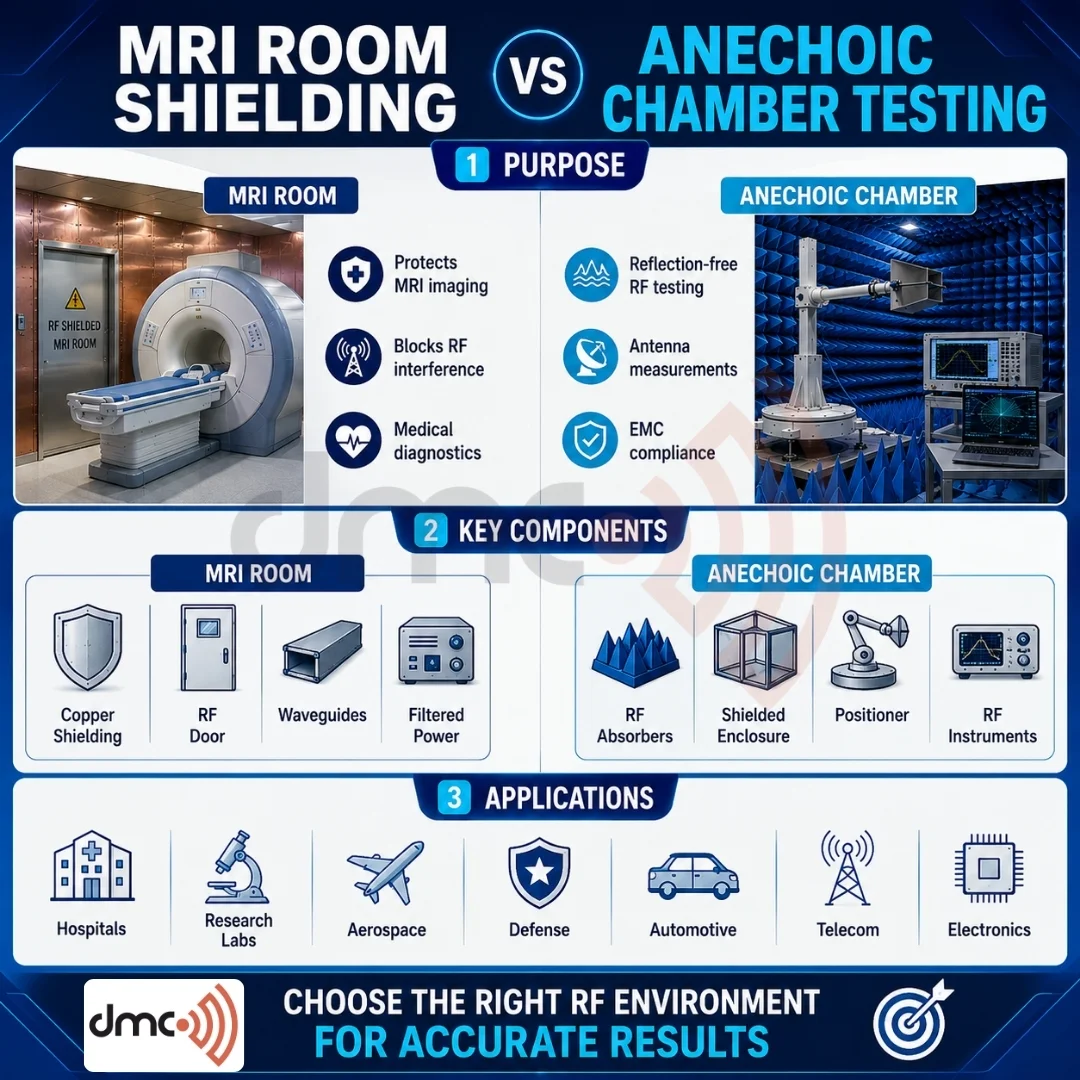
Key components include:
- RF shielded walls
- RF ceiling
- RF floor
- Shielded penetration panels
- Filtered electrical connections
- RF doors
- Observation windows with shielding mesh
The goal is maintaining signal purity for diagnostic imaging.
How Anechoic Chambers Work
RF Shielding
The chamber blocks external electromagnetic interference using conductive metallic construction.
RF Absorption
Large RF absorbers convert electromagnetic waves into heat energy instead of reflecting them.
This creates an environment that closely resembles open-space measurements.
Benefits include:
- Reflection-free testing
- Repeatable measurements
- High measurement accuracy
- International standard compliance
Industries Using MRI Shielding
MRI shielding is primarily used in:
- Hospitals
- Medical imaging centers
- Diagnostic laboratories
- Research hospitals
- Medical universities
Its focus remains patient diagnosis and medical imaging quality.
Industries Using Anechoic Chambers
Anechoic chambers serve many high-technology industries.
These include:
- Aerospace
- Defense
- Telecommunications
- Automotive
- Electronics manufacturing
- Satellite communication
- IoT development
- Consumer electronics
- Research laboratories
- Government testing agencies
Shielding Materials Comparison
| Component | MRI Room | Anechoic Chamber |
|---|---|---|
| Copper Shielding | ✔ | Sometimes |
| Steel Shielding | Sometimes | ✔ |
| Aluminum Panels | ✔ | ✔ |
| RF Absorbers | ✘ | ✔ |
| Ferrite Tiles | ✘ | ✔ (EMC Chambers) |
| Polyurethane Absorbers | ✘ | ✔ |
| Hybrid Absorbers | ✘ | ✔ |
Testing Applications
MRI Room
- Medical imaging
- Brain scans
- Spine imaging
- Cardiac imaging
- Orthopedic diagnosis
Anechoic Chamber
- Antenna measurements
- OTA testing
- EMC compliance
- Radar testing
- 5G testing
- 6G research
- Satellite antenna evaluation
- Automotive radar validation
Measurement Accuracy
MRI image quality depends on:
- RF isolation
- Magnetic field stability
- Noise reduction
Anechoic chamber accuracy depends on:
- Reflection suppression
- Chamber calibration
- Positioner precision
- RF absorber performance
- Instrument calibration
Standards Followed
MRI shielding commonly aligns with healthcare installation requirements and manufacturer specifications.
Anechoic chambers are often designed to support internationally recognized EMC and antenna testing standards, including:
- IEC standards
- CISPR standards
- MIL-STD requirements
- IEEE antenna measurement practices
- ISO automotive EMC standards
The exact standards depend on the intended application and customer requirements.
Installation Complexity
MRI installations require:
- Hospital integration
- Medical equipment coordination
- Magnetic shielding considerations
- RF shielding verification
Anechoic chamber installations require:
- Civil engineering preparation
- Precision chamber assembly
- RF absorber installation
- Positioner integration
- Instrument setup
- Chamber calibration
Cost Considerations
Several factors influence project cost.
MRI Shielding Cost Factors
- Room size
- Shielding material
- RF door quality
- Penetration count
- HVAC integration
- Medical equipment requirements
Anechoic Chamber Cost Factors
- Chamber dimensions
- Frequency range
- RF absorber type
- Positioner capability
- Automation level
- Measurement instruments
- Compliance standards
Because every project has unique technical requirements, costs are typically determined after evaluating the application, performance targets, and installation scope.
Advantages of MRI Room Shielding
- High-quality diagnostic imaging
- Reduced RF interference
- Better patient outcomes
- Reliable medical operation
- Long service life
Advantages of Anechoic Chambers
- Highly accurate RF measurements
- Reflection-free environment
- EMC compliance testing
- Antenna characterization
- OTA validation
- Repeatable test results
- Support for advanced wireless technologies
Choosing the Right Solution
Choose MRI room shielding if you need:
- Medical imaging
- Diagnostic scanning
- Hospital installation
- Healthcare compliance
Choose an anechoic chamber if you require:
- RF measurements
- Antenna testing
- EMC compliance
- Wireless device validation
- Aerospace testing
- Defense applications
- Research and development
Pro Tip
Never substitute an MRI shielded room for an anechoic chamber, or vice versa. While both use RF shielding, only an anechoic chamber incorporates RF absorbers to create a reflection-free environment required for precise antenna and EMC testing. Selecting the correct facility ensures accurate results, regulatory compliance, and optimal system performance.
Conclusion
Understanding the differences between MRI Room Shielding vs Anechoic Chamber Testing is essential when planning a medical imaging facility or an RF testing laboratory. Although both environments rely on electromagnetic shielding, their design philosophies, construction methods, and applications are fundamentally different. MRI rooms prioritize clean diagnostic imaging by blocking external interference, while anechoic chambers combine shielding with RF absorption to deliver highly accurate, reflection-free testing conditions.
Diamond Microwave Chambers Ltd designs and manufactures advanced RF testing solutions, including anechoic chambers, RF shielded enclosures, RF absorbers, and customized measurement systems tailored to research, aerospace, defense, telecommunications, and EMC applications. Selecting the appropriate solution based on your operational needs is key to achieving reliable, repeatable, and standards-compliant performance.
Frequently Asked Questions
MRI room shielding protects medical imaging equipment from external RF interference, while anechoic chambers provide a reflection-free environment for accurate RF, antenna, and EMC testing.
No. MRI shielded rooms do not contain RF absorbers required to eliminate signal reflections, making them unsuitable for precision antenna measurements.
RF absorbers convert electromagnetic waves into heat energy, preventing reflections and enabling accurate, repeatable testing under free-space conditions.
Aerospace, defense, telecommunications, automotive, electronics, satellite communications, IoT development, and research laboratories frequently use anechoic chambers.
Yes. Diamond Microwave Chambers Ltd offers customized anechoic chambers, RF shielded enclosures, RF absorbers, and complete antenna measurement solutions designed to meet specific testing requirements.