
Table of Contents
- How much does an antenna measurement system cost in 2026?
- Major Factors That Affect Antenna Measurement System Cost
- Which Industries Invest in Antenna Measurement Systems?
As wireless technologies continue to evolve, antenna performance has become more important than ever. Industries working with 5G, satellite communication, aerospace, automotive radar, IoT, defense, and wireless devices require highly accurate antenna measurements to validate product performance before launch. An Antenna Measurement System combines an RF chamber, precision positioning equipment, measurement instruments, software, and automation to evaluate antenna characteristics such as gain, radiation pattern, efficiency, polarization, beamwidth, and directivity.
One of the most common questions asked by research laboratories, manufacturers, and testing facilities is:
How much does an antenna measurement system cost in 2026?
The response is contingent upon several operational and technological aspects. Rather than offering a single price, it is more practical to understand what contributes to the total investment.
This guide from Diamond Microwave Chambers Ltd explains realistic pricing expectations, major cost drivers, different system types, and how organizations can choose the right solution.
What Is an Antenna Measurement System?
An antenna measurement system is a specialized testing environment designed to evaluate antenna performance under controlled RF conditions.
A complete system generally includes:
- RF Anechoic Chamber
- Precision Positioner
- Turntable
- Antenna Mast
- Vector Network Analyzer (VNA)
- RF Cables
- Measurement Software
- Automation Controller
- Calibration Equipment
- Safety Accessories
Each component contributes to the overall system cost and testing accuracy.
Typical Antenna Measurement System Cost in 2026
The overall investment varies significantly depending on testing requirements.
| System Type | Typical Applications | Estimated Investment |
|---|---|---|
| Entry-Level Compact System | Universities, R&D Labs | Lower Cost |
| Standard Near-Field System | Electronics Manufacturers | Medium Investment |
| Far-Field Outdoor Range | Large Antenna Testing | High Investment |
| Compact Antenna Test Range (CATR) | Aerospace & Defense | Premium Investment |
| Automotive Radar OTA Facility | Automotive Industry | Enterprise-Level Investment |
Rather than focusing only on purchase price, buyers should evaluate the complete project scope, long-term maintenance, automation needs, and future expansion.
Major Factors That Affect Antenna Measurement System Cost
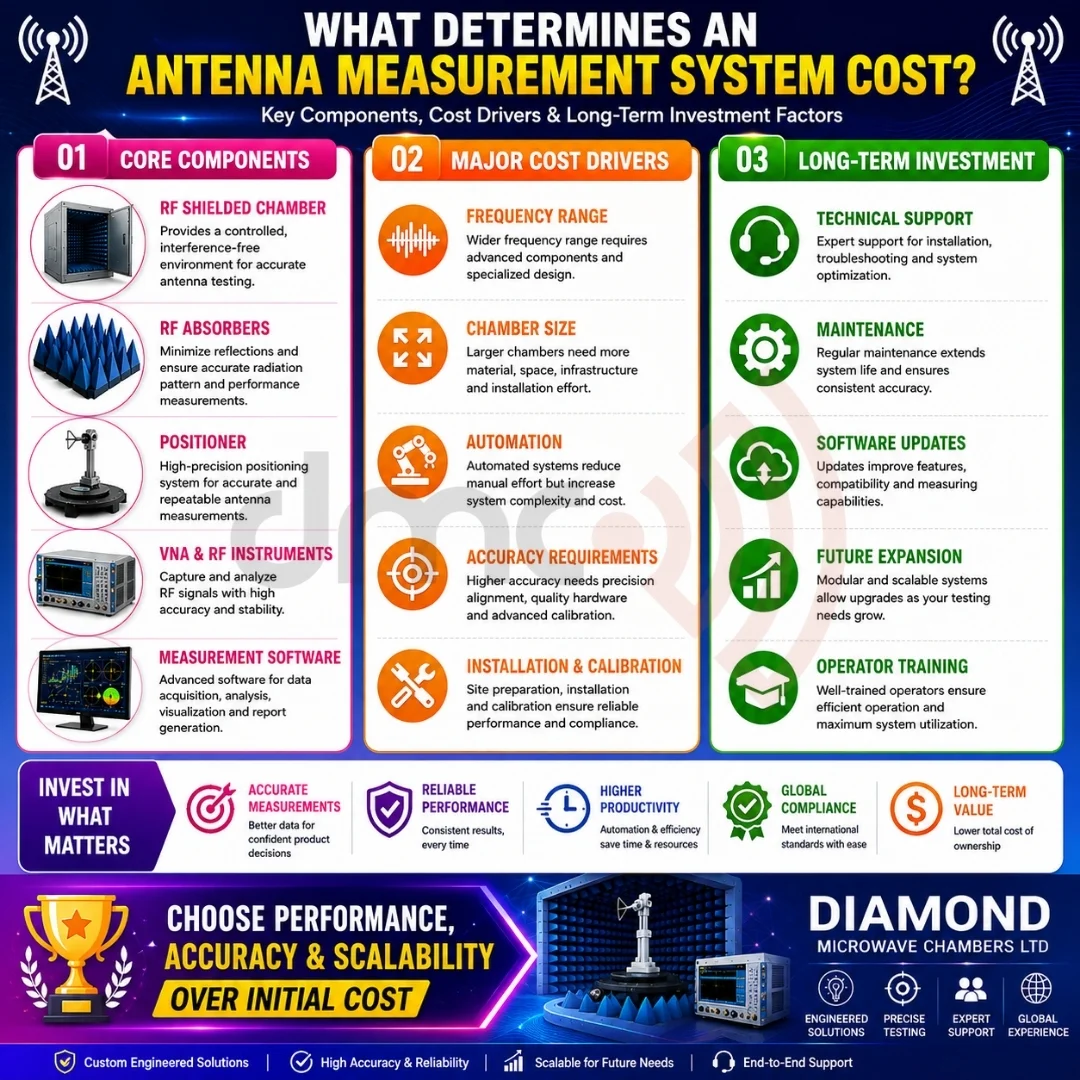
Several elements influence the final project budget.
1. Chamber Size
Larger chambers require:
- More RF absorbers
- Additional shielding
- Larger structures
- Higher installation effort
This naturally increases the investment.
2. Frequency Range
Testing from 700 MHz differs significantly from testing at 40 GHz, 60 GHz, or higher frequencies.
Higher-frequency systems require:
- Better absorber performance
- Higher precision
- Improved alignment
- Specialized components
These requirements increase system complexity.
3. Measurement Method
Different testing approaches have different infrastructure requirements.
Common options include:
- Near Field Measurement
- Far Field Measurement
- Compact Antenna Test Range (CATR)
- Cylindrical Scanning
- Spherical Scanning
- Planar Scanning
Each method requires different positioning systems and software capabilities.
4. Positioning Accuracy
Modern antenna systems use robotic positioners capable of extremely precise movement.
Higher positioning accuracy improves:
- Measurement repeatability
- Automation
- Production efficiency
However, higher precision also increases equipment cost.
5. Automation Software
Modern testing facilities often require:
- Automatic test sequences
- Report generation
- Data visualization
- Remote monitoring
- Instrument integration
Advanced software improves productivity but also adds to the project cost.
6. RF Instrumentation
Instrumentation may include:
- Vector Network Analyzer
- Spectrum Analyzer
- Signal Generator
- Power Meter
- RF Switch Matrix
The selected instrument models and performance specifications significantly influence the total investment.
Additional Costs Often Overlooked
Many buyers focus only on equipment pricing while overlooking associated expenses.
These may include:
- Site preparation
- Electrical infrastructure
- HVAC systems
- Installation
- Calibration
- Operator training
- Annual maintenance
- Software upgrades
- Spare parts
- Preventive servicing
Planning for these items helps avoid unexpected costs later.
Which Industries Invest in Antenna Measurement Systems?
Many industries rely on accurate antenna testing.
Examples include:
- Aerospace
- Defense
- Telecommunications
- Automotive
- Consumer Electronics
- Satellite Communication
- Research Institutions
- Universities
- Semiconductor Companies
- IoT Device Manufacturers
Each industry has unique testing requirements, which influence system selection.
Benefits of Investing in a Quality Measurement System
A professionally designed antenna measurement system offers long-term operational value.
Key benefits include:
- Higher measurement accuracy
- Faster product validation
- Better compliance with international standards
- Reduced testing errors
- Improved product quality
- Increased laboratory productivity
- Long-term scalability
- Lower operational downtime
Although the initial investment may seem significant, reliable testing often reduces costly product redesigns and repeated validation efforts.
How to Choose the Right Antenna Measurement System
Selecting the right system requires more than comparing prices.
Consider the following:
- Current testing requirements
- Future frequency expansion
- Available laboratory space
- Automation requirements
- Required measurement accuracy
- Industry standards
- Calibration requirements
- Maintenance support
- Software compatibility
- Vendor experience
A complete technical evaluation helps ensure the system aligns with both present and future testing needs.
Pro Tip
Don’t choose an antenna measurement system based solely on the lowest purchase price. Evaluate the complete lifecycle cost—including installation, calibration, maintenance, software updates, future upgrades, and technical support—to ensure long-term performance and return on investment.
The Antenna Measurement System Cost in 2026 depends on technical specifications, chamber size, frequency range, automation level, measurement method, and testing objectives. There is no universal price because every laboratory has unique operational requirements.
Instead of focusing only on initial investment, organizations should evaluate long-term performance, measurement accuracy, scalability, maintenance, and engineering support.
With careful planning and the right technology partner, businesses can build a testing environment that supports innovation, compliance, and reliable product development for years to come.
Frequently Asked Questions
The main factors include chamber size, frequency range, measurement technique, automation level, RF instruments, positioning accuracy, and installation requirements.
Yes. Compact systems are available for universities, startups, and R&D labs with lower testing capacity while still providing reliable measurements.
Industries such as telecommunications, aerospace, defense, automotive, electronics, satellite communications, and academic research frequently use these systems.
Many modern systems are modular and can be expanded with additional instruments, software features, higher-frequency support, or larger chambers depending on future requirements.
Professional support helps with installation, calibration, training, maintenance, troubleshooting, and future upgrades, ensuring consistent testing performance over the system’s lifetime.