

Table of Contents
- What is EMC Pre-Compliance Testing?
- Why Near-Field Probes Are Essential
- How Near-Field Probe Testing Works
- Common EMI Issues Identified
Electromagnetic Compatibility (EMC) plays a vital role in modern electronic product development. As
electronic devices become more compact and complex, the risk of electromagnetic interference (EMI) increases
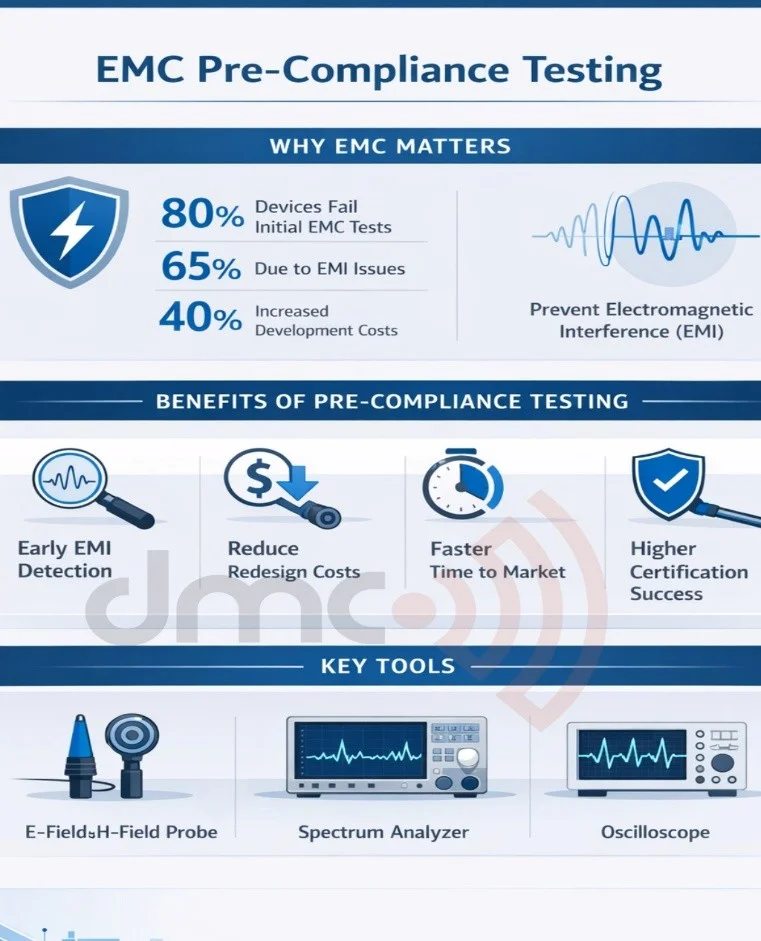
significantly. To avoid costly failures during final certification, engineers rely on EMC pre-compliance testing using near-field probes to identify issues early in the design phase.
Pre-compliance testing acts as a preventive approach, allowing designers to analyze and fix EMI problems
before sending products to certified labs. This not only reduces development costs but also speeds up
time-to-market.
What is EMC Pre-Compliance Testing?
EMC pre-compliance testing is an early-stage evaluation process used to check whether a device is likely
to meet electromagnetic compatibility standards. It is not a replacement for official compliance testing
but serves as a crucial step before final validation.
This testing approach helps engineers:
- Detect EMI issues during product development
- Avoid expensive redesign after certification failure
- Improve overall product performance
- Ensure smoother compliance testing outcomes
By integrating pre-compliance testing into the design cycle, companies can significantly reduce risks
associated with EMC failures.
Understanding Near-Field Probes
Near-field probes are specialized diagnostic tools used to measure electromagnetic fields close to the
source of emission. These probes are typically used at very short distances—often just a few millimeters
from the PCB or electronic components.
There are two primary types of near-field probes:
- Magnetic field probes (H-field probes)
- Detect current flow and magnetic emissions
- Ideal for identifying loop currents and switching noise
- Electric field probes (E-field probes)
- Detect voltage-related emissions
- Useful for tracing signal leakage and high-voltage areas
These probes provide localized measurements, making it easier to pinpoint the exact source of EMI within
a circuit.
Why Near-Field Probes Are Essential
Near-field probes offer a level of precision and flexibility that traditional testing methods cannot match. They are especially valuable during the design and debugging stages of product development.
- Accurate identification of EMI sources
- Real-time signal monitoring and analysis
- Faster debugging and troubleshooting
- Reduced need for repeated lab testing
- Cost-effective testing solution
With these benefits, engineers can quickly identify problem areas and implement design improvements
efficiently.
How Near-Field Probe Testing Works
Near-field probe testing involves scanning the surface of a PCB or device while monitoring
electromagnetic emissions using measurement instruments like a spectrum analyzer.
- Powering the device under test (DUT)
- Scanning different areas of the PCB using probes
- Capturing emission signals at various frequencies
- Analyzing signal strength and patterns
- Identifying noise sources and problematic components
- Applying corrective design changes
This step-by-step approach helps engineers visualize EMI behavior and make informed decisions.
Applications of Near-Field Probes
Near-field probes are widely used across different industries and electronic applications. Their
versatility makes them an essential tool for engineers working on various technologies.
- PCB design validation and debugging
- High-speed digital circuit analysis
- RF and wireless communication testing
- Power electronics and SMPS analysis
- Automotive electronics systems
- IoT and embedded device development
These probes are particularly useful in environments where precision and early detection are critical.
Near-Field vs Far-Field Testing
Understanding the difference between near-field and far-field testing is important for effective EMC
analysis. Both methods serve different purposes but complement each other in the testing process.
| Feature | Near-Field Testing | Far-Field Testing |
|---|---|---|
| Distance | Very close to source | Several meters away |
| Purpose | Debugging and diagnosis | Compliance certification |
| Accuracy | High (localized) | Broad (overall emissions) |
| Cost | Low | High |
| Stage | Design phase | Final testing phase |
Near-field testing focuses on identifying the root cause of EMI, while far-field testing ensures
compliance with regulatory standards.
Common EMI Issues Identified
Using near-field probes, engineers can detect a wide range of electromagnetic interference issues that
may affect device performance.
- High-frequency noise from switching regulators
- Signal integrity issues in high-speed circuits
- Poor grounding and improper PCB layout
- Crosstalk between adjacent traces
- Power supply fluctuations and noise
Early detection of these issues helps in minimizing performance degradation and avoiding compliance
failures.
Best Practices for Accurate Testing
To achieve reliable and consistent results, it is important to follow proper testing practices when
using near-field probes.
- Maintain proper grounding during testing
- Focus on high-speed components and clock lines
- Test the device under real operating conditions
- Use calibrated measurement equipment
- Document observations for future improvements
Following these practices ensures more accurate EMI analysis and better design optimization.
Pro Tip
Always begin testing around high-frequency components such as processors, clock circuits, and switching
power supplies. These areas are the most common sources of EMI and identifying issues here first can
significantly reduce debugging time.
Tools Required for Testing
To perform effective EMC pre-compliance testing using near-field probes, engineers need the right set of
tools and equipment.
- Near-field probe set (E-field and H-field probes)
- Spectrum analyzer for frequency analysis
- Oscilloscope for time-domain signals
- EMI receiver (optional for advanced testing)
- Shielded environment to reduce external noise
Having the right tools ensures accurate measurements and reliable results.
EMC pre-compliance testing using near-field probes is a powerful technique that helps engineers detect
and resolve EMI issues early in the design phase. By combining detailed analysis with practical debugging, this method improves product quality and increases the likelihood of passing final compliance
tests.
Incorporating near-field probe testing into your workflow not only reduces costs but also enhances product reliability and performance. As electronic systems continue to evolve, adopting proactive EMC strategies is essential for staying competitive in the industry.
Frequently Asked Questions
It is an early-stage testing method used to identify EMI issues before official certification.
They help locate the exact source of electromagnetic interference in a circuit.
There are two types: E-field probes and H-field probes.
No, it is only used for debugging and pre-compliance, not official certification.
It reduces costs, saves time, and improves product performance.