

Table of Contents
- What is a Planar Near-Field System?
- What is a Spherical Near-Field System?
- Planar vs Spherical Near-Field: Key Differences
- Advantages of Planar Near-Field Systems
- How to Choose the Right Near-Field System
Planar systems are generally best for highly directive, electrically large antennas, while spherical systems offer superior, full-sphere accuracy for low-to-moderate gain antennas, sidelobe analysis, and smaller devices. In today’s advanced RF and wireless ecosystem, antenna measurement accuracy plays a critical role in ensuring system performance. Whether you’re working on 5G antenna testing, radar systems, or satellite communication, selecting the right near-field measurement technique is essential.
Two dominant methods— planar near-field systems and spherical near-field systems—are widely used for antenna characterization and radiation pattern analysis. Both rely on near-field scanning and far-field transformation, but they differ in coverage, complexity, and application.
This guide provides a detailed comparison to help you choose the right RF measurement system for your needs.
What is a Planar Near-Field System?
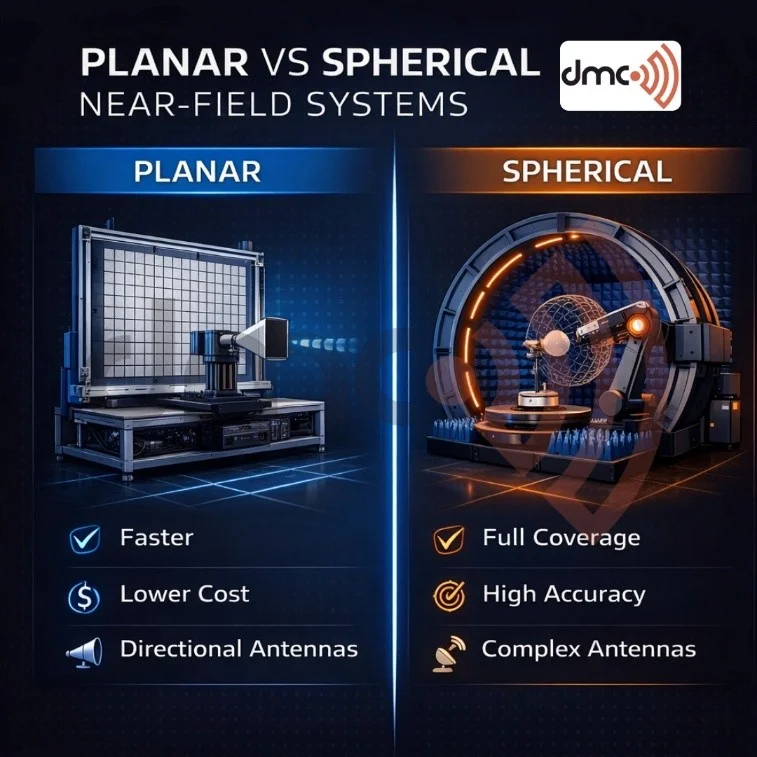
A planar near-field system (PNF) measures the electromagnetic field over a flat scanning surface positioned in front of the antenna. This method captures data across a 2D grid and converts it into far-field results using mathematical transformations.
Planar systems are highly effective for directional antennas, where radiation is concentrated in a single direction. They are commonly used in controlled environments where fast and repeatable antenna testing is required.
Key Features of Planar Near-Field Systems
- 2D scanning (X-Y plane)
- Optimized for narrow beam antennas
- Faster measurement and data acquisition
- Lower system complexity
Planar systems are widely used in RF testing equipment setups where antenna radiation patterns are predictable and focused.
What is a Spherical Near-Field System?
A spherical near-field system (SNF) measures electromagnetic fields over a spherical surface surrounding the antenna. This enables full 3D data collection, capturing radiation patterns in all directions.
This method is essential for antenna measurement techniques involving complex designs, such as 5G antennas, MIMO systems, and IoT devices.
Key Features of Spherical Near-Field Systems
- Full angular scanning (θ and φ)
- Complete radiation pattern measurement
- High accuracy for complex antennas
- Advanced data processing requirements
Spherical systems are critical for antenna characterization in modern wireless communication systems.
Planar vs Spherical Near-Field: Key Differences
| Feature | Planar Near-Field System | Spherical Near-Field System |
|---|---|---|
| Measurement Technique | Flat surface scanning | Spherical scanning |
| Radiation Coverage | Partial (forward direction) | Full 360° |
| Antenna Type | Directional | Omnidirectional / complex |
| Measurement Speed | Faster | Slower |
| Accuracy | Moderate | High |
| Data Processing | Simpler | Complex |
| Cost | Lower | Higher |
Advantages of Planar Near-Field Systems
Planar near-field systems are ideal for applications where speed, simplicity, and cost efficiency are priorities. They are widely used in production testing environments where antennas have predictable radiation patterns.
Benefits
- Faster near-field scanning and reduced testing time
- Lower cost RF measurement setup
- Easy integration into existing antenna testing systems
- Minimal computational overhead
Despite these advantages, planar systems may not fully capture wide-angle electromagnetic behavior, especially in advanced antenna designs.
Advantages of Spherical Near-Field Systems
Spherical systems provide a complete understanding of antenna radiation patterns, making them essential for high-precision applications.
They are particularly valuable in industries where full angular measurement and regulatory compliance testing are required.
Benefits
- Complete 3D antenna radiation pattern analysis
- High accuracy for complex RF systems
- Ideal for 5G, automotive radar, and IoT antennas
- Supports advanced antenna measurement techniques
The trade-off is increased system complexity and longer measurement cycles.
Limitations of Each System
Understanding limitations is crucial when selecting the right antenna measurement solution.
Planar Near-Field Limitations
- Limited angular coverage
- Less effective for omnidirectional antennas
- Potential approximation errors in far-field transformation
Spherical Near-Field Limitations
- Higher equipment and setup cost
- Longer scanning and processing time
- Requires skilled operation
Real-World Applications
Different industries adopt these systems based on their RF testing requirements and antenna designs.
Planar Near-Field Applications
- Satellite communication antennas
- Radar systems
- High-gain directional antennas
Spherical Near-Field Applications
- 5G antenna testing and validation
- Automotive radar and ADAS systems
- IoT and smart device antennas
These use cases highlight the importance of choosing the right antenna testing method based on real-world needs.
How to Choose the Right Near-Field System
Selecting between planar and spherical systems depends on multiple technical and operational factors. The decision should align with both current requirements and future scalability.
Key Decision Factors
- Type of antenna (directional vs omnidirectional)
- Required accuracy of radiation pattern measurement
- Budget for RF measurement systems
- Complexity of antenna design
- Future expansion into advanced wireless technologies
A well-informed choice ensures better performance, reduced costs, and long-term efficiency.
Pro Tip
For businesses working on next-generation wireless technologies, investing in a spherical near-field system early can provide long-term advantages. It ensures compatibility with evolving standards like 5G and beyond, reducing the need for future upgrades.
Both planar and spherical near-field systems are essential tools in antenna measurement and RF testing. The choice ultimately depends on whether you prioritize speed and simplicity or accuracy and full coverage.
- Choose planar near-field systems for fast, cost-effective testing
- Choose spherical near-field systems for complete and precise analysis
By aligning your selection with your application and future goals, you can optimize both performance and investment.
Frequently Asked Questions
It is a method used to measure electromagnetic fields close to the antenna and convert them into far-field radiation patterns.
Planar is better for directional antennas, while spherical is ideal for complex and omnidirectional antennas.
Because it captures full 3D radiation data, ensuring complete antenna characterization.
Yes, planar systems are faster due to limited scanning area.
Spherical near-field systems are preferred due to their ability to measure complex radiation patterns.