
Table of Contents
- What Is Drone RCS and Why Does It Matter?
- What Equipment Does an RCS Chamber Need
- Which Measurement Setup Should You Use
- What Affects the Accuracy of Drone RCS Results
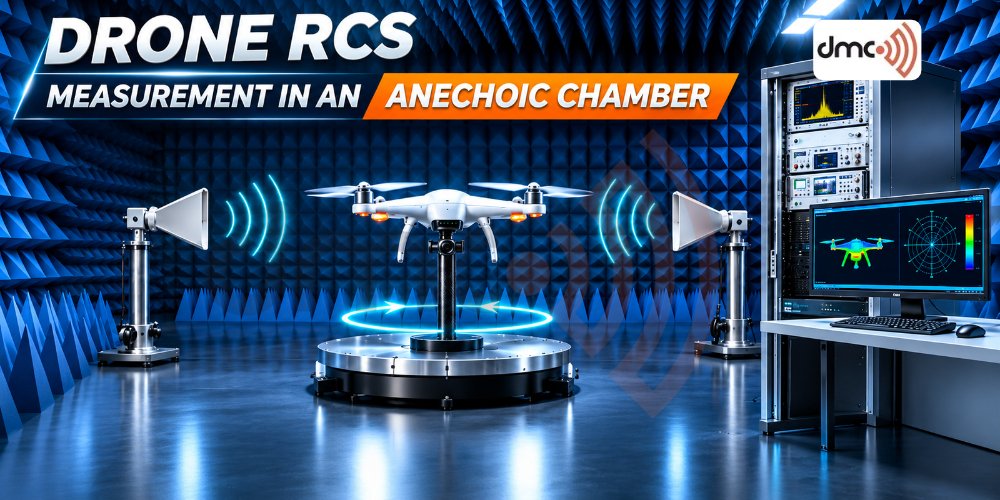
Drone radar cross section is measured by mounting the drone on a low-reflectivity positioner inside an anechoic chamber, sending a known radar signal at it, and recording how much energy scatters back at each angle. The result is given in square metres or dBsm. It shows how visible the drone is to radar. Small drones return very little energy, so even minor reflections from the room can ruin the data.
What Is Drone RCS and Why Does It Matter?
Radar cross section describes how strongly a target reflects radar energy toward the receiver. A small quadcopter can have an RCS of around 0.01 m² or less, which is close to a bird. That is why detection systems struggle to tell the two apart.
Accurate RCS measurement helps three groups:
- Counter-drone developers tune detection and classification algorithms against real signatures.
- Drone manufacturers check how materials, battery placement and propeller design change visibility.
- Defence and airspace researchers build signature libraries for different drone types.
Why Is an Anechoic Chamber Used for RCS Testing?
Outdoor ranges bring wind, weather, ground clutter and interference. An anechoic chamber removes those problems. Its walls, floor and ceiling are covered with radar absorbing material, usually pyramidal foam, which soaks up stray reflections so the receiver sees only the drone.
The chamber also provides a clean quiet zone, the region where the incoming wave is uniform enough to treat as a plane wave. The drone sits inside this zone during drone RCS testing. If the zone is poor, the measured signature will not match real-world behaviour.
What Equipment Does an RCS Chamber Need?
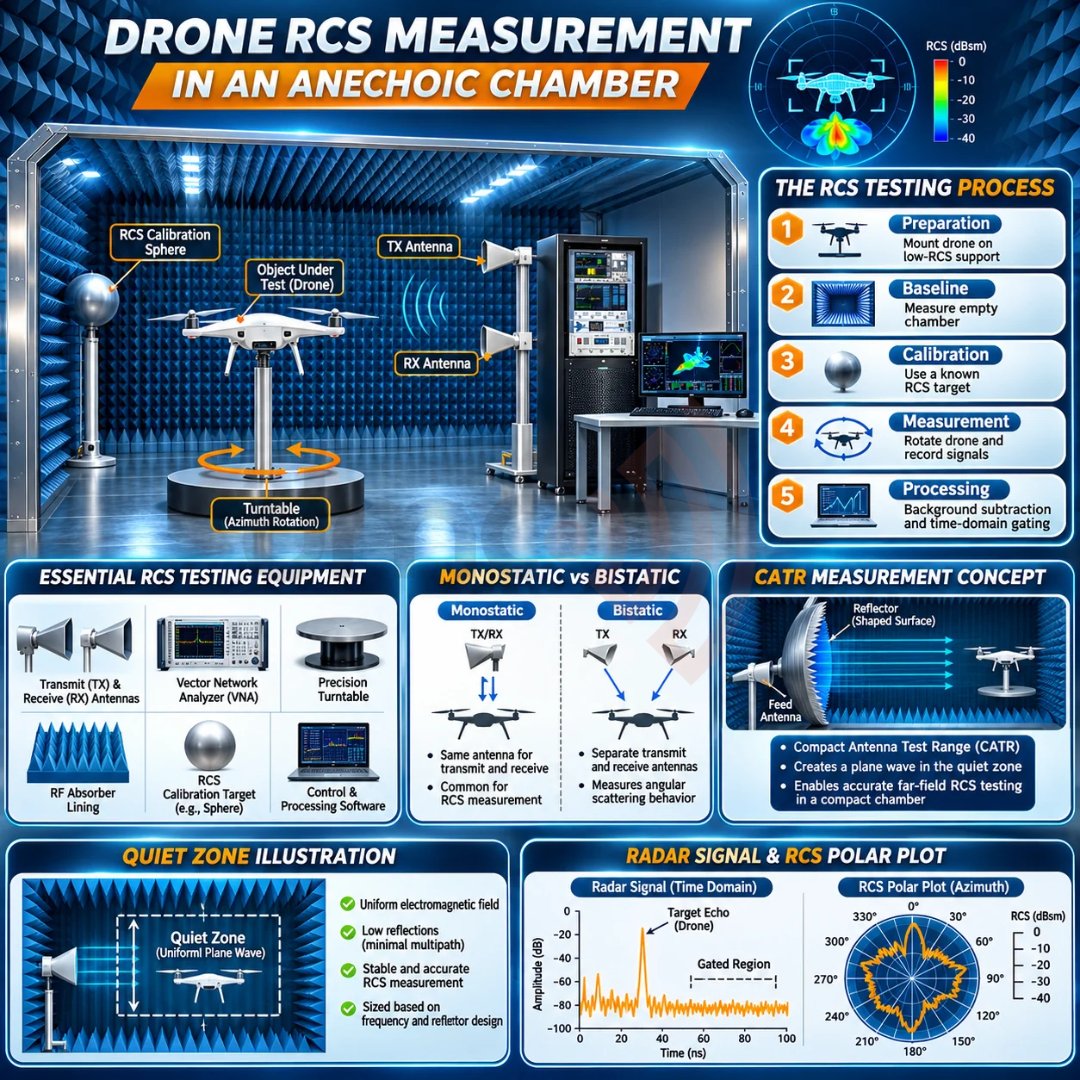
A typical setup has five main parts:
- 1. Transmit and receive antennas. Horn antennas are common for X-band and Ku-band work.
- 2. Vector network analyzer. A vector network analyzer sends the swept signal and records both amplitude and phase of the return.
- 3. Positioner. A rotating azimuth stage, sometimes with elevation control, turns the drone through all viewing angles.
- 4. Low-RCS support. Foam columns or fine nylon lines hold the drone with minimal reflection of their own.
- 5. Calibration target. A calibration target with a known RCS, such as a metal sphere or flat plate, sets the reference level.
Some labs use a compact antenna test range (CATR). It uses a reflector to create a plane wave over a short distance, which suits small chambers where true far-field distance cannot be reached.
How Is Drone RCS Measured Step by Step?
1. Prepare the chamber and the drone
Power down the drone and remove anything loose. Mount it on the foam support so its orientation matches the test plan. Check that no cables run into the quiet zone.
2. Measure the empty chamber
Run a sweep with no drone on the support. This captures residual reflections from the walls, support and antennas. It becomes the baseline for background subtraction later.
3. Measure the calibration target
Place the calibration target on the same support and record its response. Because its true RCS is known, you can scale every later measurement against it.
4. Rotate and record the drone
The positioner turns the drone in small steps, often 0.5° to 1°, while the analyzer sweeps across the chosen frequency band. This builds a full RCS pattern for each polarization, usually HH and VV.
5. Process the data
Software removes the empty-chamber baseline, applies time-domain gating to cut out late-arriving reflections, and converts the result into calibrated RCS values.
Which Measurement Setup Should You Use?
The right configuration depends on what you want to learn about the drone.
| Setup | How It Works | Best For | Main Limitation |
|---|---|---|---|
| Monostatic RCS | One antenna transmits and receives from the same position | Radar detection studies, signature libraries | Cannot show scattering in other directions |
| Bistatic RCS | Separate transmit and receive antennas at an angle | Multistatic radar, stealth and scattering studies | More complex alignment and calibration |
| CATR-based | Reflector creates a plane wave in a short range | Compact chambers, higher frequencies | Reflector edges can add diffraction errors |
| Far-field range | Antennas sit at full far-field distance | Large drones, low frequencies | Needs a very large chamber |
Most labs start with monostatic RCS, because it matches how a typical radar sees the drone. They add bistatic RCS tests when the project involves networked or passive radar.
Pro Tip: Always record the empty-chamber sweep and the calibration sweep on the same day, with the same cable positions and the same temperature. Cable flex and thermal drift can shift results by a fraction of a dB, and for a drone with an RCS near -20 dBsm, that is enough to blur the signature you are trying to measure.
What Affects the Accuracy of Drone RCS Results?
Four things cause most of the errors:
- Support reflections. If the foam column or line scatters more than the drone, the result is meaningless. Choose the lightest, lowest-RCS support that holds the drone steady.
- Quiet zone quality. The drone must fit well inside the uniform region. Larger drones may need a bigger chamber or a CATR.
- Frequency choice. A drone’s signature changes with frequency, so test the bands your radar will actually use.
- Moving parts. Rotating propellers add a micro-Doppler signature that a static test misses. Some labs run a second test with the rotors spinning to capture it.
Material also matters. Carbon fibre frames reflect differently from plastic ones, and metal motors and batteries often dominate the return. That is why two drones of the same size can have very different RCS values.
Final Thoughts
Measuring drone radar cross section in a chamber comes down to clean reflections, careful calibration and consistent processing. A well-built anechoic chambers, a calibrated vector network analyzer and a low-reflectivity support give you repeatable data that radar teams can trust. If you are planning a drone RCS testing setup, start with the frequency band and the angles that matter most, then pick the chamber and range type to match.
Frequently Asked Questions
Drone RCS is a measure of how much radar energy a drone reflects back to the radar, given in m² or dBsm. A lower value means the drone is harder to detect.
It absorbs stray reflections and blocks outside interference, so the receiver records only the drone’s own scattering.
Monostatic RCS uses one antenna position for transmit and receive. Bistatic RCS uses separate positions at an angle, showing how the drone scatters in other directions.
Yes. A CATR creates a plane wave over a short distance, which makes it useful when the chamber is too small for a full far-field setup.
With proper calibration, background subtraction and a low-reflectivity support, results are typically accurate to within 1 to 2 dB. Accuracy drops if the support or chamber reflections are not controlled.