
Table of Contents
- What is a Honeycomb Core?
- Why Honeycomb Core Is Used in Industrial Applications
- Applications of Honeycomb Core Across Industries
- Strength, Weight & ROI Breakdown Table
- ROI Breakdown: Why Industries Prefer Honeycomb Core
- Future of Honeycomb Core Technology
Industrial engineering has evolved rapidly, with manufacturers demanding materials that deliver high strength, low weight, thermal efficiency, and reduced long-term costs. One material that stands out across aerospace, construction, defense, transportation, and marine industries is the honeycomb core structure.
Inspired by natural honeycombs created by bees, these engineered cores offer an unmatched combination of strength-to-weight ratio, shock absorption, energy efficiency, and cost-effectiveness. This blog explores honeycomb core applications, performance characteristics, the science behind its strength, and the ROI it provides to industries worldwide.
What is a Honeycomb Core?
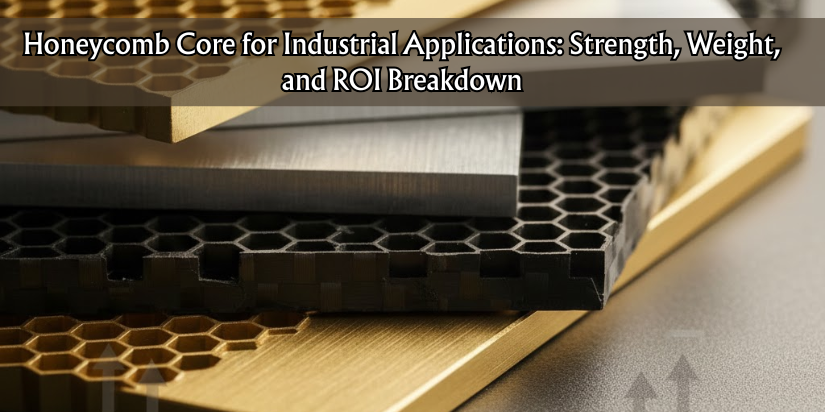
A honeycomb core is a lightweight structure composed of hexagonal cells, typically made from materials such as:
- Aluminum
- Nomex (Aramid Fiber)
- Paper/Kraft
- Thermoplastics
- Fiberglass (FRP)
These cells form a rigid yet lightweight geometry that is incredibly efficient at distributing load and resisting compression.
Why Honeycomb Core Is Used in Industrial Applications
Industries prefer honeycomb cores due to a combination of engineering and economic advantages:
1. Superior Strength-to-Weight Ratio
The hexagonal pattern distributes mechanical stress uniformly, allowing the core to handle high loads despite being lightweight.
2. Lightweight Construction
Reducing material weight improves:
- Vehicle fuel efficiency
- Aircraft payload capacity
- Ease of installation
- Reduced structural load on buildings
3. Excellent Compression & Shear Strength
Honeycomb cores resist:
- Out-of-plane compression
- Shear force
- Impact and vibration
This makes them ideal for aerospace panels, automotive crash structures, and marine flooring.
4. Energy Absorption
In industries like defense and automotive, honeycomb cores are used as impact energy absorbers, offering high protection during collisions or explosions.
5. Corrosion & Fire Resistance
Materials like aluminum and Nomex offer excellent resistance to:
- Corrosion
- Fire
- Moisture
- Chemicals
6. Customization & Versatility
Honeycomb cores can be manufactured in various:
- Densities
- Cell sizes
- Materials
- Thickness levels
This gives engineers flexibility based on performance requirements.
Applications of Honeycomb Core Across Industries
1. Aerospace
Honeycomb core is a standard material for:
- Aircraft floorboards
- Interior panels
- Rudders and wings
- Engine nacelles
Aerospace engineers rely on honeycomb because it saves fuel and increases payload capacity.
2. Building & Construction
Used in:
- Facade cladding
- Curtain walls
- Ceiling panels
- Cleanrooms
- Partition panels
Lightweight yet rigid panels reduce construction costs and improve seismic performance.
3. Marine Industry
Honeycomb panels help build:
- Boat hulls
- Decks
- Bulkheads
Resistant to moisture and corrosion, ideal for salty marine environments.
4. Automotive & EV Sector
Honeycomb cores are used for:
- Crash absorber structures
- Floor panels
- Roof panels
- Battery pack protection
EV manufacturers use honeycomb materials to reduce vehicle weight and increase range.
5. Defense & Security
Honeycomb structures serve as:
- Blast absorption panels
- Military vehicle floors
- Shielding panels
Nomex and aluminum variants offer high performance under extreme pressure.
6. Industrial Machinery
Applications include:
- Workstation tables
- Conveyor systems
- Machine enclosures
- Noise-insulation panels
Strength, Weight & ROI Breakdown Table
| Factor | Honeycomb Core Performance | Benefits | ROI Impact |
|---|---|---|---|
| Strength-to-Weight Ratio | Extremely high due to hexagonal geometry | Supports high loads without mass | Lower transport fuel cost; easier installation |
| Weight Reduction | Up to 80% lighter than solid panels | Reduced structural load | Lower material usage & labor cost |
| Compression Strength | Excellent out-of-plane strength | Ideal for structural panels | Longer life, fewer replacements |
| Shear Strength | High shear resistance | Stable under dynamic loads | Increased durability in aerospace & automotive |
| Corrosion / Fire Resistance | Aluminum & Nomex variants offer strong resistance | Suitable for harsh environments | Reduced maintenance cost |
| Customization | Variable cell size, density, thickness | Fits multiple industries | Higher efficiency in production |
| Cost Efficiency | Lower material usage with high performance | Economical alternative to solid materials | High long-term ROI |
ROI Breakdown: Why Industries Prefer Honeycomb Core
Industries achieve high ROI due to the following:
1. Reduced Weight = Lower Operational Costs
For aerospace, automotive, and marine sectors:
- Lower fuel consumption
- Higher payload capacity
- Reduced emissions penalties
2. Longer Material Life
Due to resistance to:
- Impact
- Moisture
- Fire
- Corrosion
This reduces maintenance and replacement costs significantly.
3. Easy Fabrication & Installation
Lightweight materials require:
- Less labor
- Reduced installation cost
- Faster project completion
4. Improved Safety & Performance
Impact absorption helps reduce injuries and vehicle damage in accidents.
5. High Durability in Extreme Environments
Suitable for industries demanding durability under:
- Heat
- Fire
- Vibration
- Marine exposure
Future of Honeycomb Core Technology
As industries shift toward lightweighting and green manufacturing, honeycomb core materials will continue to grow in demand. Emerging technologies include:
- 3D-printed honeycomb structures
- Bio-based honeycomb materials
- Enhanced fire-resistant honeycomb composites
- Nanotechnology-infused honeycomb cores
These innovations promise higher performance at reduced cost.
Top 5 FAQs
1. What materials are used to make honeycomb cores?
Common materials are aluminum, Nomex, paper, thermoplastic, and fiberglass, depending on the application.
2. Why is honeycomb core so strong despite being lightweight?
The hexagonal geometry distributes load evenly, increasing compression and shear strength.
3. Where is honeycomb core used most commonly?
Industries such as aerospace, construction, automotive, marine, defense, and cleanroom manufacturing use it heavily.
4. Is honeycomb core expensive?
Upfront cost may be higher than solid materials, but ROI is significantly better due to durability, weight savings, and low maintenance.
5. Can honeycomb core be customized?
Yes, cell size, density, thickness, and materials can be customized based on performance requirements.