

Table of Contents
- Understanding Absorber Geometry in Anechoic Chambersa>
- What Are Pyramidal Absorbers?
- What Are Planar (Flat) Absorbers?
- Application-Based Selection Guide
- Which Geometry Is Right for You?
Anechoic chambers are critical environments for accurate electromagnetic (EM) and acoustic testing. By eliminating unwanted reflections, they create a controlled “free-space” condition that allows engineers to measure antennas, wireless devices, radar systems, and acoustic equipment with high precision. At the heart of every anechoic chamber lies its absorber geometry—and the two most common designs are pyramidal absorbers and planar (flat) absorbers.
Choosing the right geometry is not merely an aesthetic or cost decision; it directly impacts performance, frequency coverage, chamber size, maintenance, and long-term reliability. This in-depth guide explores the differences between pyramidal and planar absorbers, their working principles, advantages, limitations, and practical selection criteria—helping you confidently choose the right solution for your anechoic chamber.
Understanding Absorber Geometry in Anechoic Chambers
Absorbers are engineered materials designed to attenuate incident electromagnetic or acoustic waves by converting them into heat. Geometry plays a crucial role because it determines:
- How waves interact with the surface
- The effective path length inside the absorber
- Reflection coefficient and return loss
- Performance across different frequency ranges
The two dominant geometries—pyramidal and planar—achieve absorption using different physical mechanisms.
What Are Pyramidal Absorbers?
Design and Structure
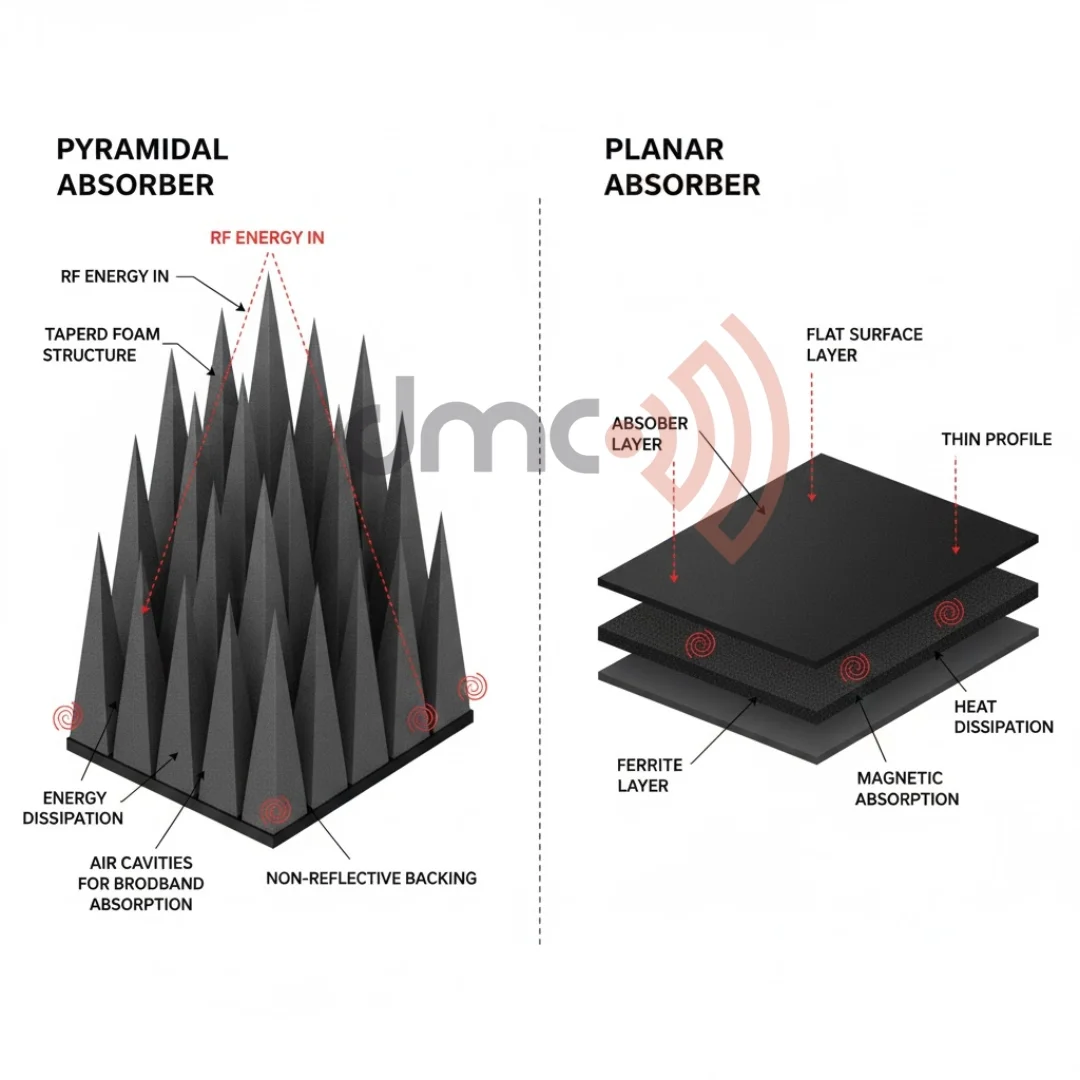
Pyramidal absorbers are three-dimensional, tapered structures shaped like cones or pyramids. They are typically manufactured from carbon-loaded foam or ferrite-backed materials and mounted across chamber walls, ceilings, and sometimes floors.
How They Work
When an electromagnetic wave strikes a pyramidal absorber:
- The wave enters gradually at the tip (low impedance mismatch).
- As it travels deeper, it encounters increasing lossy material.
- Multiple internal reflections occur within the pyramid’s geometry.
- Energy is progressively dissipated as heat, minimizing reflection back into the chamber.
Key Advantages of Pyramidal Absorbers
- Broadband Performance: Excellent absorption from low GHz to mmWave frequencies
- Low Reflectivity: Superior reflectivity performance due to gradual impedance transition
- High Measurement Accuracy: Ideal for antenna and EMC testing
- Established Standard: Widely acknowledged in compliance labs and research and development institutions.
Limitations
- Space Consumption: Requires significant depth, increasing chamber size
- Higher Cost: More material and complex fabrication
- Fragility: Foam pyramids can be damaged by physical contact or humidity
What Are Planar (Flat) Absorbers?
Design and Structure
Planar absorbers have a flat, uniform profile. They are typically constructed from ferrite tiles, rubber-based composites, or multilayer lossy sheets bonded to rigid panels.
How They Work
Planar absorbers rely on:
- Material loss (magnetic and dielectric)
- Resonant absorption at specific frequencies
- Reflection cancellation using backing structures
Unlike pyramidal absorbers, they do not rely on extended physical depth but instead on material composition and thickness.
Key Advantages of Planar Absorbers
- Space Efficient: Ideal for compact chambers and shielded enclosures
- Mechanical Durability: Robust and long-lasting
- Lower Maintenance: Easier cleaning and replacement
- Cost Effective (in some bands): Especially for mid- to high-frequency ranges
Limitations
- Narrower Bandwidth: Performance often optimized for specific frequency ranges
- Higher Reflection at Low Frequencies: Less effective without added thickness
- Design Sensitivity: Requires precise engineering for consistent results
Performance Comparison: Pyramidal vs. Planar
| Parameter | Pyramidal Absorbers | Planar Absorbers |
|---|---|---|
| Frequency Range | Very wide (broadband) | Moderate to targeted |
| Reflection Loss | Excellent (low reflectivity) | Good to moderate |
| Chamber Size Impact | Requires more depth | Compact design |
| Durability | Moderate | High |
| Installation Cost | Higher | Lower to moderate |
| Maintenance | Moderate | Low |
| Typical Applications | Antenna, EMC, OTA | Compact RF, shielded rooms |
Application-Based Selection Guide
Antenna Measurement Chambers
Pyramidal absorbers are generally preferred due to their low reflectivity and wideband characteristics. They provide highly uniform test zones, essential for radiation pattern and gain measurements.
EMC / EMI Testing
A hybrid approach is often used—ferrite planar tiles for low frequencies combined with pyramidal absorbers for higher frequencies—to meet regulatory standards.
Compact RF Test Enclosures
Planar absorbers are ideal where space is constrained and testing is limited to defined frequency bands.
Acoustic Anechoic Chambers
Pyramidal or wedge-shaped absorbers dominate due to their effectiveness in absorbing sound waves across wide audible ranges.
Hybrid Absorber Systems: Best of Both Worlds
Modern anechoic chambers increasingly adopt hybrid absorber configurations, combining:
- Ferrite planar tiles for low-frequency absorption
- Foam pyramidal absorbers for mid-to-high frequencies
Installation and Environmental Considerations
- Humidity Control: Foam pyramidal absorbers require controlled humidity to prevent degradation
- Fire Retardancy: Ensure materials meet safety standards
- Mounting Precision: Proper alignment is critical to avoid reflective gaps
- Floor Design: Walk-on absorber options or hybrid flooring may be required
Cost vs. Performance: Making the Right Investment
While pyramidal absorbers may carry higher upfront costs, they often deliver superior long-term value for precision testing. Planar absorbers, on the other hand, offer practical and economical solutions for targeted applications.
The true cost should be evaluated based on:
- Measurement accuracy requirements
- Available space
- Frequency range
- Long-term maintenance
Which Geometry Is Right for You?
There is no universal “best” absorber geometry—only the right choice for your application.
- Choose pyramidal absorbers if you need wideband performance, minimal reflections, and high-accuracy testing.
- Choose planar absorbers if space efficiency, durability, and targeted frequency performance are your priorities.
- Consider hybrid systems for optimal balance between performance and practicality.
By understanding the strengths and limitations of pyramidal and planar geometries, you can design an anechoic chamber that delivers reliable, repeatable, and standards-compliant results—now and into the future.
Frequently Asked Questions
1. What is the main difference between pyramidal and planar absorbers?
Pyramidal absorbers use a tapered shape to gradually absorb electromagnetic waves, offering superior low-frequency performance, while planar absorbers are flat and space-efficient, ideal for higher frequencies.
2. Which absorber geometry is better for low-frequency testing?
Pyramidal absorbers are better suited for low-frequency testing because their depth and shape provide higher absorption across a wider frequency range.
3. Are planar absorbers suitable for EMC testing chambers?
Yes, planar absorbers are commonly used in EMC chambers where space constraints, cost efficiency, and mid-to-high frequency performance are priorities.
4. How does chamber size affect absorber selection?
Smaller chambers often use planar absorbers to save space, while larger anechoic chambers typically use pyramidal absorbers to achieve better broadband absorption.
5. Can pyramidal and planar absorbers be used together?
Yes, many modern anechoic chambers use a hybrid approach—pyramidal absorbers on walls and planar absorbers on doors or tight spaces—to balance performance and cost.