
Table of Contents
- Understanding RF Anechoic Chambers
- What Is a Pre-Compliance RF Anechoic Chamber?
- What Is a Full-Compliance RF Anechoic Chamber?
- Pre-Compliance vs. Full-Compliance: A Side-by-Side Comparison
- Which RF Anechoic Chamber Do You Actually Need?
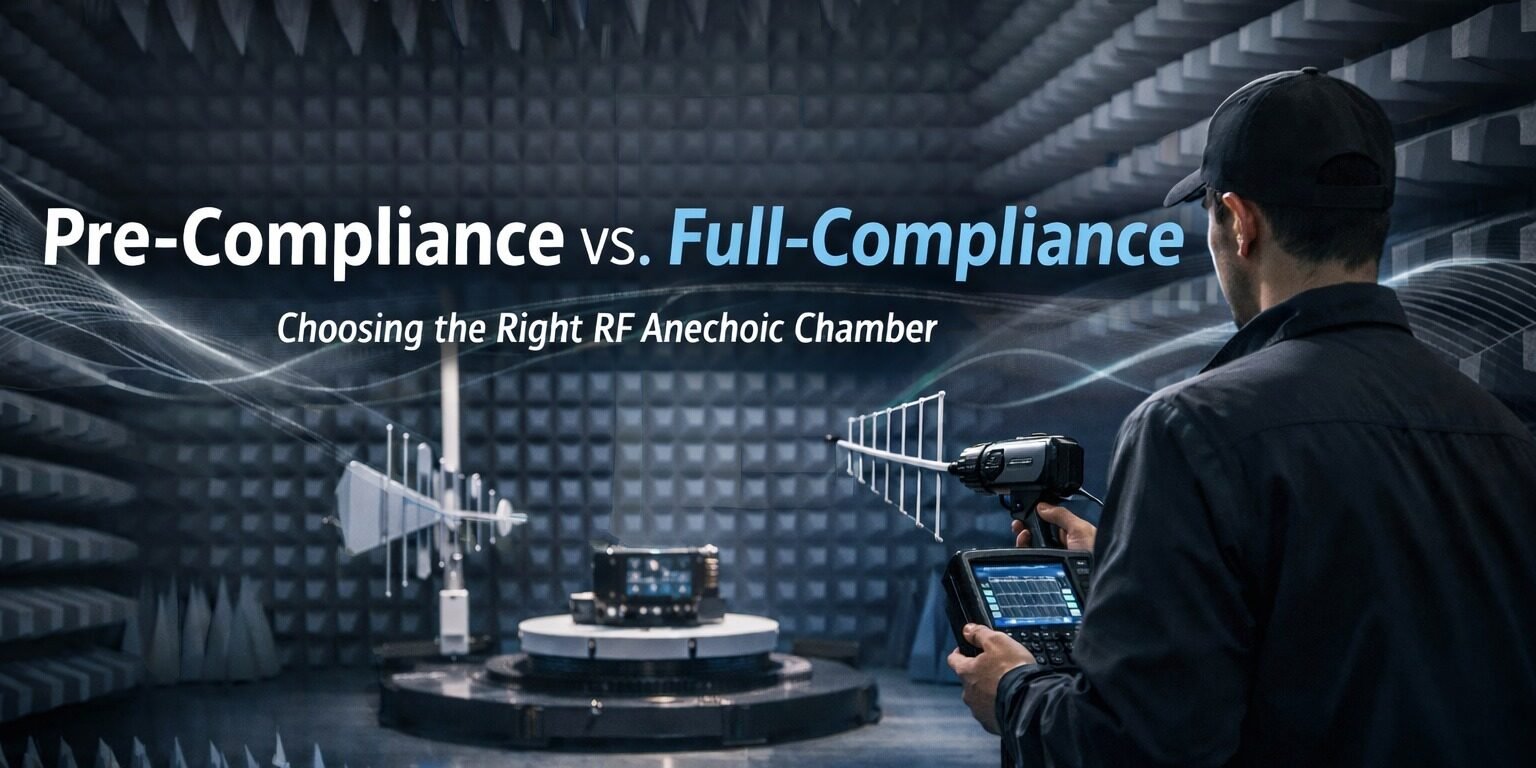
As electronic devices become faster, smaller, and more complex, electromagnetic compatibility (EMC) and radio frequency (RF) compliance are no longer optional—they are mandatory. From consumer electronics and automotive systems to medical devices and aerospace equipment, manufacturers must ensure their products meet regulatory standards before entering the market.At the heart of RF and EMC testing lies the RF Anechoic Chamber. However, not all chambers are built for the same purpose. The most common dilemma engineers and decision-makers face is choosing between a Pre-Compliance RF Anechoic Chamber and a Full-Compliance RF Anechoic Chamber.
At the heart of RF and EMC testing lies the RF Anechoic Chamber. However, not all chambers are built for the same purpose. The most common dilemma engineers and decision-makers face is choosing between a Pre-Compliance RF Anechoic Chamber and a Full-Compliance RF Anechoic Chamber.
This blog explains the differences in detail, compares costs and capabilities, and helps you decide which RF anechoic chamber best suits your testing needs.
Understanding RF Anechoic Chambers
An RF anechoic chamber is a specially designed, shielded enclosure lined with RF absorbers. Its purpose is to simulate a free-space environment by eliminating reflections and blocking external electromagnetic interference.
These chambers are used for:
- EMC/EMI testing
- Antenna measurements
- Wireless device validation
- Radar and defense applications
- Automotive and IoT testing
The level of accuracy, repeatability, and regulatory acceptance depends on whether the chamber is designed for pre-compliance or full-compliance testing.
What Is a Pre-Compliance RF Anechoic Chamber?
A pre-compliance RF anechoic chamber is primarily used during the development and design phase of a product. It allows engineers to identify potential EMC and RF issues early—before formal certification testing begins.
Key Characteristics of Pre-Compliance Chambers
- Designed for internal testing and debugging
- Lower shielding effectiveness compared to compliance chambers
- Moderate absorber performance
- Compact size, often suitable for R&D labs
- Not intended for official certification reports
Typical Applications
- Early-stage EMI troubleshooting
- Comparing design revisions
- Checking emissions trends
- Antenna tuning and optimization
- Cost-effective validation before lab testing
Advantages of Pre-Compliance Chambers
-
Cost-Effective
Pre-compliance chambers are significantly cheaper than full-compliance setups, making them ideal for startups and mid-sized R&D teams.
-
Faster Design Iterations
Engineers can test frequently without waiting for external lab availability.
-
Early Risk Detection
Identifying EMC failures early prevents expensive redesigns later.
-
Compact & Flexible
Requires less space and simpler infrastructure.
Limitations of Pre-Compliance Chambers
- Results are indicative, not legally certifiable
- Limited accuracy at higher frequencies
- Lower shielding performance
- Cannot replace accredited compliance testing
What Is a Full-Compliance RF Anechoic Chamber?
A full-compliance RF anechoic chamber is engineered to meet international EMC and RF standards. These chambers are used for official certification testing and are accepted by regulatory authorities worldwide.
Key Characteristics of Full-Compliance Chambers
- Meets CISPR, ISO, ANSI, FCC, and IEC standards
- High shielding effectiveness (often >100 dB)
- Advanced absorber configurations (hybrid or ferrite-based)
- Precisely controlled test distances
- Accredited-lab compatible design
Typical Applications
- EMC emission and immunity testing
- Regulatory certification testing
- Automotive EMC validation
- Defense and aerospace RF testing
- Commercial test laboratories
Advantages of Full-Compliance Chambers
-
Regulatory Acceptance
Test results can be submitted directly for certification and approvals.
-
High Accuracy & Repeatability
Designed for consistent, standards-compliant measurements.
-
Wide Frequency Coverage
Supports low-frequency to millimeter-wave testing.
-
Long-Term Investment
Suitable for high-volume testing and commercial services.
Limitations of Full-Compliance Chambers
- High initial investment
- Requires larger space and structural planning
- Higher maintenance and calibration costs
- Longer installation timelines
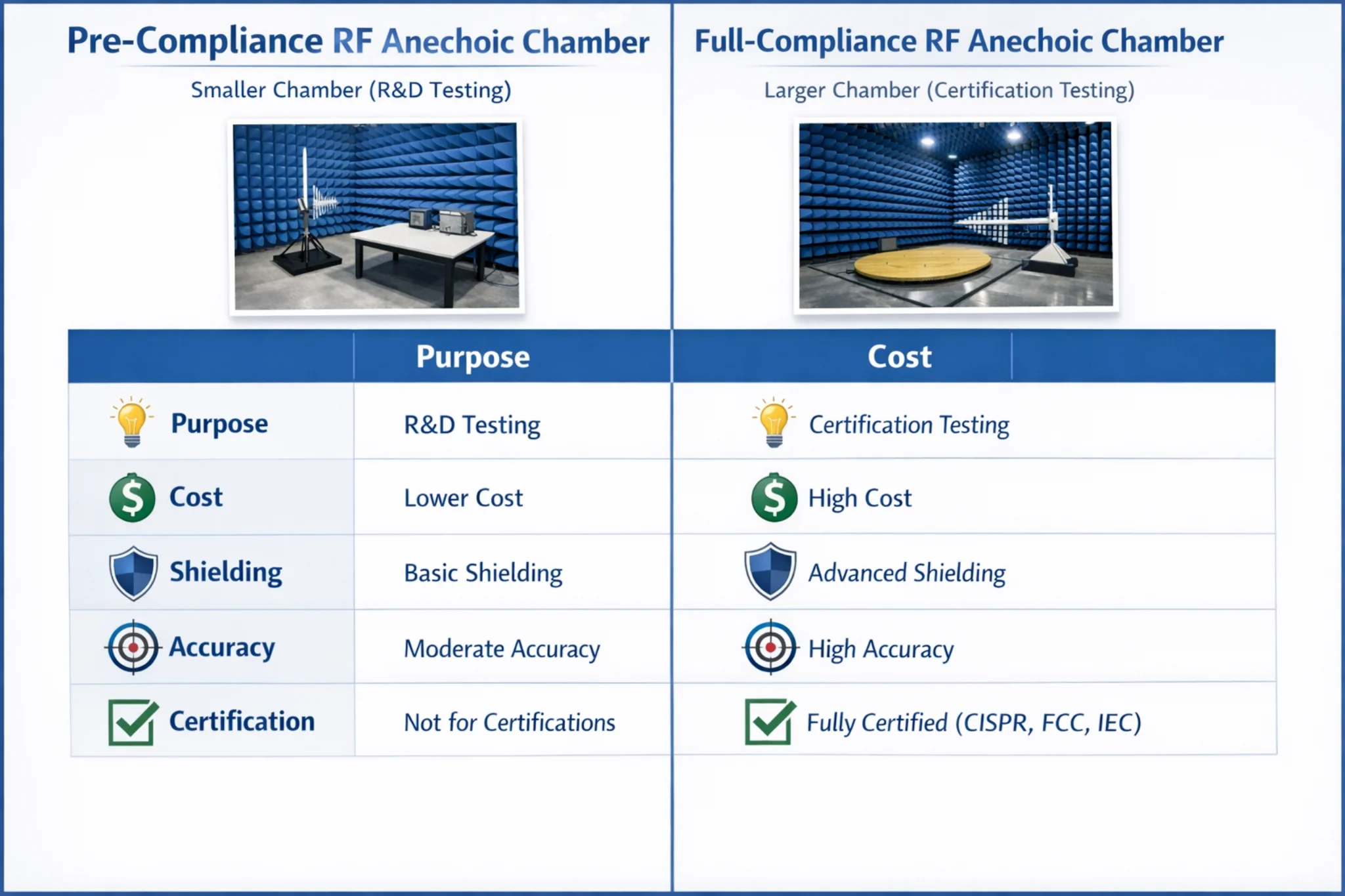
Pre-Compliance vs. Full-Compliance: A Side-by-Side Comparison
| Feature | Pre-Compliance Chamber | Full-Compliance Chamber |
|---|---|---|
| Primary Use | Design & Debug | Certification & Approval |
| Cost | Low to Medium | High |
| Accuracy | Indicative | Standards-Compliant |
| Shielding Effectiveness | Moderate | Very High |
| Absorber Type | Pyramidal / Hybrid (basic) | Ferrite + Pyramidal (advanced) |
| Certification Validity | No | Yes |
| Ideal Users | R&D Teams, Startups | Test Labs, OEMs, Automotive |
Which RF Anechoic Chamber Do You Actually Need?
The right choice depends on your business model, product lifecycle, and compliance requirements.
Choose a Pre-Compliance RF Anechoic Chamber if:
- You are in product development or R&D
- You want to reduce external testing costs
- You need frequent internal testing
- Certification testing will still be done externally
- Budget and space are limited
Choose a Full-Compliance RF Anechoic Chamber if:
- You perform official EMC/RF certification
- You operate a commercial test laboratory
- You handle automotive, defense, or medical products
- You require globally accepted test results
- Long-term testing capacity is a priority
Can You Use Both?
Yes—and many advanced organizations do.
A common strategy is:
- Pre-compliance chamber for design, debugging, and optimization
- Full-compliance chamber for final validation and certification
This hybrid approach reduces overall testing costs, shortens development cycles, and improves first-pass certification success.
Cost vs. Risk: A Strategic Perspective
While pre-compliance chambers are affordable, relying on them alone can be risky if you skip proper certification testing. On the other hand, investing in a full-compliance chamber without sufficient testing volume may not be financially viable.
The smartest decision balances:
- Product complexity
- Frequency of testing
- Regulatory obligations
- Long-term business goals
Choosing between Pre-Compliance and Full-Compliance RF Anechoic Chambers is not just a technical decision—it’s a strategic one.
- Pre-compliance chambersempower innovation, speed up development, and reduce early-stage risks.
- Full-compliance chambersensure regulatory success, market access, and customer trust.
Understanding your testing objectives today—and where your organization will be tomorrow—will guide you to the right RF anechoic chamber investment.
If you need help evaluating chamber specifications, absorber types, or future scalability, choosing the right solution early can save significant time, cost, and compliance headaches down the road.
Top 5 FAQs
1. What is the key difference between pre-compliance and full-compliance RF anechoic chambers?
Pre-compliance chambers are used for internal testing and debugging, while full-compliance chambers are used for official, standards-based certification testing.
2. Can pre-compliance testing replace full-compliance testing?
No. Pre-compliance testing helps identify issues early, but only full-compliance testing is accepted for regulatory approval.
3. Who should use a pre-compliance RF anechoic chamber?
R&D teams, startups, and product developers who want faster testing and fewer failures during final certification.
4. When is a full-compliance RF anechoic chamber required?
When you need certified EMC/RF test results for regulatory approval or operate a professional test lab.
5. Is it useful to have both types of chambers?
Yes. Using pre-compliance for development and full-compliance for certification reduces time, cost, and test failures.