
Table of Contents
- Why RF Absorbers Need to Be Replaced
- Typical Cost Range for Absorber Replacement
- How Absorber Type Impacts Cost
- Influence of Chamber Size and Geometry
- Frequency Requirements and Performance Expectations
- Installation and Labor Considerations
- Calibration and Validation After Replacement
- New Absorbers vs Refurbished Absorbers
- Ways to Optimize Replacement Costs
- When Should You Plan for Replacement?
RF absorbers are one of the most critical components inside RF shielded cabinets and RF anechoic chambers. They ensure that electromagnetic waves are absorbed instead of reflected, allowing engineers to obtain accurate and repeatable RF measurements. Without properly functioning absorbers, even the most advanced test equipment can produce misleading or non-compliant results.
One of the most common questions asked by lab managers and test engineers is: How much does it cost to replace RF absorbers in RF shielded cabinets and RF anechoic chambers?
The answer depends on several technical and commercial factors, which we explain in detail below.
Why RF Absorbers Need to Be Replaced
RF absorbers are typically made from carbon-loaded polyurethane foam, ferrite tiles, or a combination of both. While these materials are designed for long-term use, they are not permanent.
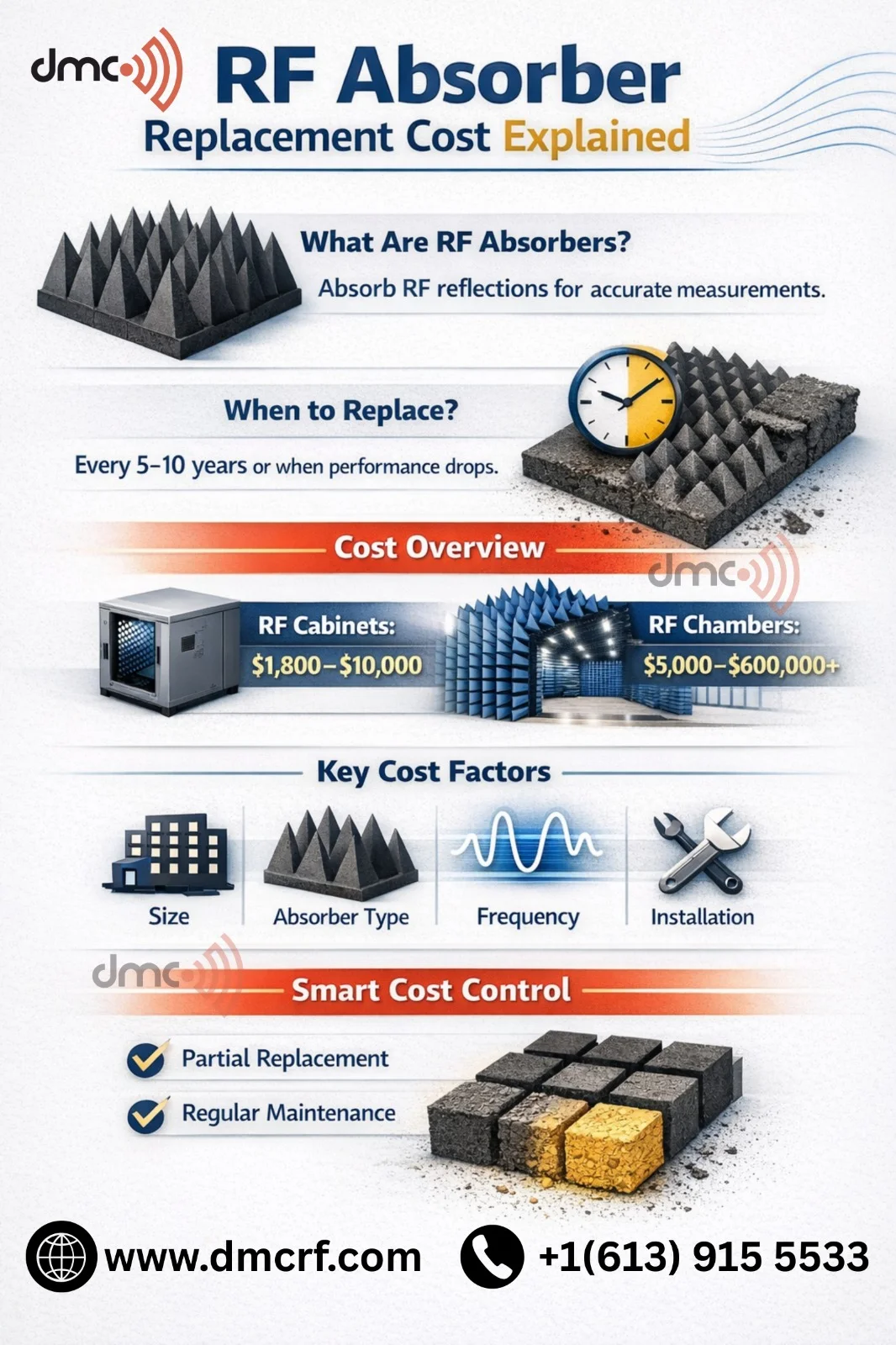
In most real-world environments, RF absorbers have a usable life of five to ten years. After this period, replacement becomes necessary to restore the chamber to its original performance level.
Typical Cost Range for Absorber Replacement
The overall cost of replacing RF absorbers varies widely depending on the size and complexity of the enclosure.
For RF shielded cabinets, replacement costs usually start at around $1,800 and can go up to $10,000, depending on cabinet size and absorber quality.
| Chamber Size | Estimated Replacement Cost |
|---|---|
| Small (2m x 2m) | $5,000 – $15,000 |
| Medium (4m x 4m) | $15,000 – $45,000 |
| Large (5m+ EMC chamber) | $40,000 – $600,000 |
These figures include absorber materials and basic installation but may increase depending on frequency requirements and compliance needs.
How Absorber Type Impacts Cost
The type of absorber used is one of the biggest cost drivers.
- Pyramidal foam absorbers are the most common choice for RF anechoic chambers. They provide excellent broadband absorption and are relatively affordable. Their cost increases with size, height, and frequency performance.
- Ferrite tile absorbers are primarily used for low-frequency performance, especially in EMC chambers. They are heavier, more expensive to install, and require careful bonding to chamber walls.
- Hybrid absorber systems, which combine ferrite tiles with foam absorbers, offer the best overall performance but are also the most expensive. These systems are typically required for full compliance testing environments.
Influence of Chamber Size and Geometry
The total number of absorbers required directly depends on chamber dimensions and surface coverage. Walls, ceilings, doors, and sometimes floors must be treated to achieve the desired reflectivity performance.
A compact RF shielded cabinet may require only a few dozen absorber pieces. In contrast, a medium-sized anechoic chamber may require over a thousand absorbers, while a large EMC chamber can require several thousand units.
Additionally, special areas such as turntables, cable entry points, and ventilation zones may need custom absorber treatments, which further increase cost.
Frequency Requirements and Performance Expectations
Chambers designed for higher frequencies require more precise and higher-quality absorbers. For example, chambers operating up to 6 GHz can use standard foam absorbers, while those supporting 18 GHz or 40 GHz require tighter tolerances and specialized materials.
As frequency performance requirements increase, absorber cost can rise by 20–60%, depending on the specification. Millimeter-wave testing environments are particularly expensive due to the need for precision manufacturing and testing.
Installation and Labor Considerations
Absorber replacement is not just about purchasing new materials. Installation plays a major role in the overall budget.
The process includes removing old absorbers, cleaning the chamber surfaces, applying adhesives, aligning new absorbers correctly, and allowing sufficient curing time. In large chambers, installation can take several days or even weeks.
Labor costs typically account for 10% to 25% of the total project cost. For large EMC chambers, installation alone can cost tens of thousands of dollars.
Calibration and Validation After Replacement
Once new absorbers are installed, the chamber must be recalibrated and validated. This step ensures that reflectivity, site VSWR, and normalized site attenuation meet the required standards.
Calibration costs may range from $600 to $8,000, depending on chamber size and test standards. Skipping this step is not recommended, especially for compliance or certification laboratories.
New Absorbers vs Refurbished Absorbers
To reduce costs, some laboratories consider refurbished or reused absorbers. While these options can reduce upfront expenses by 30–50%, they come with limitations.
Refurbished absorbers generally offer shorter lifespans, reduced performance, and limited compliance suitability. They are best suited for internal R&D labs rather than certification or customer-facing test facilities.
| Parameter | New Absorbers | Refurbished Absorbers |
|---|---|---|
| Cost | High | 30–50% cheaper |
| Performance | Excellent | Moderate |
| Lifespan | 8–10 years | 3–5 years |
| Compliance | Full EMC compliance | Limited |
| Use Case | Certification labs | R&D and internal testing |
Refurbished absorbers are budget-friendly but not ideal for compliance testing.
Ways to Optimize Replacement Costs
There are several strategies to control absorber replacement expenses without compromising performance.
One effective approach is partial replacement, where only the most degraded or high-impact zones are renewed. Another option is to use mixed absorber heights, placing taller absorbers only where low-frequency performance is critical.
Sourcing absorbers locally can reduce shipping costs, while regular cleaning and maintenance can extend absorber life and delay full replacement.
When Should You Plan for Replacement?
You should start planning absorber replacement if you notice increased noise levels, unstable measurement results, or repeated compliance failures. Visible physical damage, aging materials, or changes in safety regulations are also strong indicators.
Most laboratories plan absorber replacement as part of a long-term maintenance strategy rather than waiting for performance to collapse.
Replacing RF absorbers in RF shielded cabinets and RF anechoic chambers is a significant investment, but it is essential for maintaining measurement accuracy and regulatory compliance. Costs can range from a few thousand dollars for small cabinets to hundreds of thousands of dollars for full EMC chambers.
Rather than viewing absorber replacement as an expense, it should be seen as a performance restoration and risk-reduction investment. With proper planning, the right absorber selection, and professional installation, laboratories can ensure reliable RF testing for many years while keeping costs under control.
Frequently Asked Questions
1. How often should RF absorbers be replaced?
Most RF absorbers need replacement every 5 to 10 years, depending on environmental conditions, usage intensity, humidity levels, and maintenance practices. High-usage compliance labs may require earlier replacement.
2. What is the average cost to replace RF absorbers?
The cost varies by chamber size and absorber type. RF shielded cabinets typically cost $1,800 to $10,000, while RF anechoic chambers can range from $5,000 to over $600,000 for large EMC compliance chambers.
3. Can I replace only damaged RF absorbers instead of the entire chamber?
Yes. Partial replacement is possible and often recommended when absorber degradation is localized. This approach can reduce costs by 30–40% while still restoring acceptable performance.
4. Does absorber replacement require chamber recalibration?
Yes. After replacing RF absorbers, chamber calibration and validation are essential to ensure accurate measurements and compliance with RF and EMC standards.
5. Are refurbished RF absorbers a good option?
Refurbished absorbers are suitable for R&D and internal testing environments but are generally not recommended for compliance or certification labs due to reduced lifespan and limited performance guarantees.